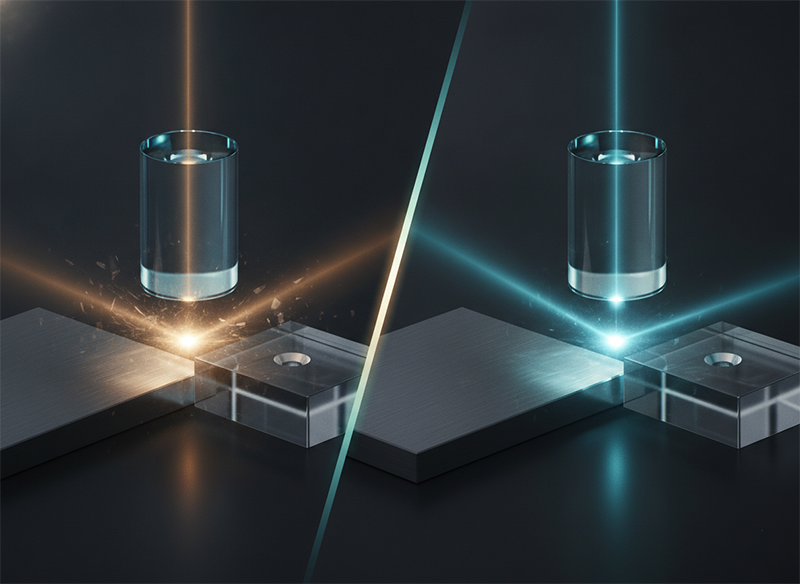
A 300 W laser can put less power on your part than a 150 W one. That reads like a typo, and it is exactly the trap that catches teams who buy ultrafast sources by the wattage on the quote. We have watched a higher-power line lose to the cheaper one it replaced.
“We specified the line at 300 W — more average power, more throughput, the safe call. On the cold bench it measured M² near 1.2. In production, once the head reached thermal equilibrium, M² drifted past 2.3. Focusable intensity scales with power over M² squared, so the degraded 300 W source delivered lower usable power density at the focus than the 150 W, M² 1.2 source it replaced. Sub-micron features stopped resolving, and the heat-affected zone we had engineered out with ultrafast pulses crept back. We added watts and lost brightness — the number on the purchase order went up while the number that actually hit the part went down.” — process engineer, ultrafast micromachining line scale-up
This matters because high power laser beam quality is not two independent specs you can max out side by side. Above a certain point they pull against each other, and the spec sheet rarely shows you where.
High power and low M² fight because raising power adds heat and nonlinear effects that degrade the beam. More average power heats the gain medium, creating thermal lensing and aberrations that push M² up. In ultrafast lasers, high peak power adds nonlinear self-focusing on top of that. What reaches your part is not watts but brightness — power divided by M² squared — so a degraded high-power beam can focus to a lower power density than a clean lower-power one.
People reach this question at a specific moment: they are sizing a laser for an ultrafast process, the quotes list rising wattage at rising price, and something about the performance promises does not add up. A 300 W source and a 150 W source are both on the table, and the assumption is that more power is the safer buy.
In our experience qualifying ultrafast sources for micromachining, the recurring disappointment is not a lack of power. It is a beam that looked excellent on a cold bench and degraded once the system ran at rated output. The watts were real; the focusable power density was not.
So this guide goes past the textbook definition of M². It explains why power and beam quality compete, why ultrafast lasers feel this tension more sharply than continuous-wave systems, which amplifier architecture holds M² at high power, and what a degraded beam actually does to feature size, throughput, and heat-affected zones. Each section maps to a decision you are likely weighing right now, whether you are an engineer tuning a process or a buyer comparing two datasheets that look identical.
Power is what the laser produces. Brightness is what reaches the work. The two are only the same when beam quality is perfect, and it never is.
For a given wavelength and lens, focal spot diameter grows with M², so spot area grows with M² squared. Focusable power density — the intensity that drives ablation — therefore scales as power divided by M² squared. Double M² and you quarter the intensity at the focus, even at the same wattage.
Run the earlier example through that relationship. A 300 W source at M² 2.5 lands near 48 on a power-over-M²-squared scale; a 150 W source at M² 1.2 lands near 104. The lower-power, cleaner beam delivers more than twice the usable intensity. This is why “how many watts” is the wrong headline question, and brightness — which RP Photonics defines as radiance set by power and beam quality together — is the right one.
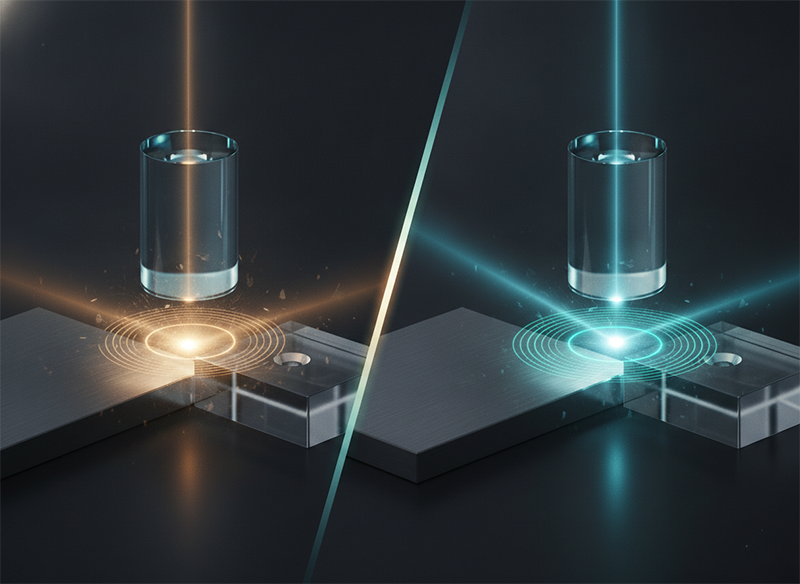
Two mechanisms degrade M² as you scale power, and ultrafast lasers face both.
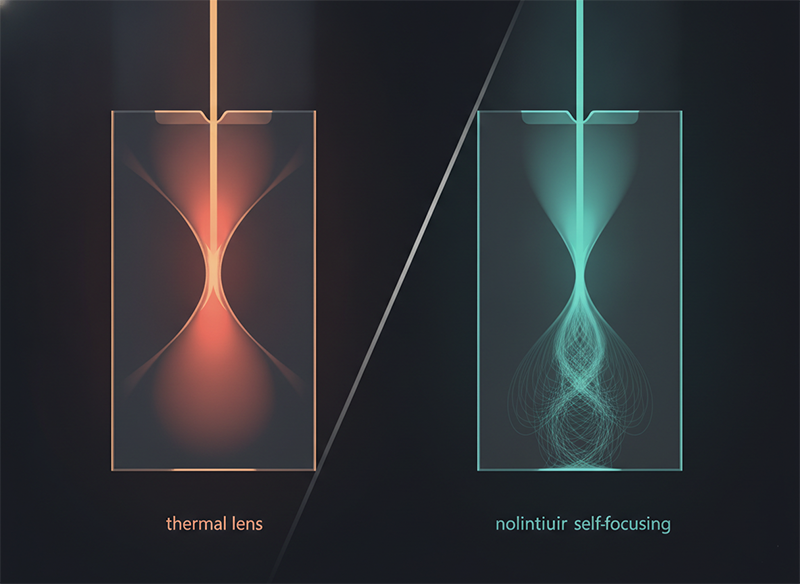
The first is thermal. Pump power that does not become laser light becomes heat in the gain medium. That heat sets up a temperature gradient, which bends light like a lens and adds stress birefringence and aberrations. As average power climbs, the thermal lens strengthens and M² rises. This is physics, not a manufacturing shortcut.
The second is nonlinear, and it is specific to ultrashort pulses. Femtosecond and picosecond pulses reach enormous peak intensity, high enough to drive self-focusing and self-phase modulation in the gain medium and optics. The accumulated nonlinear phase — the B-integral — distorts both the beam and the pulse before you reach the peak power the application needs.
A continuous-wave cutting laser mainly fights the first mechanism. An ultrafast micromachining source fights both at once: thermal load from average power and nonlinear distortion from peak power. That is why the high-power-versus-beam-quality tension is sharper in ultrafast systems than the CO₂ and fiber engraving guides usually let on.
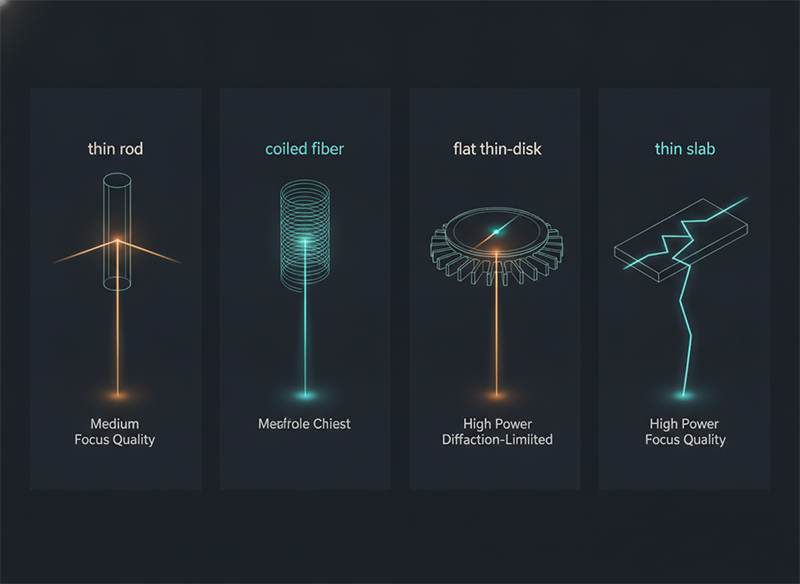
If power and M² fight, the question stops being “how many watts” and becomes “which architecture holds M² at the power my process runs.” Each gain geometry hits the wall differently.
“For an ultrafast micromachining line we specified the highest-power fiber source we could buy — wattage read as the defensible premium. At the pulse energy the process needed, the small fiber core drove nonlinear self-focusing; the B-integral climbed and both beam and pulse degraded before we reached the peak power the application required. The limit was never the rated watts — it was the architecture. A slab amplifier holding M² under 1.3 at 300 W reached the focusable peak power the fiber could not, at the same average power. The variable that decided performance was which amplifier geometry keeps M² low at the power and pulse energy we actually run.” — R&D lead, ultrafast source architecture selection
Here is how the common architectures trade power against beam quality:
| Architecture | Beam quality behavior at high average power | Main limit |
|---|---|---|
| Rod | Thermal lensing degrades M² relatively early | Heat in a small volume |
| Fiber | Excellent M², but small core | Nonlinear self-focusing caps peak power / pulse energy |
| Thin-disk | Large area, low thermal lens, scales high | System complexity, often regenerative |
| Slab (Innoslab) | Holds low M² into the hundreds of watts | Pump homogeneity, design effort |
The slab geometry is worth a closer look because it targets this exact tension. Its large cooled surface keeps the thermal lens manageable, and beam expansion inside the amplifier keeps peak intensity away from the nonlinear and damage limits. Published Innoslab work reached 400 W of 680 fs pulses with M² under 1.4 at 280 W and under 1.7 above 370 W — beam quality that stays close to diffraction-limited while the power scales. That is the engineering answer to the headline question, and it is the basis of slab integrated amplification in the 100–300 W range.
If you are weighing sources right now, the next section is where the architecture choice turns into process outcomes.
A higher M² at full power is not an abstract number. It shows up on the part.
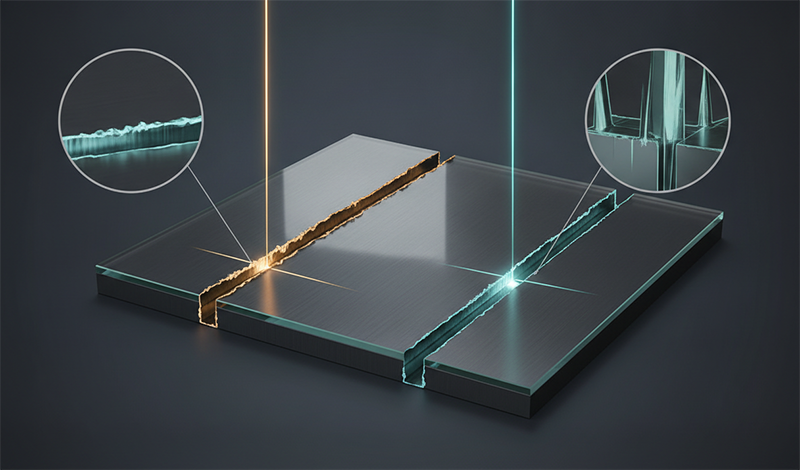
Feature size is the first casualty. Spot diameter scales with M², so a beam that degrades from 1.2 to 2.3 grows the smallest feature you can resolve, widens kerf, and opens up via taper. The precision you specified ultrafast for quietly erodes.
Throughput is the second, and it is the cruel one. Teams buy more watts for speed. If M² degrades, you cannot focus that power tightly, so the intensity gain is smaller than the wattage suggests — and if intensity drops below the ablation threshold, the process stops removing material cleanly at all. You paid for speed and bought a larger, weaker spot.
Heat-affected zone is the third. A bigger spot at the same power means lower intensity, more thermal coupling, and the HAZ you removed with ultrafast pulses creeps back. Across a large scan field, a higher-M² beam also diverges faster, so edges process differently from center.
Use this to choose without getting anchored on wattage. If your process needs sub-micron features, tight kerf, or controlled taper, treat M² at full rated power as a hard requirement and read brightness — power over M² squared — not watts. If you run high pulse energy, account for nonlinear limits and favor an architecture with a larger mode area, such as slab or thin-disk, over pushing a small fiber core. If you process across a large field, weight beam quality more heavily, because divergence decides edge performance. And whenever two sources show the same wattage and the same headline M², ask which power that M² was measured at — because a number from a cold bench at low power does not describe your line. When the application is thick-material cutting rather than fine micromachining, raw power can matter more than M²; match the spec to the job, not to the biggest number available.
Two checks separate a real source from a good datasheet. First, ask for an M²-versus-power curve through to rated output, measured after thermal equilibrium — not a single low-power figure. Second, ask for the brightness or focusable power density at your operating point, since that is what reaches the part. If you are sourcing at scale, talking to a supplier directly can surface details no product listing will tell you — how the beam behaves at full power, where the architecture’s limits sit, and whether the wattage you are paying for is wattage you can actually focus.
The 300 W line that lost to a 150 W one taught a lesson every ultrafast buyer eventually learns: watts are easy to advertise, and brightness is what does the work. Power and beam quality are not two boxes to tick independently — past a point they trade against each other, and the architecture you choose decides the exchange rate. Specify the number that hits your part, not the one that looks largest on the quote.
Can a higher-power laser actually perform worse than a lower-power one? Yes. Focusable power density scales as power divided by M² squared, so a 300 W beam at M² 2.5 can deliver less intensity at the focus than a 150 W beam at M² 1.2. If beam quality degrades at full power, more watts do not guarantee more usable intensity on the part.
Why does M² get worse as laser power increases? Two reasons. Higher average power heats the gain medium and creates thermal lensing and aberrations that raise M². In ultrafast lasers, high peak power also drives nonlinear self-focusing, which distorts the beam and pulse. Both grow with power.
Why is the tradeoff harder for ultrafast lasers than CO₂ or fiber engravers? Ultrafast sources face thermal load from average power and nonlinear distortion from peak power at the same time. Continuous-wave systems mainly face the thermal side, so the high-power-versus-beam-quality tension is sharper in femtosecond and picosecond systems.
Two sources list the same power and the same M² — how do I tell them apart?
“Two 300 W ultrafast sources, both spec’d M² under 1.3 — on paper, identical. The deciding number wasn’t on the headline: it was M² measured at full rated power after thermal equilibrium, not at low power on a cold bench. One held M² near 1.25 at 300 W; the other was characterized at 50 W and drifted past 2 once it warmed up. We now require an M²-versus-power curve through to rated output before any ultrafast source qualifies.” — process integrator, ultrafast laser source qualification
Which amplifier architecture keeps beam quality best at high power? Fiber gives excellent M² but limits peak power through nonlinear effects; rod lasers degrade through thermal lensing relatively early; thin-disk and slab geometries hold beam quality into the hundreds of watts. Slab amplifiers have reached 400 W with M² under 1.4 at 280 W in published work.
What is brightness, and why does it matter more than watts? Brightness, or radiance, combines power and beam quality. For a fixed wavelength it scales as power over M² squared, which is what sets the focal spot intensity. It tells you the power density that reaches the material, which is what actually drives the process.
Does low M² matter for every application? No. Fine micromachining, sub-micron features, and large scan fields depend heavily on low M². Thick-material cutting and large-area, lower-resolution work tolerate higher M² and benefit more from raw power. Match the spec to the job.
At what power should I ask a supplier to measure M²? At your full operating power, after the system reaches thermal equilibrium. M² measured at low power on a cold bench can look excellent and then degrade in production, so a single low-power figure is not enough to qualify a source.