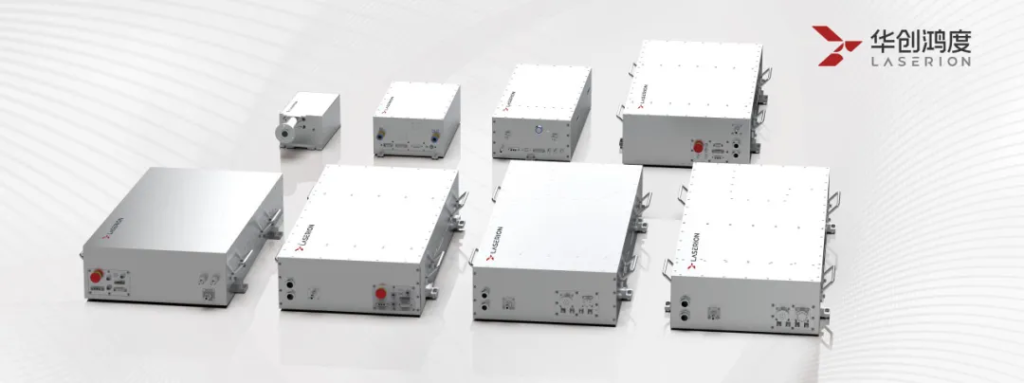
△ Huachuang Hongdu Highly Reliable Solid Lasers
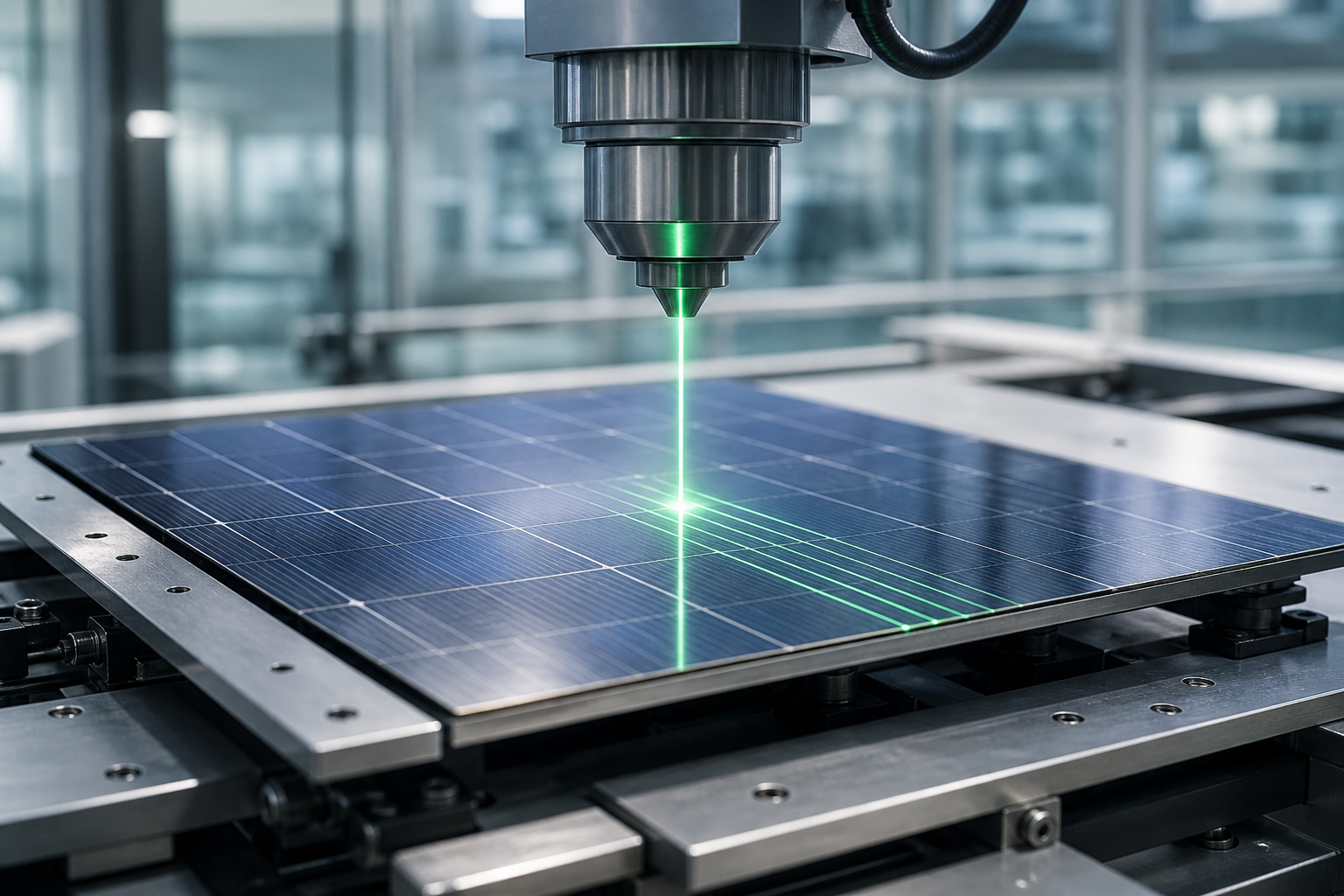
In the early chapters of the reliability series, we analyzed the fundamental frequency light behind the reliability logic。 However, in many practical scenarios such as industrial cold processing, semiconductor inspection, and scientific experiments, the 1064 nm fundamental light is not used directly; instead, it relies on nonlinear crystals to perform frequency conversion, yielding 532 nm green light, 355 nm ultraviolet, and even 266 nm deep ultraviolet sources.
The frequency-doubling module is the core component for extending the laser’s wavelength band and enhancing the single-photon energy level , but it is also the greatest bottleneck for the overall system’s reliability. There is a clear rule in the optical industry: the shorter the laser wavelength, the lower the process tolerance . The shorter the wavelength, the higher the demands on optical design precision, component lifespan, and production environment conditions. This article will dissect the reliability challenges and engineering optimization solutions for different-order frequency-doubling modules from three dimensions: optical scheme design, component selection, and precision manufacturing processes.
The core of the multi-frequency design is to balance laser conversion efficiency and operating stability, focusing on the problem of performance degradation caused by heat. Different classes of multifrequency work differently, and there is no common set of solutions, and differentiated designs need to be tailored.
① Double frequency : balanced temperature stability characteristics and beam quality
Class I phase matching scheme is used for 532nm frequency doubling, and the design focus is to balance the wide temperature working ability and beam quality, relying on SNLO simulation software to accurately calibrate the crystal cutting angle and the optimal working temperature.
Through “thermo-optic coupling” dynamic simulation, the global temperature variation of the crystal is simulated, thereby enabling the reverse optimization of the constant-temperature furnace setpoint temperature to ensure that the center temperature of the crystal’s light-transmitting region precisely matches the phase-matching point under high-power conditions.
In the phase matching mode of class I, the propagation deviation between the fundamental light and the frequency doubling light is easy to cause beam distortion. By optimizing the polarization system, iterating the crystal length, and finding the optimal balance between the conversion efficiency and the beam quality, the green light output is guaranteed to be stable and high.
② Three times the frequency: Matching the time series light path to stable ultraviolet output
355 nm ultraviolet tripling commonly adopts a “second harmonic + sum frequency” cascaded scheme, generating 355 nm ultraviolet light through the sum frequency of 1064 nm fundamental light and 532 nm second-harmonic light。 Its reliability does not depend on a single crystal; rather, it hinges on the dual high-precision matching of laser timing and optical path positioning.
When femtosecond frequency doubling, 1064nm and 532nm laser propagation speed is different in the crystal, which is prone to time walk away, resulting in pulse misalignment, which greatly reduces the frequency combination efficiency. By carrying high-precision delay adjusting mechanisms and optical phase compensation devices, the pulse timing sequence is precisely aligned to ensure stable conversion efficiency under high power conditions.
The three-frequency module is extremely sensitive to the accuracy of incoming laser direction, and a small angle drift can trigger an entire machine abnormality. The high-precision image transmission system stabilizes the spot position, coupled with the closed-loop automatic calibration system of the light path, and controls the angle drift at the micro arc level to achieve long-term stable operation of the equipment.
③ Four times frequency: dual technology route to solve deep ultraviolet problems
The 266nm deep ultraviolet laser is generated by direct frequency doubling of 532nm laser, and the process difficulty and reliability are the highest. Deep ultraviolet single photon energy is extremely strong, easy to be absorbed by air, damage crystal, crystal selection directly determines the upper limit of equipment performance, the current mainstream for BBO, CLBO two technical routes.
The BBO nonlinear coefficient is high, and only short crystals are needed to achieve efficient frequency doubling, suitable for ultrafast laser equipment with high peak and medium average power. However, its temperature and angle adaptation range is very narrow, and its fault tolerance is very low.The project is equipped with an ultra-high-precision ± 0.05 °C thermostat, which predicts the light path shift through thermal simulation, precisely calibrates the optimal cutting angle, offsets the effect of beam departure, and ensures the stability of deep ultraviolet light spots.
CLBO has stronger anti-laser damage ability and better deep ultraviolet transmittance, and is the first choice for high average power 266nm laser. The disadvantage is that it is easy to dissolve at moisture, high temperatures are easy to crack with stress.In this regard, an active high temperature thermostat strategy is used to stabilize the crystal at 120 °C to 150 °C, avoiding the decomposition zone, and at the same time optimize the furnace heating structure, evenly control the temperature difference, and balance the moisture protection and crack protection requirements.
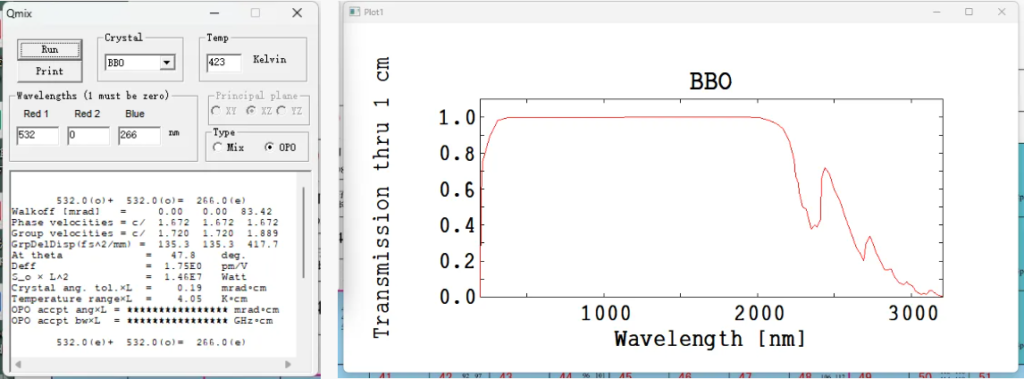
△ Picture of BBO Simulation Results
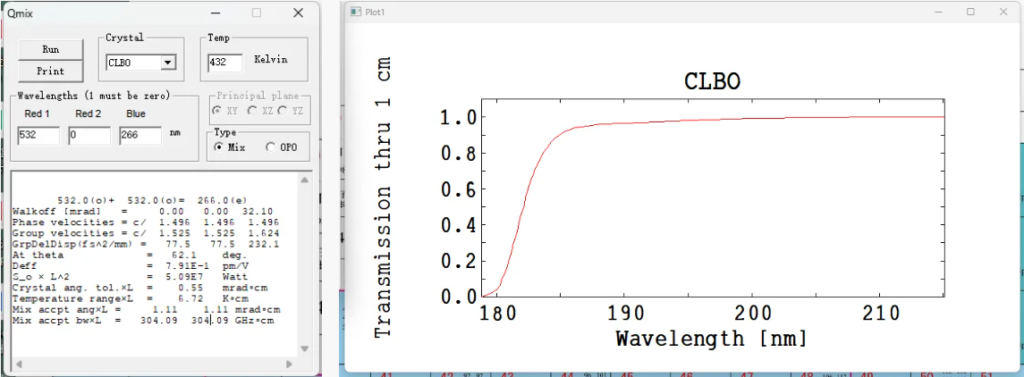
△ Picture of CLBO Simulation Results
The component selection standard for the multi-frequency module is much higher than the base frequency light path of the laser. The shorter the laser wavelength, the higher the single photon energy, the more likely such problems as crystal core damage, membrane burning, and surface gray deposition are to occur. Only by establishing a graded and refined material selection system can we establish a reliability foundation from the material end.
① Crystal materials: accurately matched by power scenario
High efficiency KTP crystal is selected for medium and low power scenes; High power scene priority anti-gray trace GTI-grade LBO crystal, strict screening absorption rate and internal defects, eliminate the performance degradation caused by defective products.
Long-term ultraviolet irradiation is easy to produce color center damage, the unified use of low hydroxyl ultraviolet LBO crystal, strict control of impurity content, from the root to reduce UV loss.
High average power industrial equipment preferred moisture-proof, high damage threshold CLBO crystal; Picosecond / femtosecond ultrafast laser equipment selects high efficiency and environmental resistance BBO crystals.
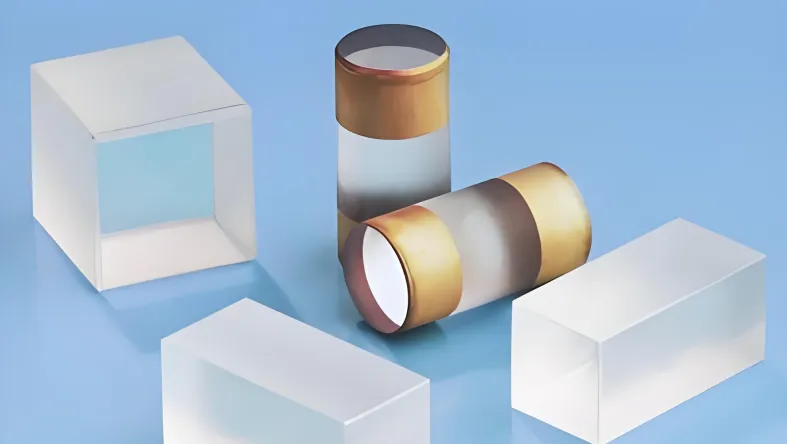
△ Photo of a Multi-frequency Crystalline Material
② coating elements: strengthening the damage resistance of the membrane layer
The membrane layer of reflectors, spectrographs, and lenses is long subject to high-energy photon shock, and the quality of the membrane layer directly determines the life of the equipment, and the coating standard differs significantly between different wavelengths.
It adopts mature SiO2 / HfO2 film system, taking into account the high and low transmittance performance, strictly controlling the laser damage threshold, adapting to high power conditions.
The ultraviolet waveband scattering loss is large, and the whole media low-absorption membrane system is used, eliminating high-loss materials, and reducing heat absorption damage of the membrane layer.
The 266nm deep ultraviolet requirements are extremely strict, the reflectance of the mirror needs to be ≥ 99.5%, and the small absorption loss can cause the thermal runaway spalling of the film.The selection of materials only relies on the measured threshold damage data, eliminates purely theoretical parameters, and ensures long-term stability.
High quality design and materials are the foundation, and precision manufacturing processes are the ultimate guarantee of reliability. The production of ultraviolet and deep ultraviolet multi-frequency modules is a combination of precision mechanical assembly and ultra-clean process technology. For short-band laser modules, cleanliness is not a plus, but a bottom line for stable operation.
① Crystal finishing: eliminating microscopic defect damage
Ultraviolet lasers are extremely sensitive to microscopic defects, and three or four times the frequency crystals use an Emmy-class ultra-sleek polishing to strictly control surface roughness, avoiding light scattering, local hotspots and laser self-focusing damage caused by micro-indentations.
According to the soft and easy cracking characteristics of CLBO, the rigid compaction structure is abandoned, and the flexible gasket is used to package and assemble, and the compaction torque is accurately calibrated to ensure that the crystal is not loose and deformation under high temperature conditions.
② Tuning process: from power locking to phase locking
The four-fold frequency angle adapted bandwidth is extremely narrow, and the traditional power peak lock tuning accuracy is insufficient to meet long-term stability requirements. The device contains a high-precision electric regulator + four-iodine detector feedback system, dynamically calibrates the light path phase, and automatically inhibits angle drift in the full power segment.
According to the differences in thermal expansion of copper, stainless steel and aluminum alloys, the strengthening torque is individually determined, and the layered process of “constant temperature strengthening + high temperature tightening” is used, together with the laser interferometer to monitor the face of the lens to avoid the light path shift caused by high temperature shape change.
③ Cleanliness control: eliminate organic pollution from producing ashes
In addition to materials and stress issues, organic pollution is the core cause of the failure of UV and deep UV modules. When exposed to ultraviolet light, trace organic matter will chemically react and generate carbonized ash, causing a permanent decline in lens permeability, which directly shortens the life of the equipment.
The assembly of three / four times frequency modules needs to be carried out in a clean shed of 100 (ISO Class 5) or higher, and VOC (volatile organic matter) filtration systems must be introduced to keep the concentration of organic molecules in the air to a very low level.
Base-frequency components can be wiped with acetone, but the coating layer of the ultraviolet components has a high risk of reacting with organic solvents. In the process, ultrasonic plasma cleaning should be promoted, and the drying process uses high-purity nitrogen ion fans to eliminate electrostatic adsorption particles.
From semi-finished storage to module assembly, all processes involving quadruple-frequency crystals must be operated in isolated glove boxes filled with dry nitrogen, and the dew point is strictly controlled below -30 °C to prevent the dehumidification mist of CLBO crystals during assembly.
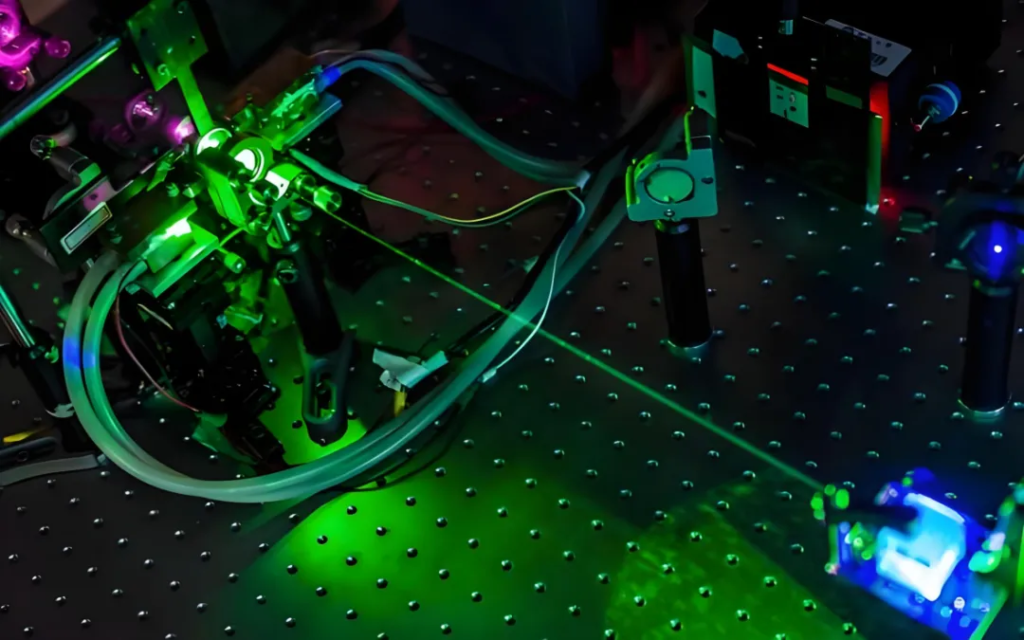
△ Photo of a Multi-frequency Path
From infrared base frequency light, to green light, ultraviolet, and deep ultraviolet, every upgrade of multi-frequency technology is a must pass for solid lasers to advance to high-end precision scenes. From the wide temperature adaptation of two times frequency to the extreme requirements of four times frequency for materials, stress and cleanliness, the shorter the laser wavelength, the higher the refinement and stability requirements of the entire system.
High-reliability multi-frequency modules do not rely on a single high-quality crystal or a single precision process, but are a systematic result supported by optical simulation design, gradient material selection and ultra-clean precision manufacturing. Only by implementing reliability into each set of simulation data, In the details of every optical component and every production process, it is possible to free ultraviolet and deep ultraviolet lasers from the stability shortcomings and achieve long-term, efficient and stable output in core high-end scenarios such as semiconductor precision manufacturing and cutting-edge scientific research.
Trailer for the series
This article is the third optical section of the “High Reliability” series, digging deep into the core difficulties and optimization solutions for the reliability of multi-frequency modules. In the future, we will interchangeably interpret mechanical and electrical control related content and gradually build a complete technology system for high-reliability lasers. Please continue to pay attention.