Peak power still dominates too many TGV laser RFQs. On a dense glass-interposer panel, that ranking often fails for a simple reason: plating and reliability do not care how impressive the datasheet headline looks—they care whether every via stays inside a geometry window the seed layer and copper fill can survive.
“On a glass-interposer TGV cell we were qualifying for panel-level pitch, the first RFQ ranked suppliers by peak power and shortest pulse. The high-power source looked decisive on paper. In sample runs, single-via SEM looked acceptable, but across a dense array the entrance diameter drifted outside the ±3% class window the plating team needed for seed continuity. We rewrote the RFQ around usable pulse energy at the process wavelength, programmable burst when the ablation recipe required it, M² ≤1.3-class beam quality, and RMS power stability under 1%, plus PSO/TRIG so every hole saw the same dose with the scanner. Peak power stayed on the sheet—but it stopped being the ranking metric. Scrap shifted from ‘laser not powerful enough’ to ‘dose not repeatable enough for Cu fill.’” — Equipment integrator applications lead, glass interposer TGV line qualification
That scene is why this question belongs on the source BOM, not only in the workstation brochure. Through-glass via (TGV) processing sits between brittle-glass physics and metallization yield. If the laser source cannot hold dose, spot quality, and timing across hundreds of thousands to millions of holes, you do not have a “laser problem”—you have a panel scrap problem.
The laser source specs that matter most for Through-Glass Via (TGV) processing are usable pulse energy in the chosen process window, temporal control (including burst when the recipe needs it), beam quality (M²) and power stability (RMS) for diameter/taper consistency, and industrial sync (GATE / TRIG / PSO) with the scanner or stage. Pulse duration selects the process family—selective modification-plus-etch versus direct ablation—but it is not the RFQ scorecard by itself. Rank sources by whether they keep vias inside the metallization window at panel scale.
Glass interposers and glass-core substrates moved from slideware into real packaging roadmaps for AI, HPC, and chiplet stacks. Electrical insulation, low dielectric loss, and panel-level formats are the commercial pull. The manufacturing pull is harsher: high via density, controlled taper or hourglass profiles, smooth sidewalls for high-frequency loss, and copper fill that survives thermal cycling.
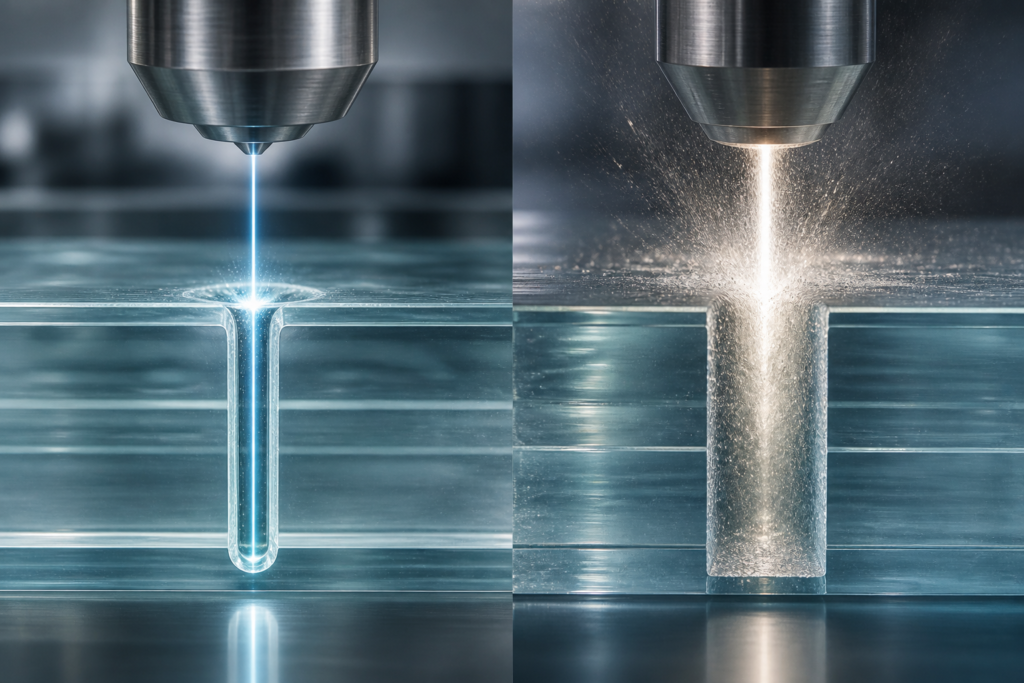
In that environment, two laser-process families dominate the conversation. Direct ablation—often with GHz-class burst packets—removes glass in a single tool path without a wet bench. Selective laser etching (modification then HF or KOH etch) trades a chemical step for crack-free channels, steep walls, and geometry that can be tuned in the etch bath. Both can produce excellent coupons. Both fail the same way when the source drifts: diameter walks, taper changes, microcrack risk rises, seed coverage thins at the waist, and electroplating leaves seams or voids.
I see RFQs that still treat the ultrafast laser like a wattage auction. Procurement compares average power and pulse width, then discovers—after etch and PVD—that the cheaper “more watts” unit cannot hold etch selectivity or hole roundness across the panel. The plating team inherits a geometry problem they cannot plate away. That is when people search for laser source specs for Through-Glass Via (TGV) processing instead of another peak-power comparison chart.
Laserion’s role in this stack is deliberate: we supply industrial ultrafast sources, not competing turnkey TGV cells. Integrators own scanners, Bessel optics, etch, and metallization. Our job is to make the source parameters that actually move via yield checkable and integrable.
Start with energy you can deliver at the process wavelength and pulse class—not a marketing peak that only appears at an unused repetition rate.
For modification-plus-etch routes, the industrial constraint is a narrow band: energy must sit above the glass modification threshold so etch selectivity appears, and below the damage threshold so the panel does not grow radial cracks or subsurface stress that later opens under thermal cycling. A source with large pulse-energy headroom helps you sit in that band across glass types (borosilicate, alkali-free display glass, fused silica) without living on the edge of the damage curve.
For percussion ablation and thick-glass paths, energy per pulse (or per burst packet) sets how quickly you open depth and how wide the entrance grows. Process work repeatedly shows hole diameter tracking total burst energy more strongly than focal length alone. If your RFQ only locks average power, two sources with the same watts can deliver very different energy-per-hole at the scanner, and your diameter window will tell on you.
How to judge: Ask for pulse energy versus repetition rate curves at the wavelength you will ship. Require that the energy used in your DOE sits with margin inside the modification or ablation recipe—not only at a lab-favorite set point. For cold, high-energy IR femtosecond work, industrial bands such as ≥1 mJ at 1030 nm with ≥50 W average power are the class of headroom modification and brittle-glass drills often need. For high-energy IR picosecond glass drilling, ≥3.5 mJ with >100 W average power (and higher power classes where the cell demands it) is the conversation for thick or high-throughput percussion recipes.
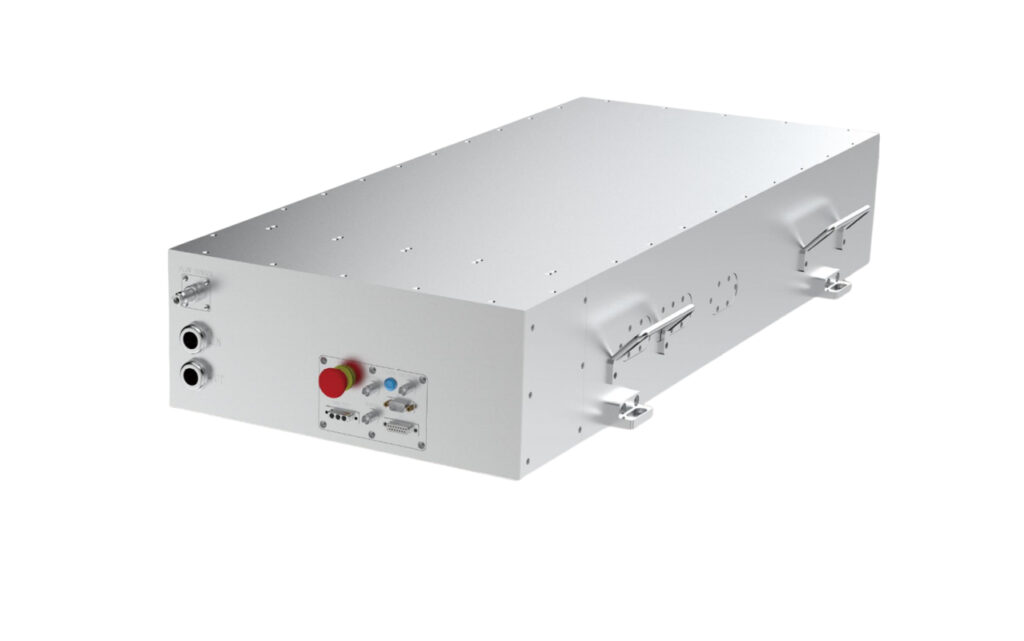
Many TGV ablation recipes do not run as single pulses. They split energy into GHz-spaced subpulses so heat and plasma dynamics open a cleaner, deeper channel than one hard hit. Selective-etch recipes also tune subpulse count and burst envelope so the modified track etches uniformly through thickness.
If your process owner’s recipe assumes burst, a source that only offers a fixed pulse train forces the integrator to fake the temporal structure in software—or abandon the recipe. Programmable burst (pulses per burst, interval, energy distribution) is then a first-class source spec, not an accessory checkbox.
How to judge: Separate “burst available” from “burst programmable and stable under continuous panel patterning.” Ask how burst configuration is commanded and whether miss-fire or low-energy detection exists on the cell side. Do not buy burst marketing for an SLE-only line that never uses it—and do not skip it for a GHz-percussion cell that cannot run without it.
If your next glass coupon matrix already has a booked etch slot, lock temporal mode and energy against the via drawing now; changing burst after seed-layer trials usually means a second metallization loop.
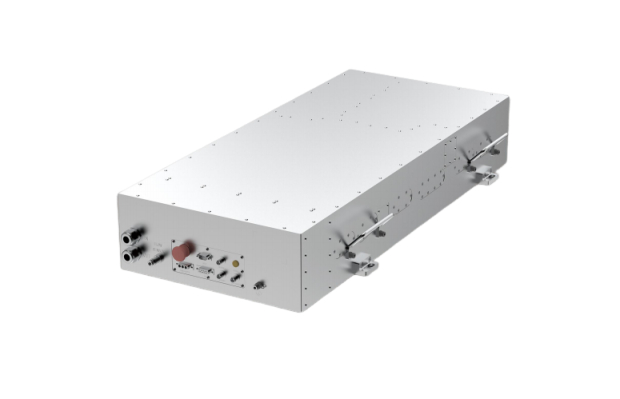
Single-via SEM is a weak predictor of panel yield. Array yield tracks whether the focal spot and delivered power stay consistent while the scanner writes tens of thousands of sites.
Beam quality (M²) governs how tightly and repeatably you can place energy. For fine interposer pitches, an M² in the ≤1.3 class (tighter on UV picosecond tools used for related glass micro-features) is the practical band on industrial IR ultrafast sources for precision glass work. Roundness and pointing stability matter for via circularity; plating teams notice when entrances go elliptical.
Power stability (RMS) is the quiet killer. Slow power wander changes effective dose. On ablation routes, diameter and depth walk. On modification routes, etch selectivity wanders, and hourglass waist control becomes a chemistry-plus-laser fight. Scenes that cite entrance diameter outside a ±3% class window are usually describing cumulative dose error, not one bad pulse.
How to judge: Put M² and RMS on the scored RFQ lines with acceptance tests at operating power and duty cycle—not only at warm idle. Laserion’s industrial IR femtosecond and IR picosecond bands publish RMS <0.8% and ≤0.8% respectively, with M² ≤1.3 / <1.3; treat those as the class of numbers you should demand from any shortlist, then verify on your glass.
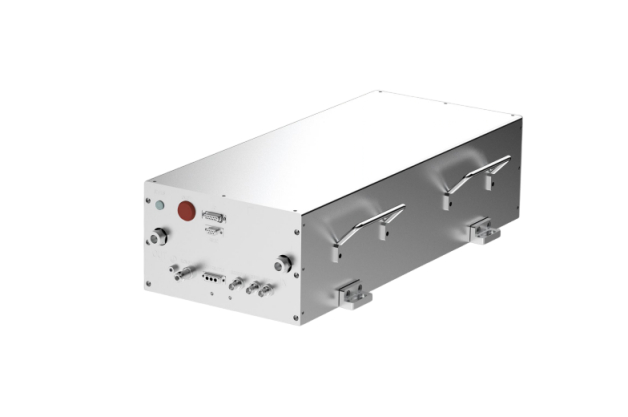
TGV is a dose-and-position problem. If the laser fires while the galvanometer is still settling, or if pulse placement does not track true scan velocity, you get miss-hits, double-hits, and diameter scatter that looks like “glass variation” in the failure review.
Position Synchronized Output (PSO) and clean GATE/TRIG behavior let the motion system request pulses where the toolpath actually is. Trigger integrity matters even more on selective-etch panels where a missing modification is a missing via after bath time you cannot rewind.
How to judge: Score the electrical interface and latency the way you score optics. Ask for PSO support, trigger schemes, and miss-fire behavior. IR picosecond platforms used in brittle-material drilling commonly expose RS232, GATE, TRIG, and PSO; that is the integration surface your controls engineer should sign.

Femtosecond-class pulses earn their place when you need cold interaction, minimal heat-affected zone (HAZ), and modification below the damage threshold for SLE-style vias. Picosecond-class pulses earn theirs when high pulse energy, industrial throughput, and proven glass percussion or hybrid recipes dominate the cell design.
The mistake is ranking every vendor by “shortest pulse wins.” Pulse width chooses the physics family. Energy, burst, M²/RMS, and sync decide whether that family yields at panel scale.
| RFQ ranking style | What it optimizes | What it usually misses | Typical failure mode |
|---|---|---|---|
| Peak / average power auction | Coupon drill speed | Dose repeatability across the panel | Diameter drift; seed thin at waist |
| Shortest-pulse contest | Cold-process branding | Whether the cell is ablation or SLE | Over-spec cost or wrong process family |
| Metallization-window RFQ | Geometry + fill yield | Vanity wattage bragging rights | Fewer Cu voids; clearer dual-source rules |
Laserion does not sell the etch wet bench or the TGV workstation. For integrators building or dual-sourcing the laser source inside those cells:
| Station / function | What the source must do | Laserion series | Specs that matter |
|---|---|---|---|
| Selective modification for wet-etch TGVs; low-HAZ brittle glass | Ultrashort IR pulses with energy headroom and cold interaction | Infrared femtosecond | 1030 nm; ≥50 W; ≥1 mJ; 500 fs–10 ps; M² ≤1.3; RMS <0.8% |
| High-energy glass percussion / thick-glass through-holes; scanner sync | High pulse energy, industrial control | Infrared picosecond | 1064 nm; >100 W (up to ~300 W class); ≥3.5 mJ; ~10 ps; M² <1.3; RMS ≤0.8%; PSO |
| Recipes that need programmable temporal splitting / DOE-ready beam | Burst control + spot uniformity | Green picosecond | 532 nm; ≥120 W; ~10 ps; M² <1.3; RMS ≤0.8%; programmable Burst Mode |
| Fine glass / polymer / semiconductor micro-features on the same packaging line | UV absorption, tight focus | UV picosecond | 355 nm; ≥40 W; ~10 ps; M² <1.2; RMS ≤1% |
If you are locking a modification-plus-etch TGV route, prioritize IR femtosecond-class energy in the modification window, M²/RMS for track uniformity, and trigger integrity so no site is skipped before the bath. Burst matters only if your modification recipe uses it.
If you are locking direct ablation / GHz-burst percussion, prioritize usable pulse energy (and burst programmability), then RMS and PSO so diameter does not walk when you raise holes-per-second.
If procurement is forcing a wattage bake-off, rewrite the scorecard before samples: geometry window agreed with plating, stability test at panel duty cycle, sync sign-off from controls. Keep peak power as a capacity check, not the rank order.
If your vias are large structural or fluid holes with loose RF requirements, a lower-spec path may be enough—do not drag an AI-interposer RFQ onto a mechanical feature.
Before you freeze the laser source BOM, confirm glass type and thickness, ablation versus modification-etch, via diameter/taper/hourglass targets, sidewall roughness the plating process can accept, and how the scanner or stage will trigger the source. Ask for energy curves, M² and RMS at operating power, and a written sync interface.
If you’re qualifying an ultrafast source for production or integrating one into OEM equipment, talking to an applications team directly can surface stability, customization, and delivery details no product listing will tell you.
Talk to our applications team →
TGV made the laser source a packaging yield tool. The integrator scene that rewrote the RFQ after diameter walked past the plating window is not a niche anecdote—it is the selection logic advanced packaging is converging on. Rank laser source specs for Through-Glass Via (TGV) processing by metallization-ready geometry at panel scale, and peak power becomes what it should have been all along: one capacity line, not the decision.
The laser source specs that matter most for TGV are the ones that keep every via inside the copper-fill window—usable energy, temporal control, M²/RMS stability, and motion sync—not the largest peak-power number on the datasheet.
Usable pulse energy in the process window, burst/temporal control when the recipe needs it, beam quality (M²) and power stability (RMS), and GATE/TRIG/PSO sync with motion. Pulse duration chooses ablation versus modification-etch; panel yield chooses stability and dose control.
No. Peak or average power can screen capacity, but array diameter drift and seed-layer failures usually trace to dose repeatability, beam quality, and sync. Rank by metallization-window metrics agreed with plating.
When your route is selective laser etching or another cold modification process that must stay between the modification and damage thresholds with minimal HAZ. Confirm ≥1 mJ-class energy headroom and RMS/M² at the operating point—not only the shortest pulse claim.
When high pulse energy percussion, thick-glass drilling, or an established picosecond ablation/hybrid recipe owns the cell. Industrial IR picosecond bands with multi-millijoule energy, >100 W average power, and PSO are built for that integration style.
GHz or programmable burst splits energy into subpulses that improve ablation efficiency and hole quality in many glass drill recipes. Require it only if your process owner’s recipe uses it—and then require it to be programmable and stable.
Poor M² and RMS show up as diameter, taper, and sidewall variation across the panel. Non-ideal profiles create PVD shadowing and discontinuous seed layers, which drive seams, voids, and resistance scatter after electroplating.
If you already own process IP, scanners, and wet etch, buying a pure laser source from a source OEM preserves your cell architecture. If you need a turnkey via cell, buy from a TGV equipment specialist—and still write a metallization-window source RFQ for dual-source risk.
Glass types/thicknesses; process family (ablation vs SLE); energy vs rep-rate curves; burst needs; M² and RMS acceptance at duty cycle; GATE/TRIG/PSO; miss-fire behavior; delivery and service for 24/7 cells. Align geometry tolerances with the plating team before scoring vendors.