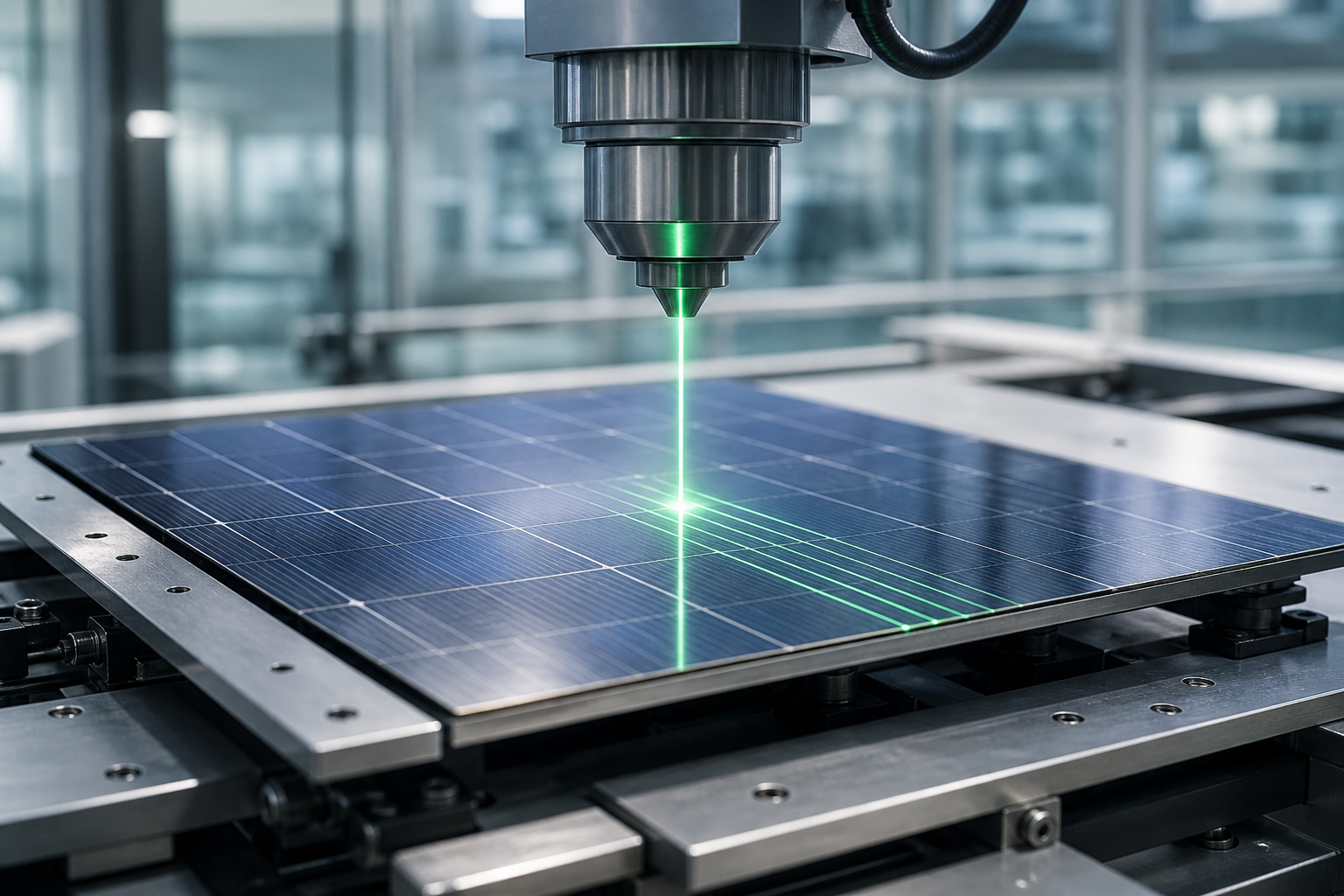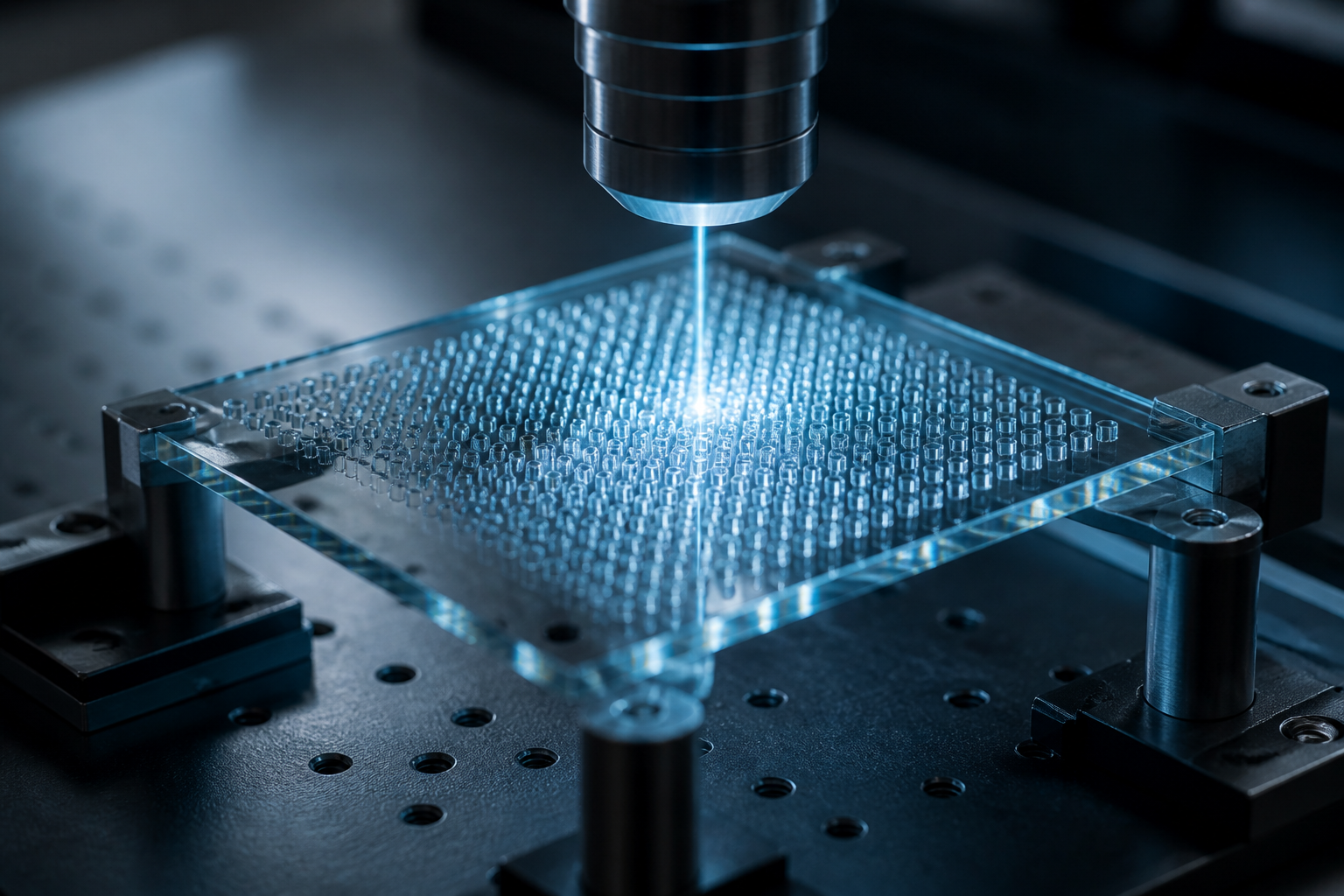
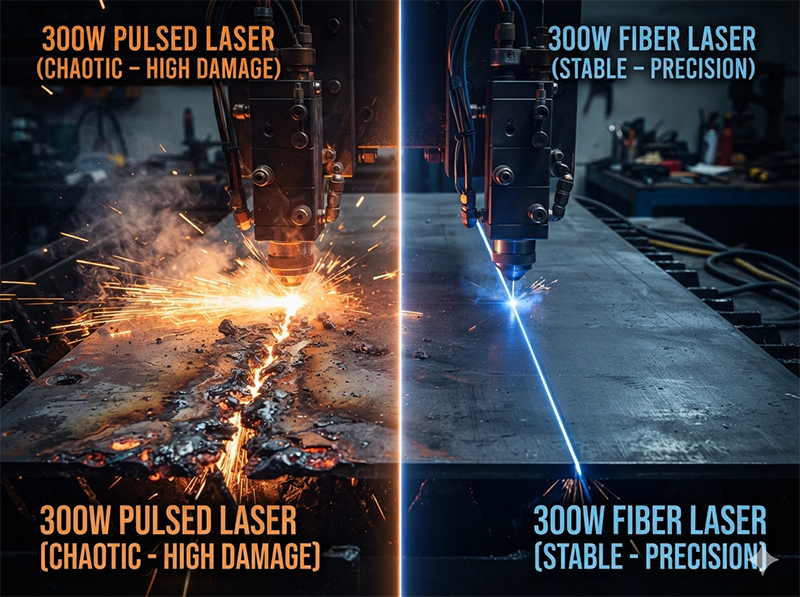
The mandate from management was simple: triple the throughput of the micro-machining line. The engineering path seemed just as clear: upgrade the ultrafast laser source from 100W to 300W. The expectation was a straightforward multiplication of output—three times the power, three times the speed, same pristine cut quality. But a few weeks after commissioning the new line, the yield reports told a story of failure. Micro-cracking was up, the heat-affected zone had doubled, and scrap rates were climbing. The revered “cold ablation” process had seemingly vanished.
“Scaling throughput meant pushing the ultrafast laser from 100W to 300W. The assumption was that maintaining the picosecond pulse width would preserve the cold ablation process. Instead, thermal accumulation at higher repetition rates widened the heat-affected zone (HAZ) and pushed micro-cracking past the ±5µm tolerance limit. The realization was physical: higher average power destroys cold-machining precision if beam quality degrades. Switching to a 300W source with slab amplification kept M²≤1.2 and decoupled pulse energy from thermal load, dropping HAZ back under 5µm while hitting 3x parts per hour. The variable treated as a throughput booster was the one destroying the cut quality.”
— Process Engineer, transparent material micro-machining line expansion
This engineer’s experience isn’t an anomaly; it’s a direct consequence of a fundamental misunderstanding in scaling ultrafast laser processes. The pursuit of higher power, if done naively, triggers secondary physical effects that completely undermine the very reason for using an ultrafast laser in the first place. The solution isn’t to abandon high power, but to understand and control it.
Scaling to 300W laser power often destroys cutting precision because of two interconnected problems: thermal accumulation at high repetition rates and beam quality (M²) degradation from thermal lensing within the laser itself. This turns a “cold” picosecond process into a “hot,” imprecise one. To prevent this, you must use a laser architecture, such as slab amplification, that is explicitly designed for thermal management. This maintains an exceptional M² value (≤1.2) at full power, preserving the cold ablation characteristics and sub-10µm precision even at maximum throughput.
If you’re investigating why higher laser power destroys cutting precision, you are likely a process engineer or R&D lead under immense pressure. You’ve invested significant capital in a 300W system to meet market demand, only to find your process window has shrunk and your yield has dropped. You’re trying to reconcile the spec sheet’s promise with the reality on the production floor.
In our work integrating high-power laser sources for precision manufacturing, we’ve seen this scenario play out repeatedly. Teams chase the headline “300W” number without asking the critical follow-up question: “What is the beam quality at 300W?” Standard laser resonator designs, which perform perfectly at 50W or 100W, begin to fail optically as they are pushed to higher average powers.
This article will break down the two physical failure modes that occur when scaling power—thermal accumulation and M² degradation at high power—and explain how a different architectural approach, slab amplification, provides a direct and reliable solution. Understanding this is the key to successfully scaling your production without sacrificing the quality that defines your product.
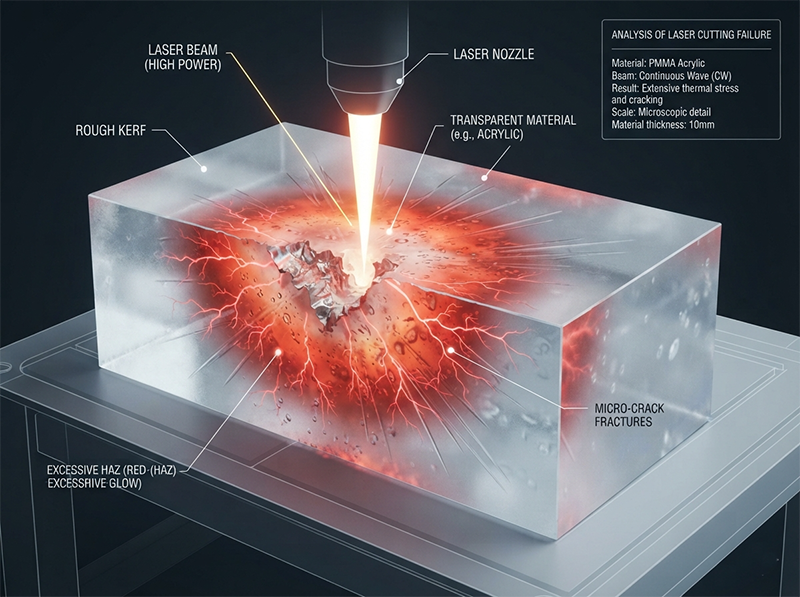
The promise of picosecond lasers is “cold ablation”—vaporizing material so quickly that heat doesn’t have time to spread into the surrounding area, resulting in a negligible Heat-Affected Zone (HAZ). This holds true at lower power levels. But when scaling to 300W, the physics change.
To leverage 300W of average power, you must increase the laser’s repetition rate significantly, firing pulses more frequently. At rates exceeding several megahertz, the time between consecutive pulses can become shorter than the material’s thermal diffusion time. The workpiece no longer has time to cool down between shots.
Heat begins to build up in the bulk material. Instead of a series of discrete, cold ablation events, the process starts to resemble continuous-wave heating. This thermal accumulation in the ultrafast laser process is what causes the HAZ to widen from a clean <5µm to a messy 15-20µm, introducing thermal stress and micro-cracks. The core benefit of the picosecond pulse is lost, not because the pulse itself changed, but because the rate of pulses overwhelmed the material’s ability to dissipate heat.
An even more insidious problem occurs inside the laser source itself. This is where many high-power integration projects fail.
“When specifying a 300W ultrafast source for advanced ceramic dicing, the focus was purely on max power to handle thicker profiles. But at 300W, standard resonator designs suffered thermal lensing, beam quality dropped, and the focal spot drifted. The ±2µm precision spec was missed entirely, leading to a 15% scrap rate during pilot runs. Higher power didn’t solve the cutting problem; it exposed optical limits. Adopting a slab-amplified architecture ensured M²≤1.2 at full 300W power, stabilizing the focal spot and recovering the yield. The spec sheet said 300W, but the deciding metric wasn’t power—it was beam quality at that power.”
— R&D Lead, advanced ceramic dicing equipment selection
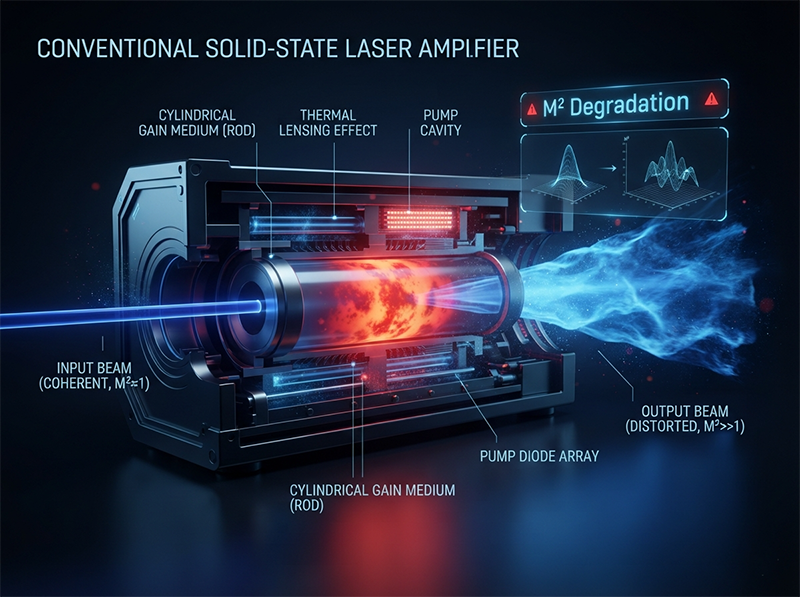
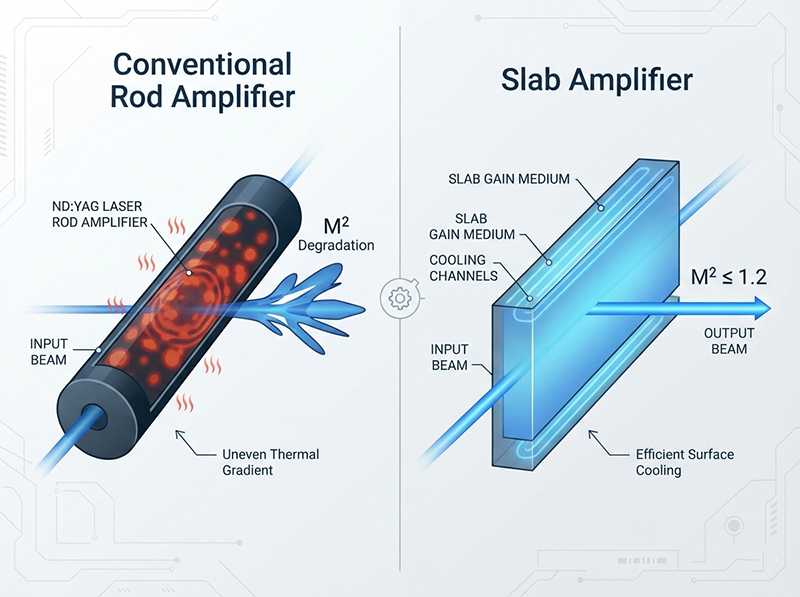
This R&D lead’s experience points directly to thermal lensing. As hundreds of watts of power pump the laser’s gain medium (the crystal that generates the light), waste heat is inevitably produced. In conventional rod-based laser designs, this heat creates a temperature gradient, causing the center of the rod to become hotter than the edges. This changes the refractive index, effectively turning the gain medium into an unwanted, unstable lens.
This thermal lens distorts the laser beam, causing a catastrophic M² degradation at high power. A beam that was a pristine M²=1.2 at 100W can degrade to M²=1.5 or worse at 300W. This means the focal spot bloats, its position drifts, and its energy profile becomes unpredictable, destroying the micron-level precision required for dicing ceramics or cutting medical stents.
If conventional designs fail at high power, the solution must lie in a fundamentally different architecture designed for superior thermal management. This is the core principle of slab amplifier technology.
Instead of using a cylindrical rod as the gain medium, a slab amplifier uses a thin, rectangular slab. This simple geometric change has profound implications for thermal management. The large, flat faces of the slab allow for highly efficient, one-dimensional heat extraction. Waste heat is pulled out uniformly across the surface, preventing the formation of the thermal gradients that cause thermal lensing.
This architectural advantage directly translates into stable, high-quality performance at extreme power levels.
| Feature | Conventional Rod/Fiber Amplifier | Slab Amplifier |
|---|---|---|
| Gain Medium Geometry | Cylindrical rod or fiber | Thin, rectangular slab |
| Heat Extraction | Radial, 2D (uneven) | Uniaxial, 1D (highly uniform) |
| Thermal Lensing @ 300W | Severe, causes M² degradation | Minimal to non-existent |
| M² Stability | Degrades significantly as power scales | Stable (M² ≤ 1.2) across the full power range |
| Focal Spot Stability | Prone to drift and size changes | Stable in size and position |
| Result for User | Must de-rate power to maintain precision | Can use full 300W power with full precision |
By preventing thermal lensing, slab amplifier technology ensures the M² value remains exceptional (≤1.2) even at the full 300W output. This stable, near-perfect beam quality means the focal spot remains tight, clean, and exactly where you command it to be. You can finally run at the high repetition rates needed to leverage 300W of power, achieving 3x throughput without compromising the “cold ablation” process. The HAZ stays narrow, the cuts are clean, and the yield is high.
For any organization looking at scaling to 300W laser power, ensuring your chosen source uses an architecture like slab amplification isn’t just a technical detail; it’s the primary insurance against project failure.
When you’re ready to make an investment, don’t just look at the maximum power on the data sheet. Use this framework to guide your decision:
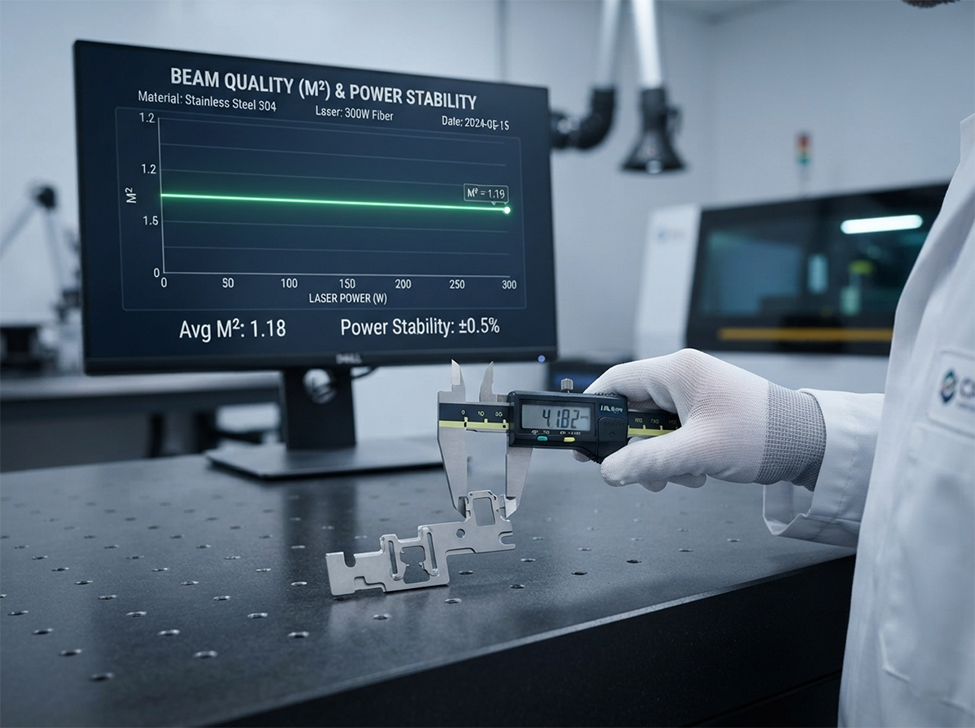
The performance of a 300W ultrafast laser is not defined by its peak power but by its ability to deliver that power without optical degradation. Before signing a purchase order, demand to see measured beam quality data (M² values) at 25%, 50%, and 100% of the maximum rated power. A stable M² across this range is the only verifiable proof that the laser’s architecture can handle the thermal load.
If you’re sourcing at scale, talking to a supplier directly can surface details no product listing will tell you.
The paradox of scaling to 300W—where more power yields less precision—is not a law of physics, but a failure of conventional engineering. It exposes the flawed assumption that a laser architecture that works at 100W will naturally scale. The real challenge of high-power ultrafast processing isn’t generating the power, but managing the heat it produces. Scaling to 300W isn’t a brute-force upgrade; it’s a test of optical stability, and only architectures designed for thermal management can pass.
Why does laser cutting precision decrease at high power?
Precision decreases primarily due to two factors. First, thermal accumulation in the material at high repetition rates widens the heat-affected zone (HAZ). Second, thermal lensing inside the laser itself degrades the beam quality (M²), causing the focal spot to become larger and less stable. This combination turns a precise “cold” process into an imprecise “hot” one.
What is thermal accumulation in ultrafast lasers?
Thermal accumulation occurs when the time between successive laser pulses is shorter than the time the material needs to cool down. At the high repetition rates used in 300W systems, heat builds up in the workpiece, leading to unwanted melting, thermal stress, and micro-cracking, effectively nullifying the “cold ablation” benefit of picosecond or femtosecond pulses.
How does M² value affect cutting quality?
M² is the beam quality factor; a value closer to 1.0 signifies a more perfect, focusable beam. A low M² (e.g., ≤1.2) creates a tiny, high-intensity focal spot for clean, precise cuts. A high M² value results in a larger, less-defined spot with a “halo” of energy that heats and damages the surrounding material instead of ablating it, leading to wider cuts and more defects.
What is the benefit of a slab amplifier in a 300W picosecond laser?
The primary benefit of a slab amplifier is superior thermal management. Its rectangular geometry allows for uniform heat extraction, which prevents thermal lensing. This ensures the laser maintains an excellent, stable beam quality (M²≤1.2) even at full 300W power, enabling maximum throughput without sacrificing micron-level precision.
Can you achieve ‘cold ablation’ at 300W?
Yes, but only with the right laser architecture. A 300W laser based on slab amplifier technology can maintain the exceptional beam quality and pulse stability needed to preserve the cold ablation process. A conventional design, however, will typically suffer from thermal effects that negate the cold ablation advantage at such high average powers.
Why is a cheap 300W laser a bad investment for precision work?
A cheaper 300W laser often compromises on thermal management. This leads to M² degradation at full power. To regain lost precision, the end-user is forced to reduce the operating power, effectively turning their 300W investment into a 150W laser. The initial savings are lost to lower throughput and higher cost-per-part, making it a poor long-term investment.