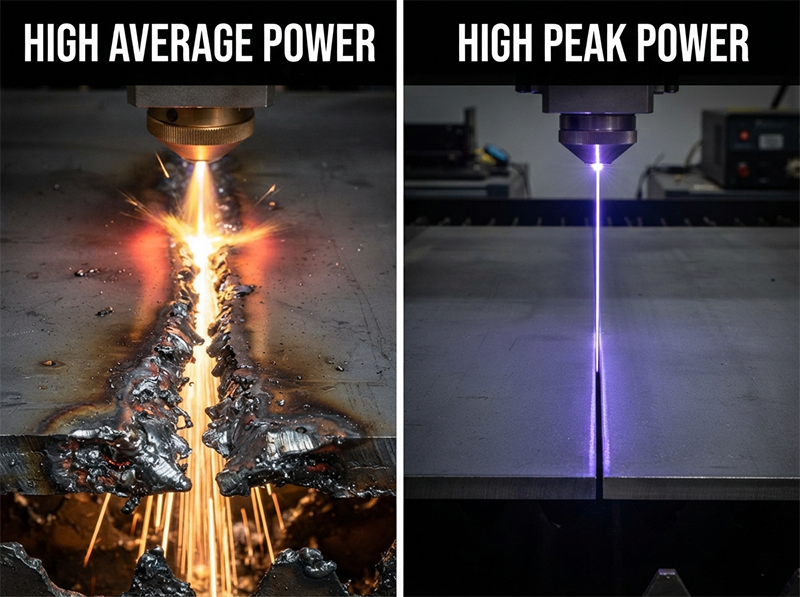
To double the output of an alumina dicing line, the math seems dangerously simple: double the laser’s average power. If 50 watts gives you X parts per hour, then 100 watts should deliver 2X parts, right? This logic is so intuitive that it drives multi-million dollar equipment upgrades across the industry. Unfortunately, in the world of ultrafast lasers, this logic is often spectacularly wrong. Physics has a way of inverting expectations, turning a promised throughput increase into a pile of scrap.
We’ve seen this firsthand. An engineer, under pressure to scale production, makes the “obvious” choice. But instead of watching the parts-per-hour meter climb, they watch the yield crash.
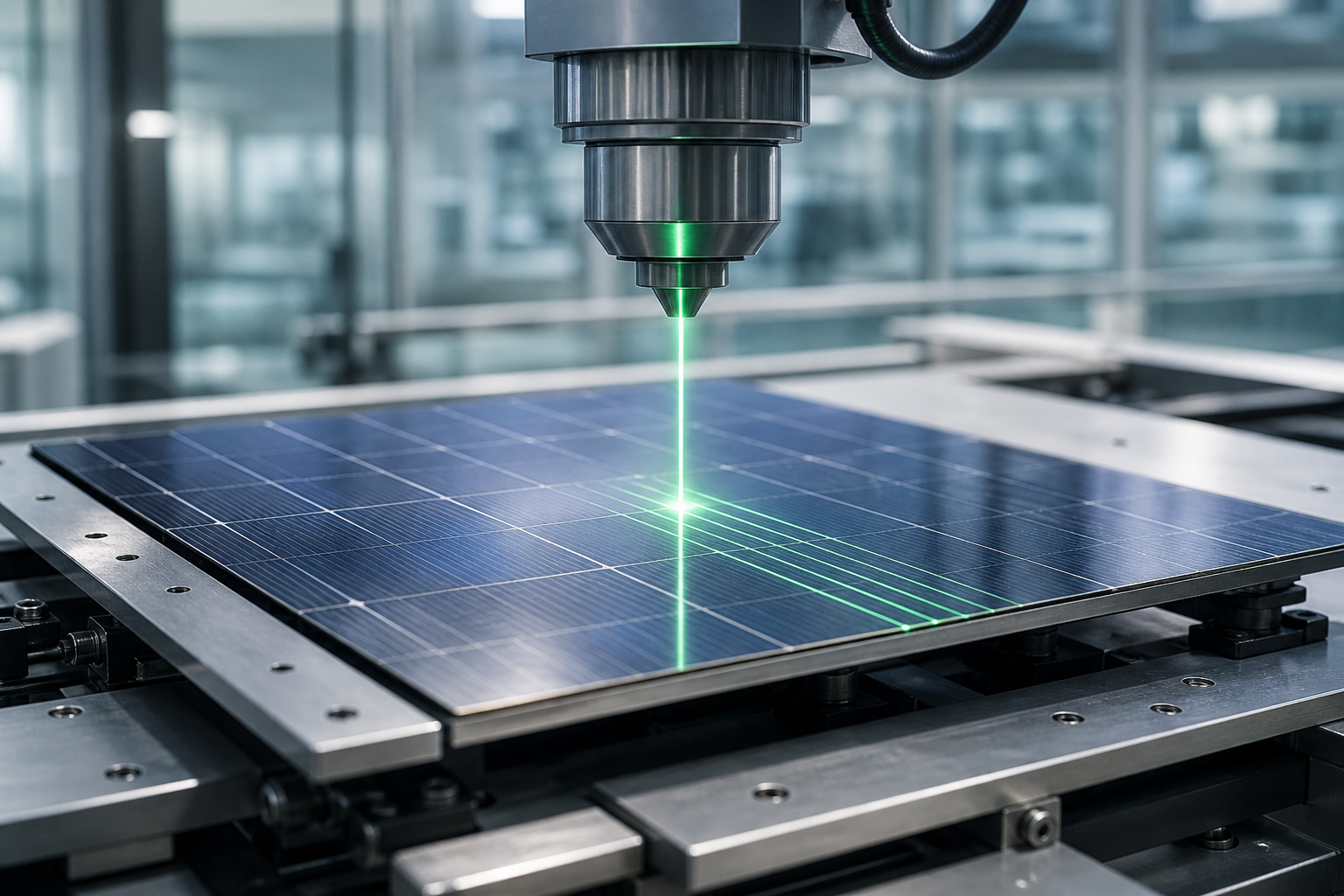
“To double alumina dicing throughput, the line was upgraded to a 100W femtosecond source, pushing repetition rates to 400kHz. The math seemed straightforward: double the average power, double the parts per hour. But the physics inverted the logic. At 400kHz, pulse energy diluted to 250µJ, pushing the fluence below the clean ablation threshold and forcing heat accumulation. The HAZ expanded from <5µm to nearly 20µm, cracking the substrate and sending scrap rates past the yield limit. Scaling back to a 50W system at 100kHz—500µJ per pulse—kept the fluence in the optimal regime, achieving the target throughput at 3.2x parts/hour while holding HAZ under 8µm. Balancing throughput and HAZ isn’t about maximizing average power; it’s about not diluting peak power below the ablation threshold.”
— process engineer, alumina ceramic dicing line expansion
This engineer’s story is a critical lesson for anyone specifying or operating an ultrafast laser. The debate over peak power vs. average power isn’t academic; it’s the fundamental variable that determines whether your process is profitable or not.
In ultrafast laser processing, Peak Power determines the quality of material removal, ensuring a clean, “cold” ablation with a minimal Heat-Affected Zone (HAZ). Average Power dictates the potential speed or throughput. The problem arises when chasing speed by increasing Average Power (via high repetition rates) dilutes the energy of each pulse. This drops the Peak Power below the material’s ablation threshold, turning a precise cutting process into a crude heating one that causes cracks and defects.
If you’re reading this, you’re likely facing the constant pressure to increase manufacturing throughput. The marketing from laser suppliers is filled with ever-increasing average power figures—100W, 200W, even 500W. It’s easy to believe that the highest number on the spec sheet is the best solution.
In our work qualifying laser systems for semiconductor and medical device manufacturing, we consistently encounter the fallout from this misconception. Engineers specify a high-power laser, only to find they can’t use all that power. To maintain quality, they are forced to run their expensive 100W laser as if it were a 50W source, effectively paying a premium for power they can never use.
The question of peak power vs. average power in ultrafast lasers is the key to escaping this expensive trap. Understanding this balance is essential for anyone trying to push the limits of throughput without sacrificing yield. It’s about learning to ask the right question: not “How many watts?” but “How many usable watts at the required pulse energy for my material?” Mastering this is crucial for balancing throughput and HAZ.
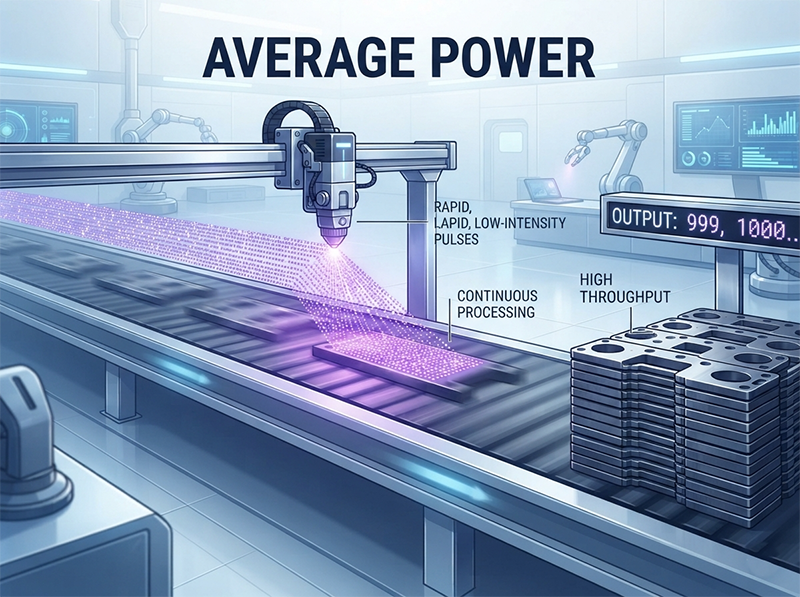
Average Power, measured in Watts (W), is the total energy the laser delivers per second. Think of it as the total amount of work the laser can do over time. It’s calculated simply:
Average Power (W) = Pulse Energy (J) × Repetition Rate (Hz)
This formula is both the key and the trap. To increase average power, a laser manufacturer can either increase the energy of each pulse or increase the number of pulses per second (the repetition rate). Since increasing the repetition rate is often technically easier, many high-power systems achieve their impressive Wattage by firing a massive number of relatively weak pulses[1].
This is the core of the problem. A laser might be advertised as “100W,” but how it generates those 100W is what matters. Is it 1 million pulses of 100 microjoules (100W = 100µJ x 1MHz) or 200,000 pulses of 500 microjoules (100W = 500µJ x 200kHz)? These two “100W” lasers will behave completely differently on the workpiece, even though their nameplate average power is identical.
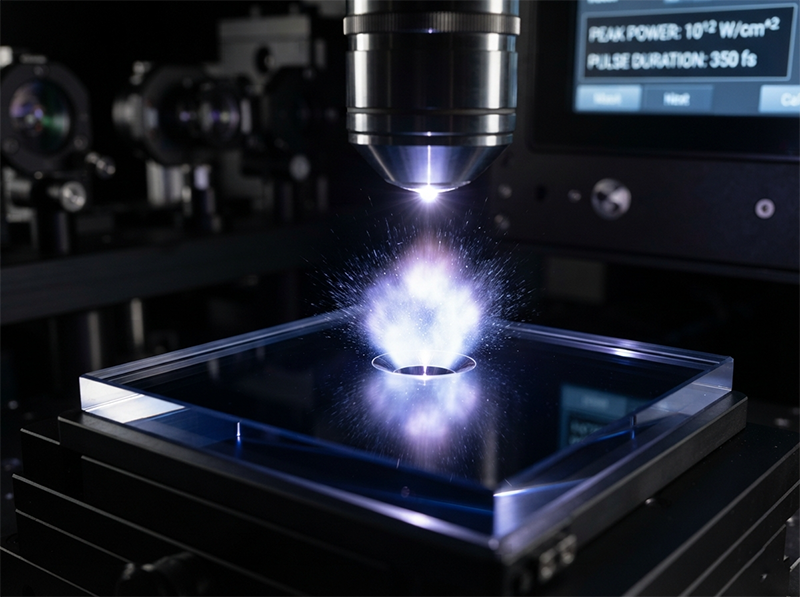
Peak Power is the instantaneous power delivered within a single, incredibly brief laser pulse (a few hundred femtoseconds to a few picoseconds). Because the duration is so short, this power is immense, often reaching megawatts or even gigawatts.
This colossal power density is what enables “cold” ablation. The energy is delivered to the material so quickly that it doesn’t have time to diffuse as heat. Instead, the material is directly vaporized, or in the case of transparent materials, the intense electric field rips electrons away, initiating a plasma. This process requires the peak power to exceed a critical value for the material, known as the ultrafast laser ablation threshold.
If the peak power is below this threshold, the magic of cold ablation vanishes. The energy is no longer sufficient to vaporize the material cleanly[2]. Instead, it gets absorbed and diffuses into the surrounding area as heat, creating a large Heat-Affected Zone (HAZ), melting, and micro-cracks—the very defects ultrafast lasers are meant to prevent.
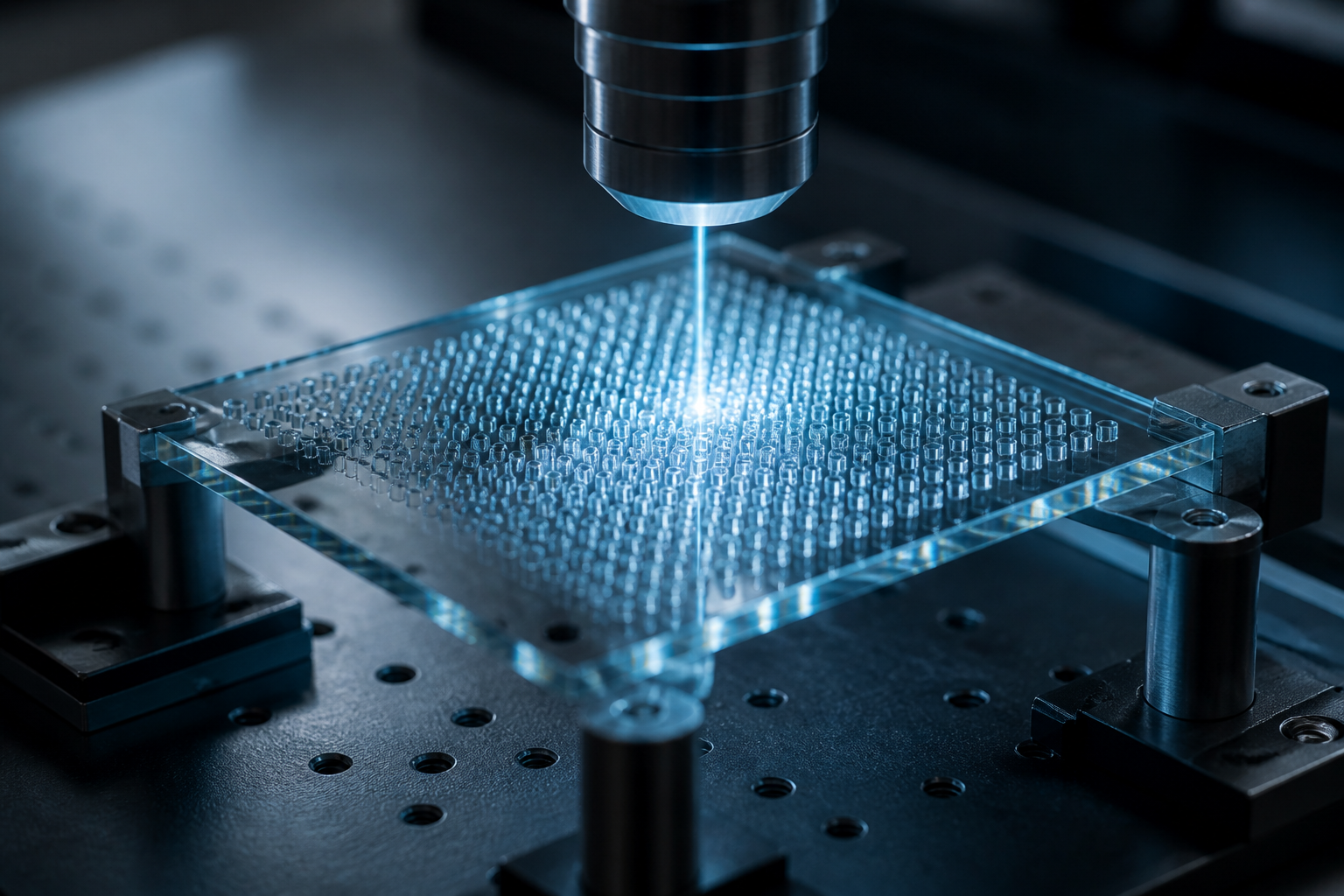
“In silicon wafer stealth dicing, we evaluated an 80W picosecond laser to push throughput against a 50W baseline… At high rep rates, the pulse energy fell to 160µJ, dropping below the nonlinear multiphoton absorption threshold. Instead of sub-surface modification, the energy coupled into phonons, creating micro-cracks and a 15µm HAZ. Running the 50W laser at lower rep rates—250µJ per pulse—confined the energy to the focal volume, keeping HAZ under 2µm and actually increasing yield per wafer. The parameter determining throughput wasn’t average power; it was maintaining peak power above the multiphoton threshold.”
— R&D lead, semiconductor wafer dicing system qualification
This R&D lead’s experience confirms the physics: peak power is non-negotiable.
The interplay between these two metrics is the most important concept in ultrafast laser specification.
| Feature | Average Power | Peak Power |
|---|---|---|
| Primary Role | Determines potential processing speed (throughput). | Determines processing quality (ablation mechanism, HAZ). |
| Unit of Measure | Watts (W) | Megawatts (MW) or Gigawatts (GW) |
| How to Increase | Increase Repetition Rate or Pulse Energy. | Increase Pulse Energy or Decrease Pulse Duration. |
| Impact on HAZ | Indirect. High average power via high rep rates can increase HAZ if pulse energy is too low. | Direct. Sufficient peak power minimizes HAZ. Insufficient peak power creates a large HAZ. |
| The Key To… | High-volume production. | High-precision, damage-free results. |
The key takeaway is that you cannot sacrifice peak power for average power. You must first determine the minimum peak power (via pulse energy and duration) needed to cleanly process your material. Only then can you determine the maximum average power you can use by finding the highest repetition rate that still delivers that necessary pulse energy.
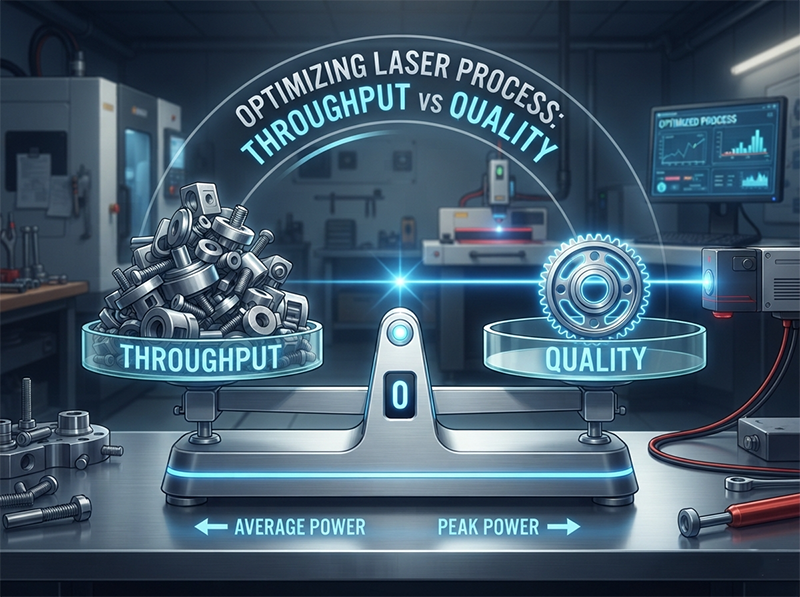
When you approach your next laser purchase, use this framework to avoid the trap of “unusable watts.”
Choosing the right laser involves more than just comparing two numbers on a spec sheet. Material properties, feature size, required edge quality, and thermal budget all play a role. A data sheet will never capture the full complexity of a production environment.
If you’re sourcing at scale, talking to a supplier directly can surface details no product listing will tell you.
The race for higher average power has overshadowed the fundamental physics of ultrafast laser processing. The engineer who doubled the power only to double the scrap rate learned a valuable lesson: the goal is not to apply the most power, but the right kind of power. For any process that values quality, precision, and yield, peak power is the parameter that reigns supreme. In ultrafast laser processing, average power gets you in the game, but peak power lets you win.
What is the simplest difference between peak power and average power in lasers?
Think of it like water: Average Power is the total volume of water flowing from a hose over one minute. Peak Power is the immense, instantaneous force of a single drop hitting from a pressure washer. Average power tells you the total work capacity, while peak power tells you the impact quality of each individual event.
Why does increasing the repetition rate sometimes hurt my process?
Most lasers have a fixed maximum average power. To increase the repetition rate (pulses per second), the laser must reduce the energy in each pulse to stay within that limit (Average Power = Pulse Energy x Rep Rate). If the pulse energy drops too low, your peak power falls below the material’s ablation threshold, turning a clean “cold” cutting process into a messy heating process that causes thermal damage (HAZ).
How do I find the ablation threshold for my material?
The ablation threshold is typically determined experimentally. It involves making a series of single-pulse marks on the material at varying pulse energies and then measuring the resulting feature size. This data is used to create a “Liu Plot” which extrapolates to the exact fluence (energy per area) needed for ablation. Reputable laser application labs can perform this characterization for you.
Can a 100W laser really perform worse than a 50W laser?
Absolutely. If a 100W laser achieves its power by running at a very high repetition rate (e.g., 2MHz), its pulse energy might be only 50µJ. A 50W laser running at a lower rate (e.g., 200kHz) could deliver 250µJ per pulse. For a material that requires 200µJ for clean ablation, the “more powerful” 100W laser would fail completely, while the 50W laser would perform perfectly.
What is HAZ and why is it so important in ultrafast laser processing?
HAZ stands for Heat-Affected Zone. It is the area of material surrounding the laser cut that has been altered by heat, but not fully removed. In metals, it can mean changes in hardness; in ceramics, it can cause micro-cracks; in polymers, it causes melting. The primary benefit of ultrafast lasers is their ability to produce a near-zero HAZ, which is critical for high-precision components and medical devices.
For B2B sourcing, what’s a better metric than just average power?
Focus on Pulse Energy at a given Repetition Rate. Ask suppliers for quotes that specify the pulse energy and pulse duration at the repetition rate required for your target throughput. This forces a more honest comparison of what the laser can actually deliver to your part. A laser that offers high pulse energy over a wide range of repetition rates offers far more process flexibility.
[1]”High-average-power, 100-Hz-repetition-rate, tabletop soft-x …. A review paper or research-lab overview of high-average-power ultrafast lasers describes how high repetition rates can produce large average output power even when individual pulse energies remain comparatively low; this supports the general engineering pattern but does not prove that it applies to every high-power laser system. Evidence role: general_support; source type: paper. Supports: Many high-power pulsed laser systems obtain high average wattage through very high repetition rates rather than high energy per pulse.. Scope note: Contextual support only; high-power laser architectures vary, and some systems instead rely on high pulse energy or continuous-wave operation.→
[2]”Ablation thresholds of metals with femtosecond laser pulses”. Ultrafast laser ablation studies describe material removal as requiring fluence above an ablation threshold; below or near this threshold, absorbed energy may not produce efficient material ejection. Evidence role: mechanism; source type: paper. Supports: If peak power is below the ablation threshold, the laser energy is insufficient for clean vaporization or efficient material removal.. Scope note: Threshold values and removal regimes depend on material, wavelength, pulse duration, and focusing conditions, so the source supports the mechanism rather than a universal numeric threshold.→
[3]”Measuring Laser Power and Energy Output”. Standard laser physics definitions state that average power is the product of pulse energy and pulse repetition rate for a pulsed laser, providing the basis for increasing repetition rate only while maintaining the pulse energy required by the process. Evidence role: definition; source type: education. Supports: The maximum usable average power can be determined from the highest repetition rate that still maintains the required pulse energy.. Scope note: This relationship is definitional and does not by itself prove the material-specific pulse energy threshold; that threshold must be determined experimentally or from process data.→