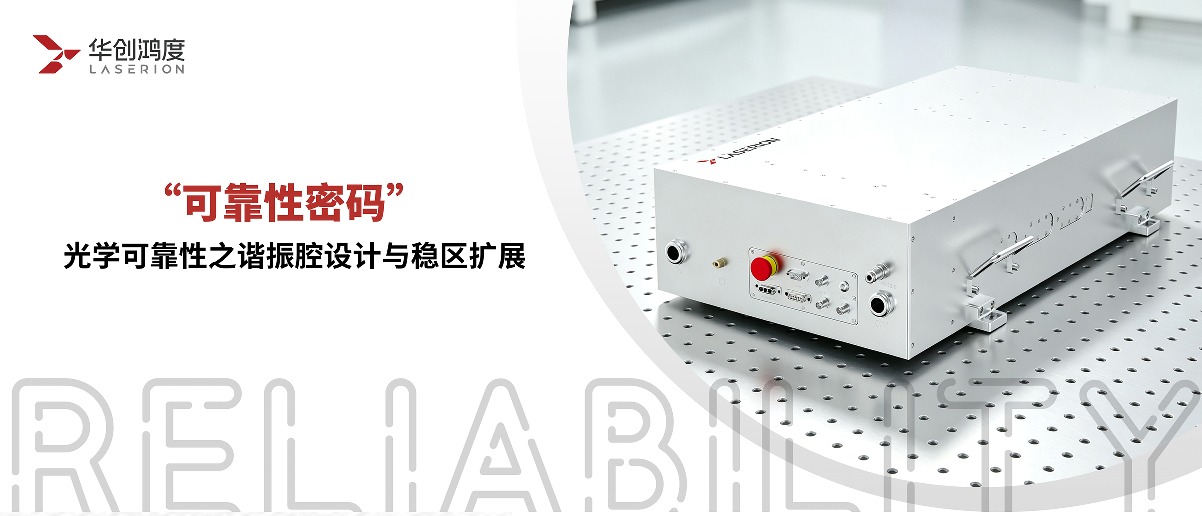
In the previous article, we provided a detailed explanation of laser site–based high–frequency alert codes and the on–site troubleshooting methods for resolving them; this article will focus on unalerted hidden faults, beam pulse anomalies, and A fault classification and routine maintenance program that addresses issues such as equipment code–free shutdowns, lack of light emission, power anomalies, and spot defects; this program defines on–site operational boundaries and maintenance standards, helping customers reduce the likelihood of equipment failures and ensuring stable laser operation.
03 No warning but unable to turn on the machine / no light
Failure 1: The whole machine is electrified without any indicators, the equipment does not start at all
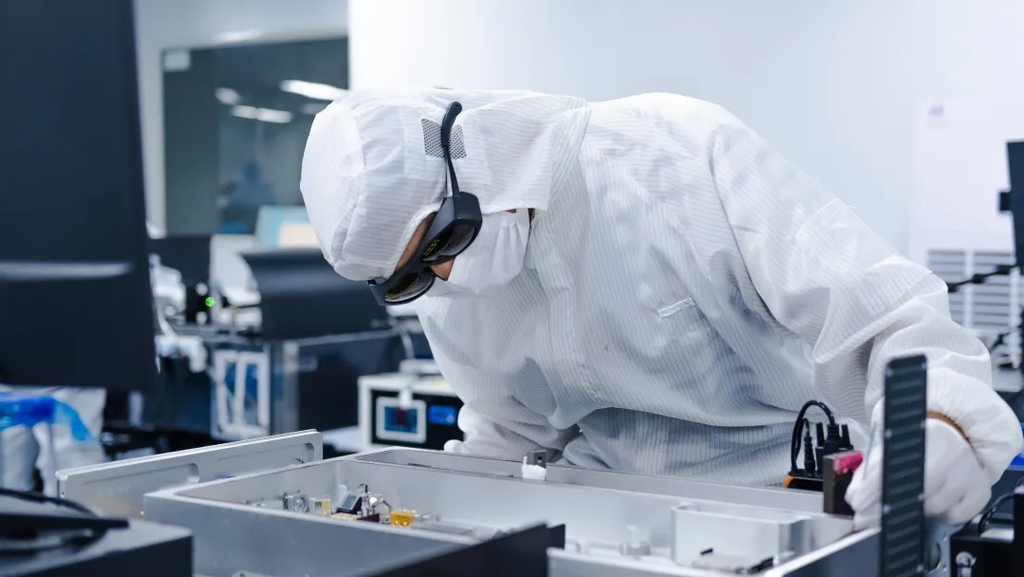
△ Professionals Test Lasers
Cause analysis: Lack of external power supply, air switch tripping, and disconnection of the power V+/V– wiring.
Detecting and resolving:
- Use a multimeter to measure the input side of a switching power supply AC 220V voltage to verify that the external power grid provides stable power, without any power outages or voltage drops.
- Measure the output terminal of a switching power supply DC 36V voltage to determine whether the switching power supply is properly delivering its operating voltage, and to diagnose any faults within the power supply itself.
- Re-lock the connector interface of the POWER SUPPLY, tighten the V + / V – terminal of the power supply, eliminate the problem of false connection and falling off.
Failure 2: The device is powered normally, the top-level machine is connected successfully, there is no laser output
Cause analysis: safety circuit limitations, mismatch between processing signals and modes, light gates not being opened, incorrect power settings, external optical path contamination/obstruction, internal components damaged by impact, optical path misalignment.
Detecting and resolving:
- The safety circuit lock has not been released: First, check the status of the device interlock (INTERLOCK) and emergency stop (E–STOP) circuits to ensure that no circuits are broken and that there are no software alerts; then, try again to activate the light gate to emit light.
- The mode does not match the external signal: Based on the device’s operating mode, perform the corresponding troubleshooting; Gate mode requires confirming that the external 5V TTL high–level signal is properly connected to BNC (G/T).Interface; Trigger mode requires that the external trigger signal frequency be lower than the laser’s set repetition rate, and that a 5V TTL high–level signal be properly connected to the corresponding BNC (G/T) interface. The internal control mode requires disconnecting the external trigger signal line and using pure software to control whether the test device emits light properly.
- The shutter is not currently open: on the host computer AOM control area, switch the Shutter shutter to an ON (open) state.
- Set the power parameter to 0%: We recommend setting the AOM power percentage to 10% or higher to generate output light for testing.
- Optical path obstruction / window contamination: After the device is powered down, use a specialized lens–wiping paper combined with anhydrous ethanol to wipe the laser output window in one direction to remove dust, oil residue, and obstructions.
- If all of the above are still functioning normally but no light is emitted, this may indicate that the AOM acousto–optic modulator is damaged or that the resonant cavity’s optical path has shifted—in which case the unit must be sent back to the factory for repair and recalibration of the optical path.
Failure 3: There is laser output, but the power is low and the processing effect is uneven
Cause analysis: Water cooling does not meet requirements; internal mismatch; abnormal voltage division in power external control interface; parameter settings do not match the process; power attenuation ; factory–set parameters have been altered.
Detecting and resolving:
- Cooling verification: Water temperature 23°C remains constant; the water temperature stability requirement for solid–state ultrafast lasers is ±0.1°C.The traffic volume meets the required standard.
- Optical inspection: output window, external scanning mirror lens – clean and free of scratches。We check whether the position of the light beam at the output port has changed; if the beam is not centered, this may indicate a mismatch or shift in the internal optical path.
- Power coefficient verification: In control mode, use a power meter to compare power levels at various power percentages against the factory report; in external control mode, verify that the external 0–5 V / 0–10 V power regulation interface (RESERVE1) shows no abnormal voltage division.
- Pulse parameters: repetition rate, burst settings are aligned with the process; switching to Trigger processing mode allows us to test the processing results.
- Modify parameters: Frequency multiplier Temperature remains at its factory–default value; users are not allowed to manually adjust the frequency multiplier temperature control settings.
- Power degradation: Over a long period of use, the efficiency of semiconductor–based pumping light emission naturally declines; when checks of cooling, lenses, optical paths, circuits, and parameters all show normal operation, this is determined to be pump source degradation, requiring the unit to be sent back to the factory for replacement.
04 Bulk and Pulse Abnormal Faults
Failure 1: The light spots are deformed, have black spots and are very dispersed
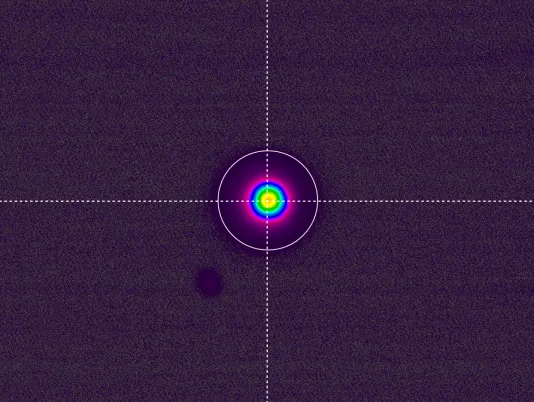
△Normal Light Spots
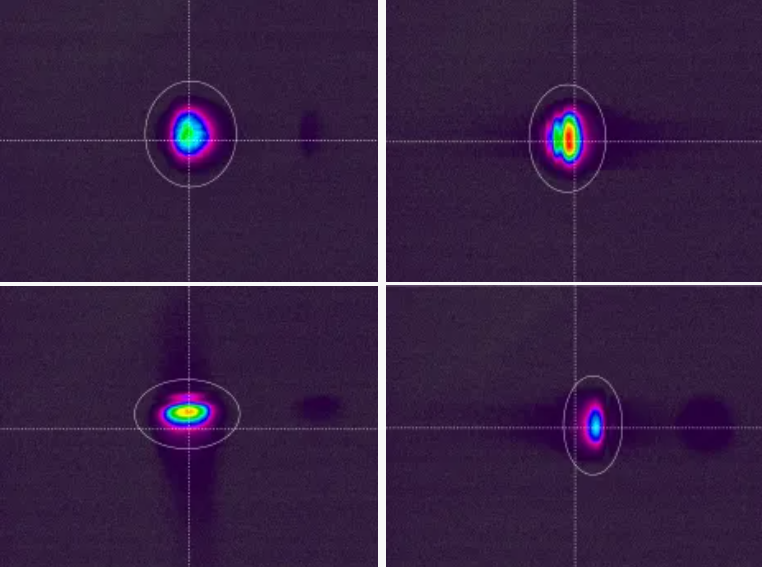
△Exceptional Light Spots
Cause analysis: Contamination of the external optical path or the output window lens; damage to the coating; transport vibrations causing a shift in the optical path inside the cavity; and contamination of the frequency–doubling crystal.
Detecting and resolving:
- Check the surface cleanliness of the external light path mirror / expansion mirror / cut head / oscilloscope and regulate the cleaning of the surface;
- After cleaning, the light spot remains abnormal, and may be an internal light path shift, which needs to be returned to the factory for repair, and cannot be dismantled on-site.
Failure 2: Pulse leak triggered, hit point missing, pulse trembling large
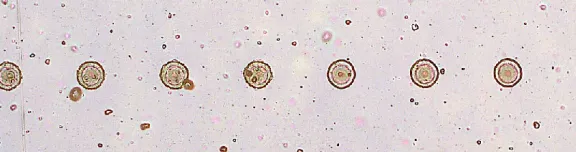
△ The Effect of Normal Punctuation
△Pulse Leak Triggers
Cause analysis: The external Trigger signal frequency exceeded the laser’s repetition rate; the signal line lacked a common ground shield; and the AOM drive was abnormal.
Detecting and resolving:
- Reduce the external trigger frequency to ensure that the trigger frequency is < the laser heavy frequency;
- GATE / TRIGGER signal line shielding layer single-end grounding, reduce electromagnetic interference;
- Switch between Trigger – Normal / Average / Compensation modes to match the timing of on–site circuit boards.
- Internal control mode pulse is still disorder, determine the AOM radio frequency control module failure.
05 Guidelines for the Grading of Field Failures
Level 1 basic fault (can be resolved independently on site)
Serial port loosening, emergency stop reset, water-cooled filter plugging, water-cooled temperature flow regulation, window lens cleaning, software version update restart, DB15 short terminal off.
Second–level hardware failure (repairable by replacing components)
Including flowmeter, communication serial line, open power, DB15 short connector damage and other issues, can be directly replaced by equipment spare parts repair, simple operation, no risk of dismantling.
Level 3 severe hardware failure (do not attempt to disassemble the device on site—contact after–sales support)
This includes sensor failures, motherboard malfunctions,Core component failures such as power drive malfunctions, seed source/pump source failures, optical path misalignment, and AOM modulator damage require specialized equipment and technicians for repair; it is strictly prohibited to dismantle the machine on site without authorization, and any problems should be reported immediately for repair .
06 Daily prevention reduces the probability of failure
Regular maintenance is the core of ensuring the stable operation of lasers and extending the service life of the equipment, and the specific operation requirements are as follows:
- Power system optimization: Use equipment paired with a dedicated voltage–regulating power supply to effectively avoid grid voltage fluctuations and sudden high–voltage surges, thereby preventing power modules from being burned or damaged.
- Water–cooling system maintenance: Replace the device’s deionized cooling water once per month, and clean the water–cooling filter elements every quarter to ensure that the water–cooling cycle remains clean and that heat dissipation remains stable.
- Routine startup checks: Before starting up each day, verify the status of emergency stops, interlocks, and flow meters; once a week, export the device’s operation logs and retain operational data.
- Operating environment control: The device’s operating environment temperature is maintained at 20–28 °C ,The ambient humidity should be kept at 70% or less to prevent dust and oil residue from accumulating and to avoid contaminating or damaging components.
- Long–term shutdown maintenance: When a device is shut down for an extended period, the entire system must be powered off, the water–cooled machine must be turned off, a laser output protection cap must be placed over it, and measures must be taken to protect against dust, moisture, and impacts.
If you would like to learn more about laser maintenance expertise or submit a service request online, please follow the official after–sales public account “Huachuang Hongdu Technical Support” 。 The platform supports accessing technical articles, submitting after–sales service requests online, and instantly retrieving after–sales contact information—all of which provide comprehensive protection for stable equipment operation.
Trailer for the series
This article is one of the contents of Hublot’s laser maintenance guide series, focusing on daily maintenance and troubleshooting of lasers. The series will continue to output more equipment maintenance solutions to protect the long-term reliable operation of the navigation laser, so please pay attention.