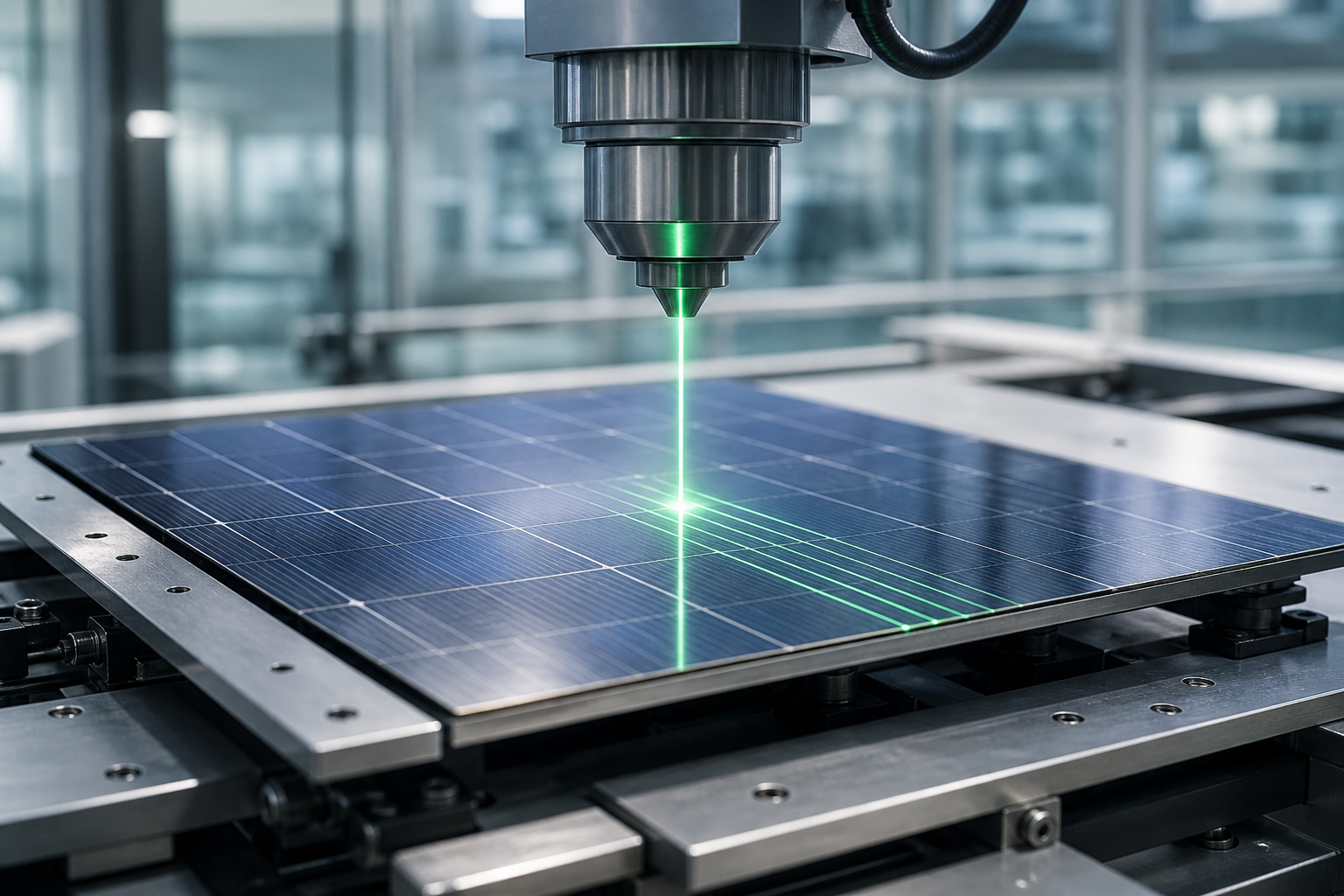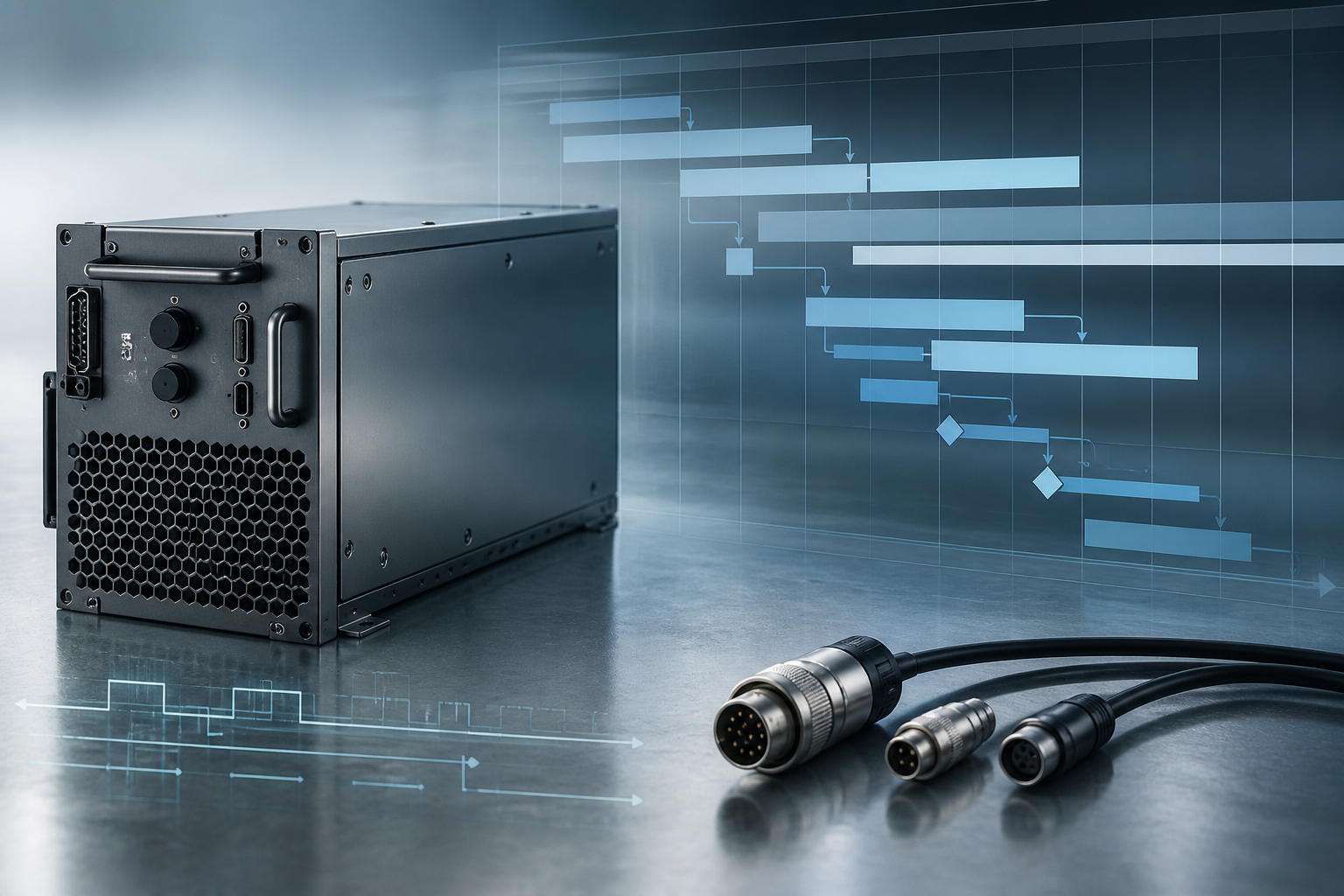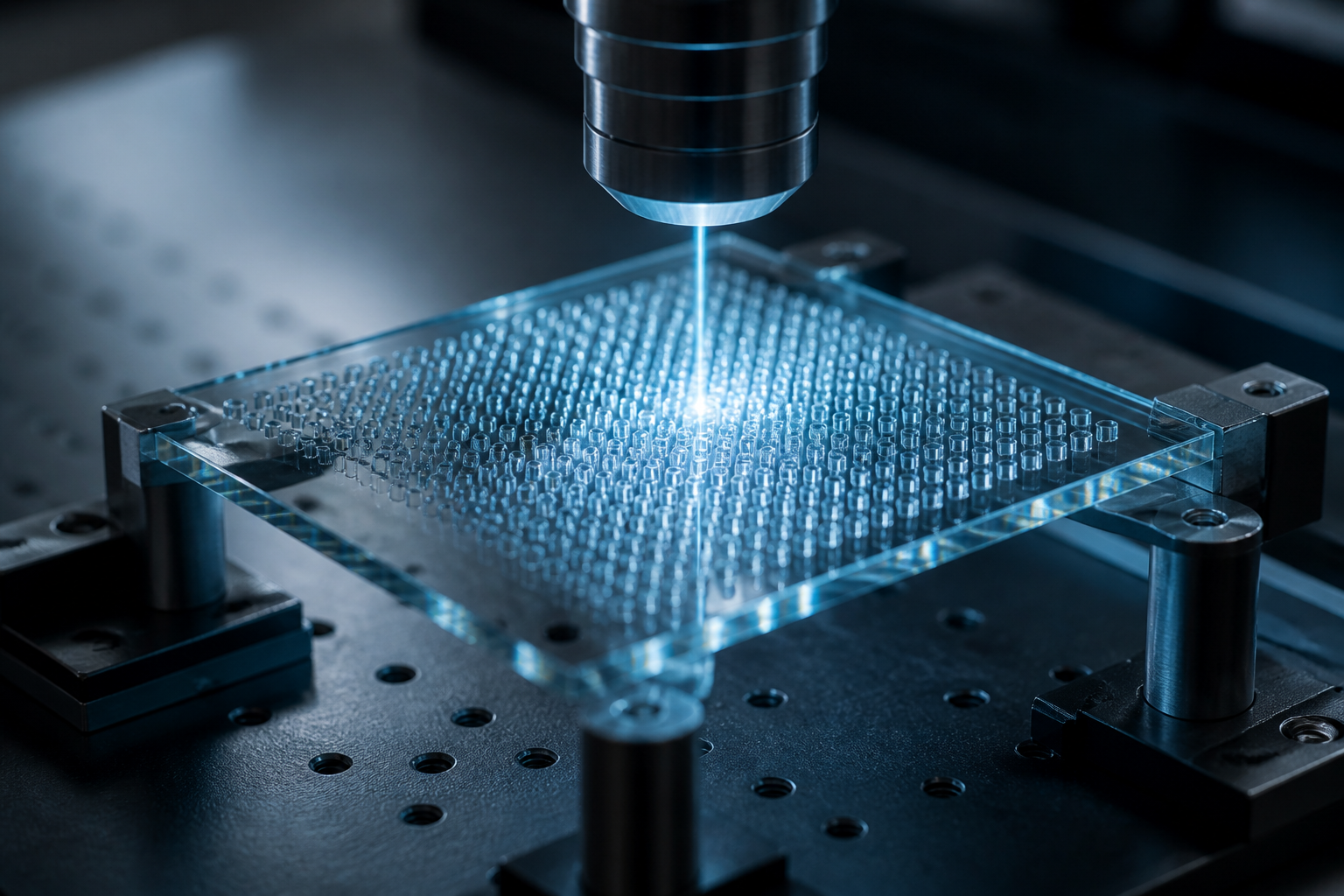
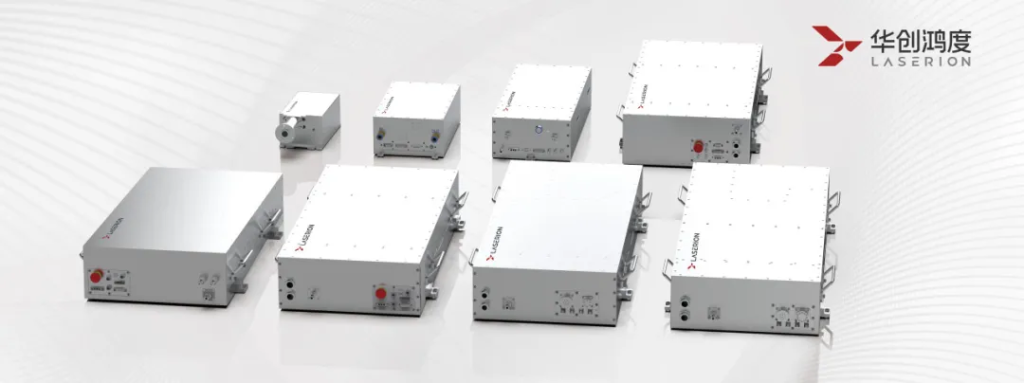
△ Huachuang Hongdu Highly Reliable Solid Lasers
The core reliability of solid-state lasers is usually largely determined during the product design phase. For femtosecond lasers, the resonator directly determines beam quality and long-term operational stability; the gain crystal is primarily constrained by the thermal lensing effect induced by pumping, which limits stable cavity operation. If steady-state verification is conducted only for a single operating condition, fluctuations in pump power can easily cause degradation of the intracavity mode field, leading to lock failure and even interruption of laser output. True optical reliability does not lie in the stability of single-point conditions, but rather in the resonator’s sufficient stability margin across the entire operating range.
This paper focuses on the design of the stable region for resonant cavities and conducts research , relying on resonant cavity simulation to construct a dynamic stable resonant cavity that is low-sensitive to thermal lensing variations, thereby expanding the stable region from the design source, enhancing stability redundancy, and achieving a transition of laser operation from single-point availability to reliable full-condition operation.
The resonator consists of two end mirrors and optical elements inside the cavity composed of specific curvature and cavity length combinations that maintain stable beam oscillation; the corresponding parameter range is known as the stable region. The traditional scheme relies on the static g-parameter criterion (g₁g₂) being between 0 and 1 for stability , but since the operating conditions of solid-state lasers continuously change, the static standard has obvious limitations.
① Thermal lenses: the root cause of stabilization problems
The pump light is incident on the gain crystal, where part of its energy is converted into laser light, while the remainder is transformed into heat. The temperature difference between the center and the edge of the crystal results in a gradient distribution of refractive index, causing the entire crystal to behave equivalently as a lens, known as a thermal lens. An increase in pump power will increase the thermal lensing power and shorten the focal length: during the cold-start stage, the focal length approaches infinity, while under full-power operation, the focal length can reach one or two hundred millimeters。 The thermal lens parameter varies continuously with power and is located at the center of the resonator, forming an essential component of the resonator core. The core requirement of the engineering design is not the determination of the static steady state of the resonator, but rather the achievement of continuous stability within the full dynamic range of thermal lensing.
② Dynamic stability: evidence for stability redundancy
The core design criterion for adapting to dynamic operating conditions is dynamic stability design: rather than pursuing extreme performance at a single power point, the focus is on achieving low sensitivity of the cavity mode size to thermal lensing variations. Based on the correspondence curve between the gain crystal spot radius and the thermal lens focal length, the flatter the curve is, the smaller the fluctuation of the cavity mode within the full power range, and the more sufficient the stability margin becomes. The smoothness of this curve directly determines whether the laser can achieve stable operation from cold start to full power, serving as the core quantitative optimization metric in steady-state region design.
Static manual calculations can only solve a single point of work and cannot map the complete trajectory of changes in the cavity mold with the thermal lens, which is where the stability redundancy manifests itself. Therefore, resonance cavity simulation is a necessary tool for quantifying and optimizing stability redundancy during the design phase – it allows you to see and calculate stability adequacy before a prototype is built.
① Quantifying Dynamic Stability Using Scan Curves
By continuously changing the strength of the thermal lens in simulation, we can obtain a curve of the subsequent change of the cavity photosphere. The closer the curve is to the level, the less sensitive the cavity model is to thermal lens changes, and the more adequate the stability redundancy. It is important to emphasize that the scan interval for the evaluation must cover the entire process from the chiller to the full pump – the narrowness of the interval often masks the true stability boundaries and leads to a “seemingly stable” miscalculation.
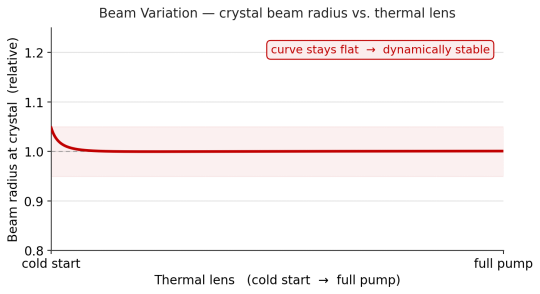
△ The Change of Luminous Spots at Crystals with the Thermal Lens (Longitudinal Axis is Relative Value): the Entire Process from the Cold Machine to the Full Pump is Nearly Level, Indicating that the Cavity Mold is not Sensitive to the Changes of the Thermal Mirror and that the Stability is Sufficiently Redundant.
② Identify key components using intracavity photophoresis distribution
On the basis of confirming dynamic stability, using a Caustic diagram, the model field sizes are read from the endoscopy to the gain crystal, and accordingly the beam occupancy and safety margins on each key element are checked to ensure that everything works within the design intent.
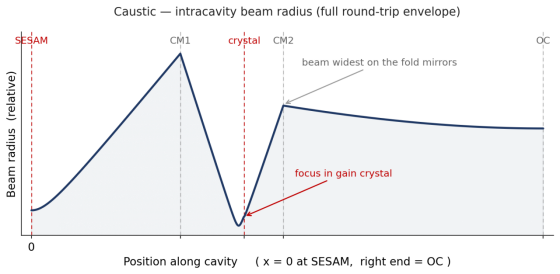
△ The Radius Distribution of Light Spots Within the Cavity (Complete Round and Round Envelopes, with a Relative Value on the Longitudinal Axis): The Beam is Narrowed at the Gain Crystal and Widened at the Folding Mirror, and the Mold Field on the Components from the Endoscopy to the Output Mirror is Obvious.
In engineering practice, steady-state region optimization often requires balancing multiple design constraints. Typical operating conditions are as follows: To reduce the SESAM risk of Q-switched mode-locking at the end mirrors, the spot size of the mirror must be increased to meet the specified requirements; However, since the optical path layout has been finalized, the total optical path length must remain constant to lock the target repetition rate, leaving very little room for adjustable design.
① Limitations of independent adjustment of single parameters
The resonant cavity belongs to a strongly coupled optical system; a change in a single parameter will cause the spot distribution throughout the cavity to shift in tandem, often resulting in a situation where local performance improves while the performance at other positions deteriorates—a case of gaining at the expense of losing elsewhere. At the same time, the closer the operating point is to the edge of the stable region, the more sensitive the cavity becomes to modeling errors, and even simple manual estimation can yield results that contradict experimental findings. Therefore, such optimization must rely on full resonator cavity simulation and cannot depend on local approximate calculations.
② Multi-parameter combined optimization strategy
The feasible solution is multi-parameter co-optimization: while the optical path structure and the total optical length are unchanged, drive multiple design variables to iterate synchronously to find the optimal solution that meets all indicators in a multidimensional constraint space. By this method, the SESAM facula can be adjusted to the target size, and the facula distribution and dynamic stability of the gain crystal can be kept basically unchanged, and the repetition rate can be stabilized in the design specification.
Thus, the steady-area performance improvement does not rely on a specific single algorithm, but at the core is to fully utilize the value of parameter scanning tools. Manual calculations can only obtain discrete single point results, simulation analysis can present complete performance panoramic, and engineering stable and reliable design needs to be supported by global panoramic analysis.
It should be emphasized that high-stability redundancy does not mean designing the resonator solely at the center of the stable region。Most femtosecond oscillators achieve self-starting operation through Kerr lens mode-locking (KLM): intense light induces self-focusing effects in the crystal, causing the beam spot to contract and optimize overlap with the pump region, thereby enhancing gain and reducing losses for the strong pulses. The intensity of this effect depends on the sensitivity of the cavity mode to perturbations of the light spot.
If the resonator operates at the center of the stable region , the response to spot changes is sluggish, Kerr self-focusing fails to generate effective gain modulation, and mode-locking cannot self-start; And when the resonator operates at the edge of the stable region , it is highly sensitive to spot perturbations; even weak self-focusing effects can be converted into significant gain modulation, ensuring smooth self-starting of mode-locking.
As can be seen, the design of resonant cavities involves a set of mutually balancing requirements: on the one hand, it is necessary to suppress disturbances caused by thermal lensing, thereby achieving dynamic stability and maintaining sufficient stability margins; On the other hand, it must maintain sufficient sensitivity to Kerr self-focusing to satisfy the KLM self-starting condition. The stable region is not necessarily larger the better; the design should achieve “stability when appropriate, sensitivity when needed”. Seeking the optimal balance point between two mutually constraining indicators is precisely the value of resonant cavity simulation optimization and engineering design.
The stabilization area design of the resonance cavity is the source of the optical reliability of solid femtosecond lasers. By introducing resonating cavity simulation at the design stage, quantifying dynamic stability and optimizing cavity models under multiple constraints, By striking a balance between stability and sensitivity, stability redundancy can be moved from “after-debugging” to “in-design,” enabling a leap from “somewhere usable” in the lab to “full-service reliability” in the field.
Covestro is focused on high-stability solid laser technology. From resonance cavity design and stabilization zone optimization to work conditions adaptation and long-term stability redundancy construction, each step is guided by the principle of “reliability begins with design,” and aims to provide long-term, stable light source support for precision machining, scientific research exploration and other key scenarios.
Trailer for the series
This article continues the “High Reliability” series on optical reliability. In the future, we will continue to dissect such areas as stability design of mechanical structures and precise regulation of electric control systems, and systematically build a complete technical system for high-reliability lasers, so please stay tuned.