Not every “specialty laser” in a research catalog is the same instrument wearing a new label.
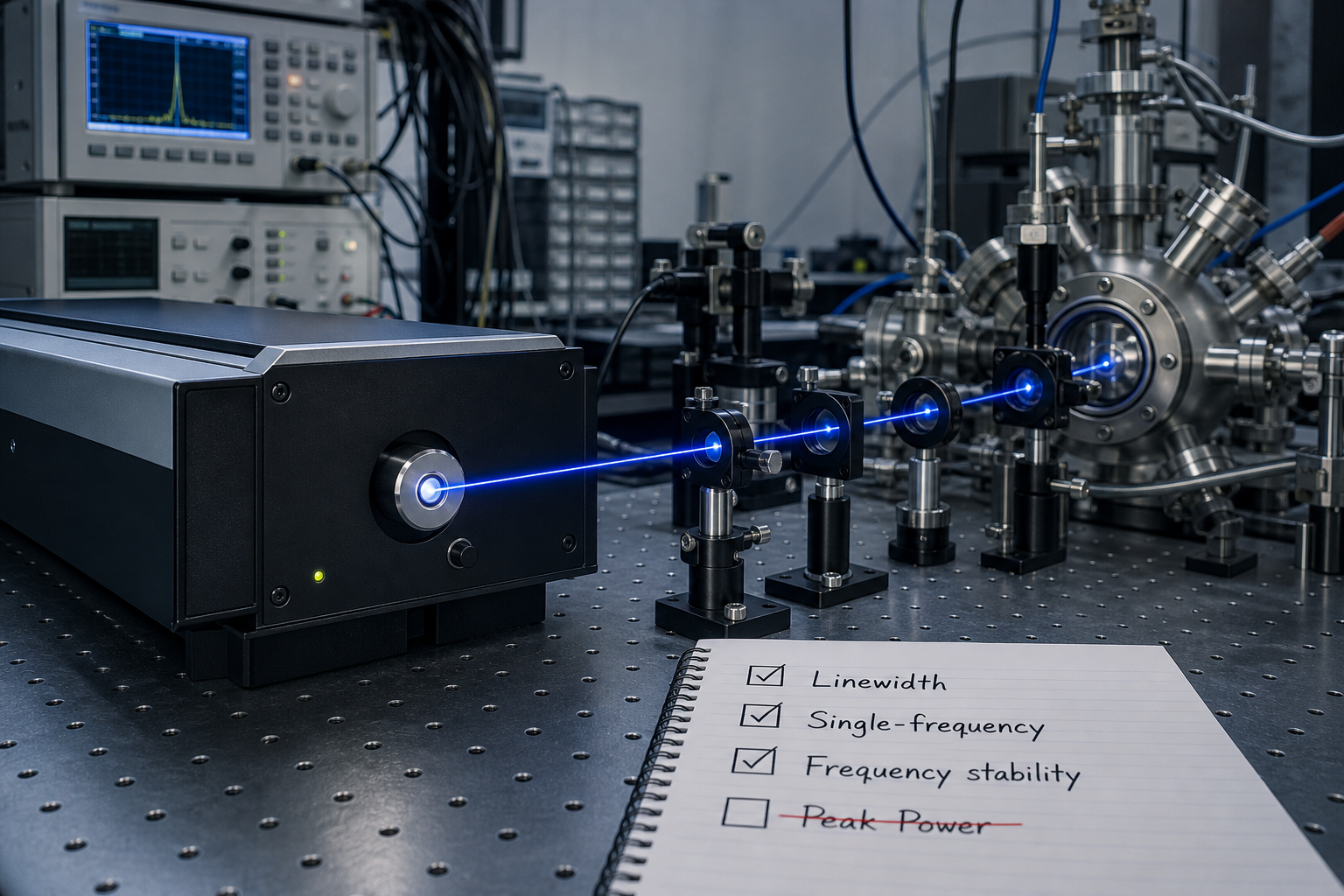
“The purchase request said ‘specialty ultrafast laser’ because that was the language every vendor webinar used. For laser cooling and coherent addressing of a trapped ensemble, the binding requirement was single-frequency operation with a narrow linewidth — spectral purity that keeps the optical field phase-coherent on the atomic transition, not a femtosecond peak for multiphoton imaging. After six weeks of trying to force a broadband high-peak source into the chain, we rewrote the RFQ around linewidth under 0.1 nm class, frequency stability over multi-hour runs, and single-frequency mode purity. Beamtime recovered only after we stopped treating a quantum source like a cold-ablation engine. Peak power never entered the acceptance test.” — research scientist, atomic laser-cooling source specification rewrite
If you are asking what a single-frequency narrow-linewidth laser is used for in quantum and spectroscopy labs, start here: it is a coherence tool. Its job is spectral purity and phase stability on a narrow transition or fringe — not cold ablation, not multiphoton life-science imaging, and not “whichever specialty box ranked highest on peak power.”
A single-frequency narrow-linewidth laser is used wherever the experiment needs a stable, spectrally pure optical field: laser cooling and coherent atomic addressing, high-resolution spectroscopy that must separate close lines, and precision interferometry where fringe contrast tracks coherence length. In those labs, linewidth, single-frequency purity, and frequency drift over the run outrank peak power or femtosecond pulse width.
Search results for this query often miss the point. Life-science webinars talk about ultrafast imaging and reducing sample damage. Generic component blogs sort CW versus pulsed and budget. Medical pages discuss surgical CO₂ and Nd:YAG. Team-skills essays discuss hiring laser physicists. None of that answers a quantum or spectroscopy PI’s real question: what is this source for, and which datasheet cells actually matter?
We see RFQs rewritten after failed beamtime for the same reason. Marketplace language collapses “specialty,” “ultrafast,” and “research-grade” into one shopping cart. Quantum cooling, overnight spectroscopy, and interferometric metrology do not share that cart. A narrow-linewidth laser for quantum labs is specified by spectral purity and lock behavior. A femtosecond micromachining source is specified by pulse class and process window. Mixing them wastes campaign weeks.
Laserion’s research lane treats single-frequency / narrow-linewidth sources as specialty engines — pure laser sources you qualify against the physics at the sample, not against a peak-power leaderboard.
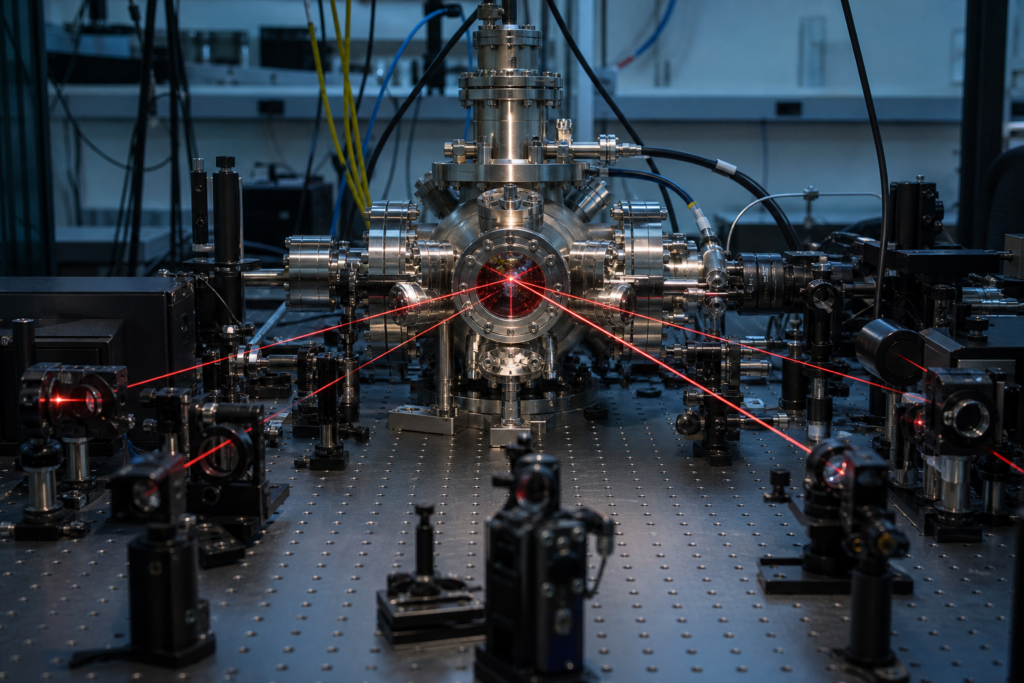
In atomic, molecular, and optical (AMO) work, light must sit on a narrow transition with enough spectral purity that atoms see a well-defined frequency, not a blurred band. Laser cooling, state preparation, and coherent addressing depend on single-frequency behavior and a tight linewidth. A broadband high-peak “ultrafast specialty” source can deliver impressive pulse energy and still be useless on that transition.
Specify laser cooling single-frequency source requirements in lab language: single-frequency mode purity, linewidth class (application-class targets often discussed near <0.1 nm for specialty/inspection-grade envelopes), and frequency stability across multi-hour runs. Peak power is a secondary threshold for scattering rate — not the ranking key.
Common mistake: copying an ultrafast life-science RFQ because the word “specialty” appeared in both vendor emails.
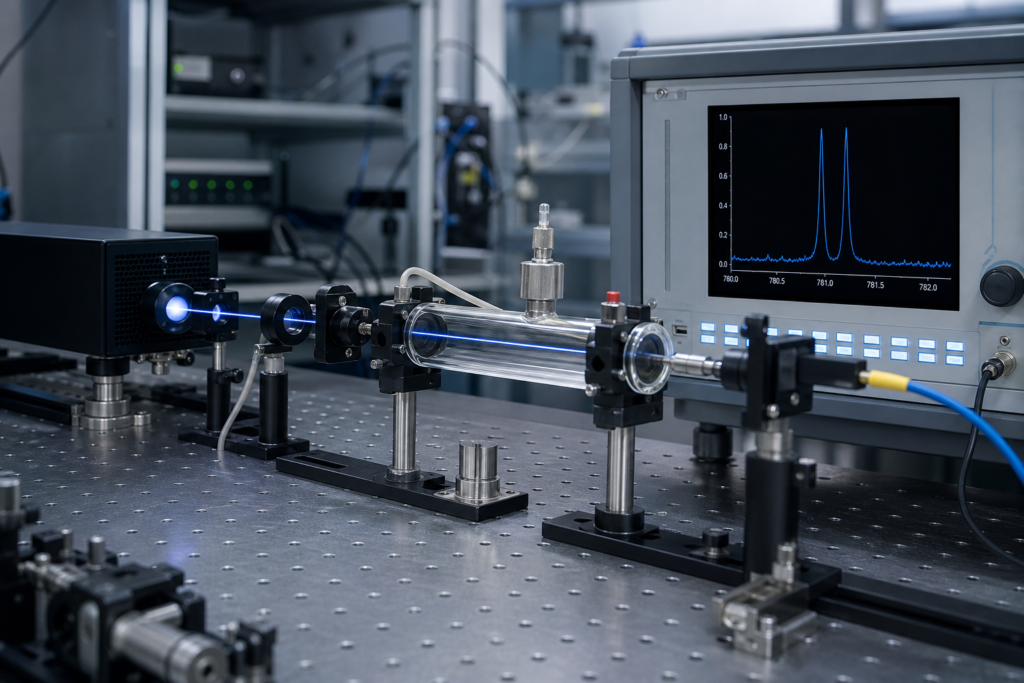
Spectroscopy labs buy narrow linewidth because resolving power is limited by the source spectrum and its drift.
“We ranked candidate sources by average power and peak figures because the datasheets made those cells easy to compare. On a high-resolution gas-phase spectroscopy campaign, resolving closely spaced features tracked linewidth and long-term frequency stability, not who claimed the brightest pulse. A broader, higher-peak alternative washed out contrast that a single-frequency narrow-linewidth source held across a 10-hour overnight scan. Cost showed up as lost campaign nights and a delayed paper, not as CapEx. The scorecard flipped to linewidth, single-frequency purity, and drift over the run — with power kept only as a signal-to-noise threshold.” — spectroscopy lab lead, overnight high-resolution scan dual-source comparison
For a single-frequency laser for high-resolution spectroscopy, ask: Can the source hold line separation through an overnight scan? What is the drift over 8–12 hours? Is the spectrum single-frequency under your lock scheme? Brighter light that blurs two lines into one is not a win.
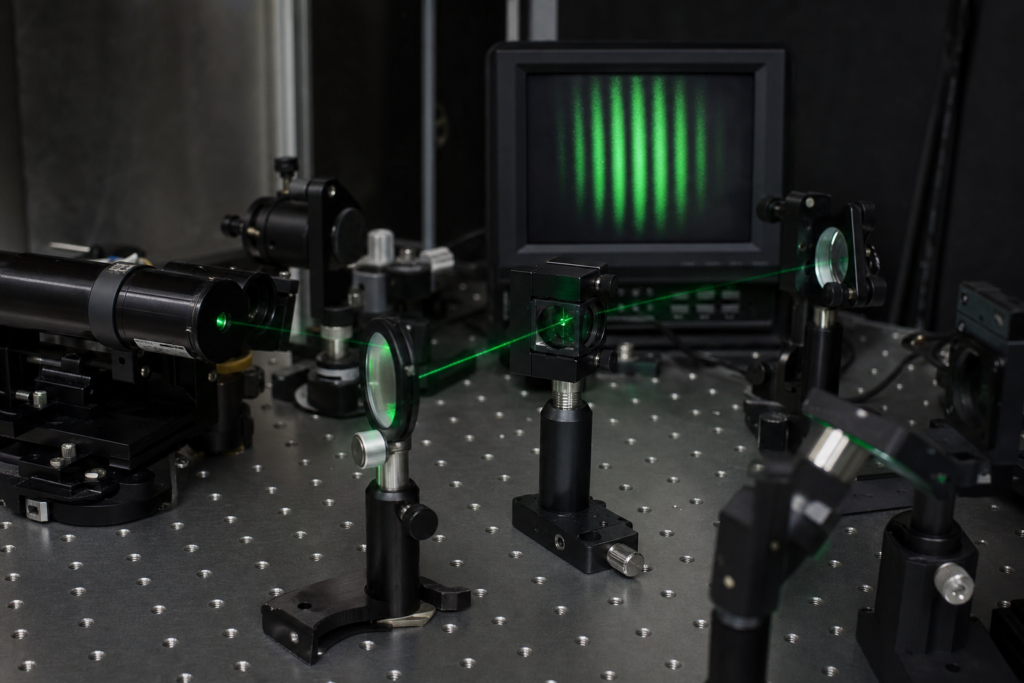
Interferometry turns spectral purity into path-length information. Coherence length shrinks as linewidth grows. Fringe contrast collapses when the source is multi-mode or drifts too fast for the measurement window.
“The assumption was that a brighter source would raise fringe contrast on a precision interferometric path. Side-by-side, usable coherence tracked spectral purity: a single-frequency narrow-linewidth source under 0.1 nm class with long-term stability on the order of >20,000 h duty preserved fringe visibility that a higher-peak, multi-mode alternative scrambled within minutes. We changed the pre-spec questions to coherence length needs, single-frequency lock behavior, and frequency drift over the measurement window. Power stayed on the sheet as a detection floor. The laser’s job in that lab was to be a phase-stable ruler — not an ablation engine.” — metrology engineer, precision interferometry source dual-path fringe trial
That is the cleanest definition of a precision interferometry narrow-linewidth laser: a phase-stable ruler. Adjacent research themes — precision interferometry, coherent sensing, clock-adjacent optical chains — share the same acceptance logic even when the apparatus differs.
If your next campaign night is already booked, confirming linewidth and multi-hour frequency drift against the real optical path now saves a second acceptance loop later.
| Lab need | Right tool family | Wrong substitute |
|---|---|---|
| Atomic cooling / coherent addressing | Single-frequency narrow-linewidth source | Broadband ultrafast imaging laser |
| Resolve close spectroscopic lines | Narrow-linewidth, low-drift source | Highest peak-power specialty box |
| Fringe-stable interferometry | Long coherence / single-frequency | Multi-mode high-peak pulse train |
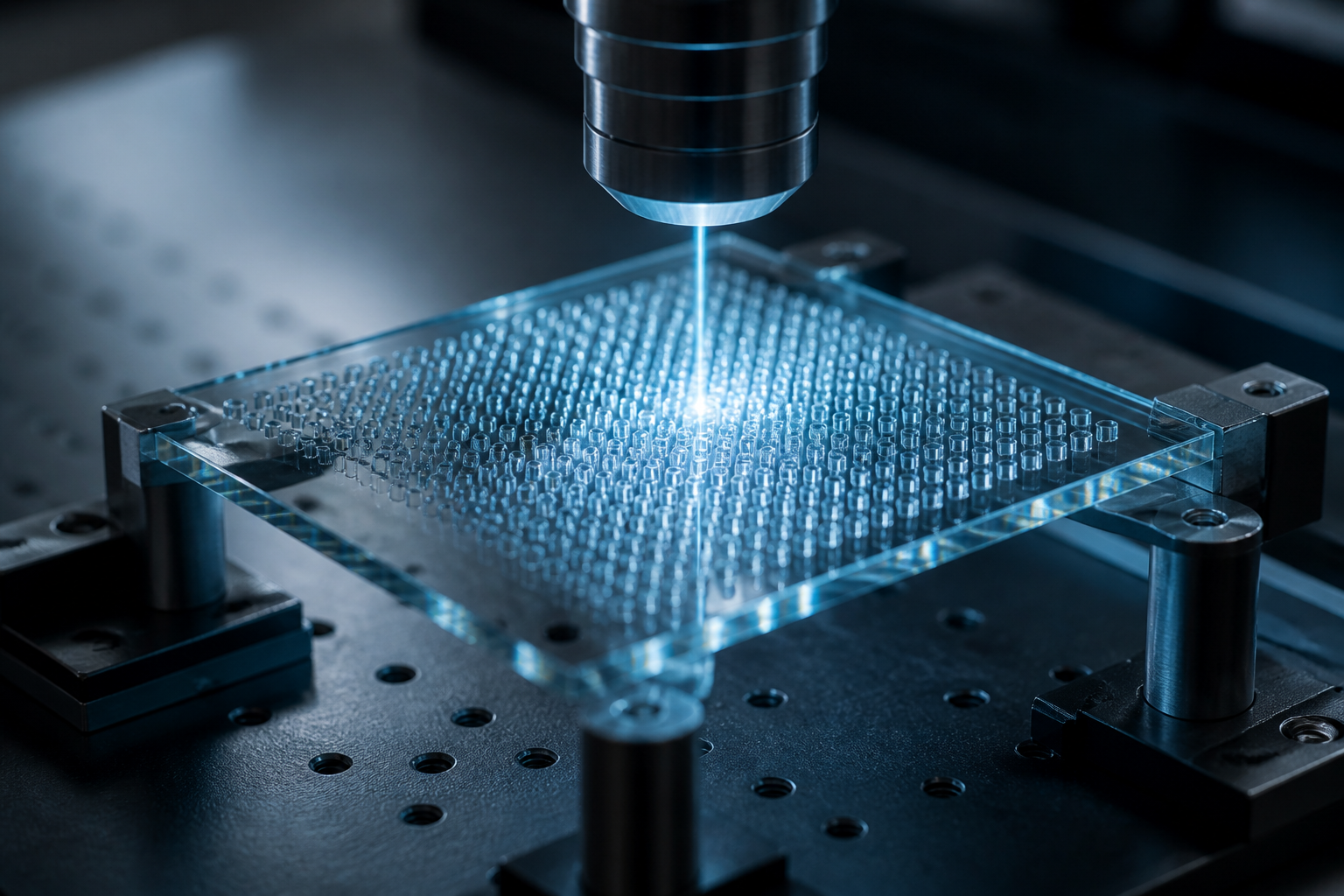
| Cold ablation / micromachining | Ultrafast industrial pulse class | Narrow-linewidth CW-style specialty alone |
| Multiphoton bioimaging | Ultrafast + suitable average power | Quantum cooling RFQ language |
Before/after in one line: before, the RFQ said “specialty ultrafast”; after, acceptance tests measured single-frequency purity, linewidth class, and overnight drift.
Write the RFQ in experiment language:
Laserion supplies specialty sources as a pure source OEM: we do not sell competing sealed science instruments into your bay. Your group keeps the experiment path; we qualify the spectral engine.
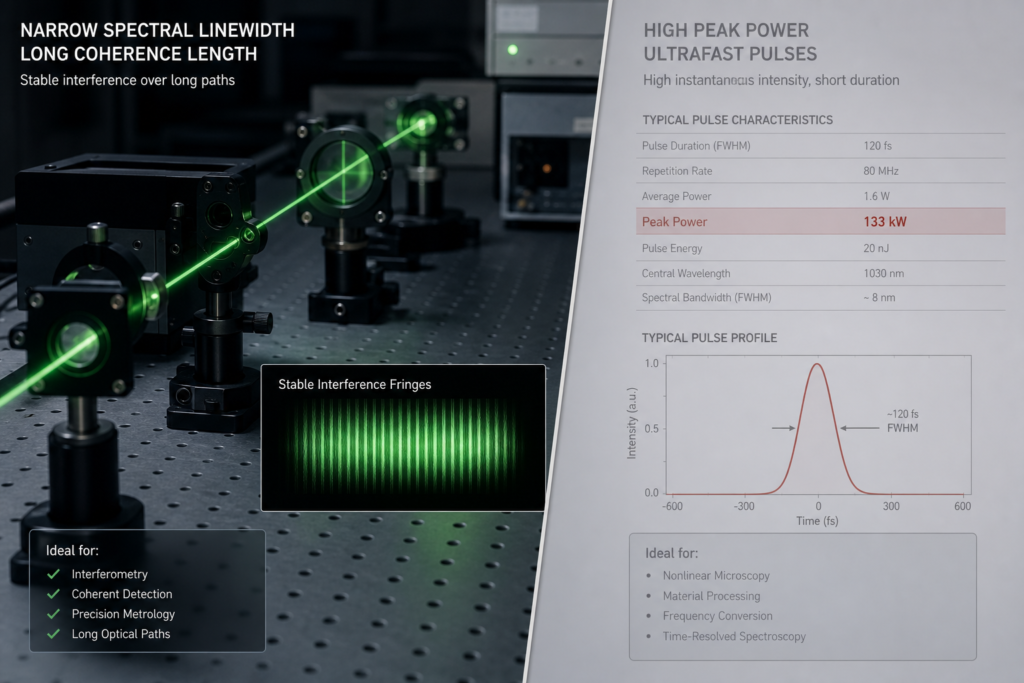
When two datasheets show similar watts, ask which figure governs your observable. If the observable is a resolved line, a cooled atom, or a stable fringe, coherence length vs peak power is not a philosophy debate — coherence wins. If the observable is material removal or multiphoton excitation volume, you are shopping a different product family.
If you cool, address, or probe narrow atomic or molecular transitions, choose a single-frequency narrow-linewidth laser and score linewidth plus frequency drift first. If you resolve dense spectra overnight, choose the same family and score long-term lock stability before average power. If you run precision interferometry, specify coherence length needs explicitly and treat peak power as a detection floor only.
If your work is micromachining, stent cutting, or multiphoton imaging, do not force a narrow-linewidth quantum RFQ onto an ultrafast industrial source — or the reverse. Wrong family costs beamtime faster than wrong wattage.
Confirm the transition or fringe requirement, the overnight drift budget, whether single-frequency purity is mandatory, and whether power is only an SNR floor. Confirm you are not copying an ultrafast life-science or medical-component checklist into a quantum RFQ.
If you’re qualifying a specialty narrow-linewidth source for a quantum, spectroscopy, or interferometry setup, talking to an applications team directly can surface linewidth, stability, and interface details no product listing will tell you.
Talk to our applications team →
The cooling lab did not fail because ultrafast lasers are irrelevant to science. They failed because a coherence problem was purchased as a peak-power problem. In quantum and spectroscopy labs, a single-frequency narrow-linewidth laser earns its place when the experiment needs a phase-stable, spectrally pure field — a ruler for atoms, lines, and fringes.
If the science cares about which frequency you hold, not how hard you hit, you are specifying a narrow-linewidth source — not a louder ultrafast brochure.
What is a single-frequency narrow-linewidth laser used for in quantum and spectroscopy labs?
It is used as a spectrally pure, phase-stable optical field for laser cooling and coherent atomic addressing, high-resolution spectroscopy that must separate close lines, and precision interferometry where fringe contrast tracks coherence. Those jobs optimize linewidth and frequency stability, not peak power.
How is a narrow-linewidth laser for quantum labs different from an ultrafast imaging laser?
Quantum cooling and coherent addressing need single-frequency purity on a narrow transition. Ultrafast imaging lasers optimize short pulses and nonlinear excitation. Substituting one for the other is a common RFQ error driven by generic “specialty laser” marketing.
Why does high-resolution spectroscopy care more about linewidth than peak power?
Resolving closely spaced features is limited by the source spectrum and its drift. A brighter, broader source can erase contrast that a single-frequency narrow-linewidth source holds across a multi-hour overnight scan. Power matters mainly as a signal-to-noise threshold.
What does coherence length vs peak power mean when comparing sources?
Coherence length falls as linewidth rises. Interferometry and many precision optical chains lose fringe contrast when the source is multi-mode or drifts quickly. Peak power cannot restore coherence that the spectrum does not provide.
What belong in laser cooling single-frequency source requirements?
Single-frequency mode purity, linewidth matched to the transition, frequency stability over multi-hour runs, and enough power for the required scattering rate. Do not lead with femtosecond pulse width or brochure peak power.
Can one specialty source cover both micromachining and quantum spectroscopy?
Usually no. Micromachining wants defined pulse class and process windows; quantum and high-res spectroscopy want spectral purity and lock stability. Treat them as different product families in the RFQ.
What stability metrics matter for overnight spectroscopy or interferometry?
Multi-hour and overnight frequency drift, lock behavior under your real optical path, and long-term duty stability. Specialty discussions often pair narrow linewidth (application-class <0.1 nm envelopes) with long operational stability targets — verify both in acceptance tests.
How should a lab RFQ avoid SERP confusion?
Ban vague phrases like “specialty ultrafast for research” as the title requirement. State the observable (cooled atoms, resolved lines, stable fringes), then demand single-frequency purity, linewidth class, and drift window. Keep peak power as a secondary check only.