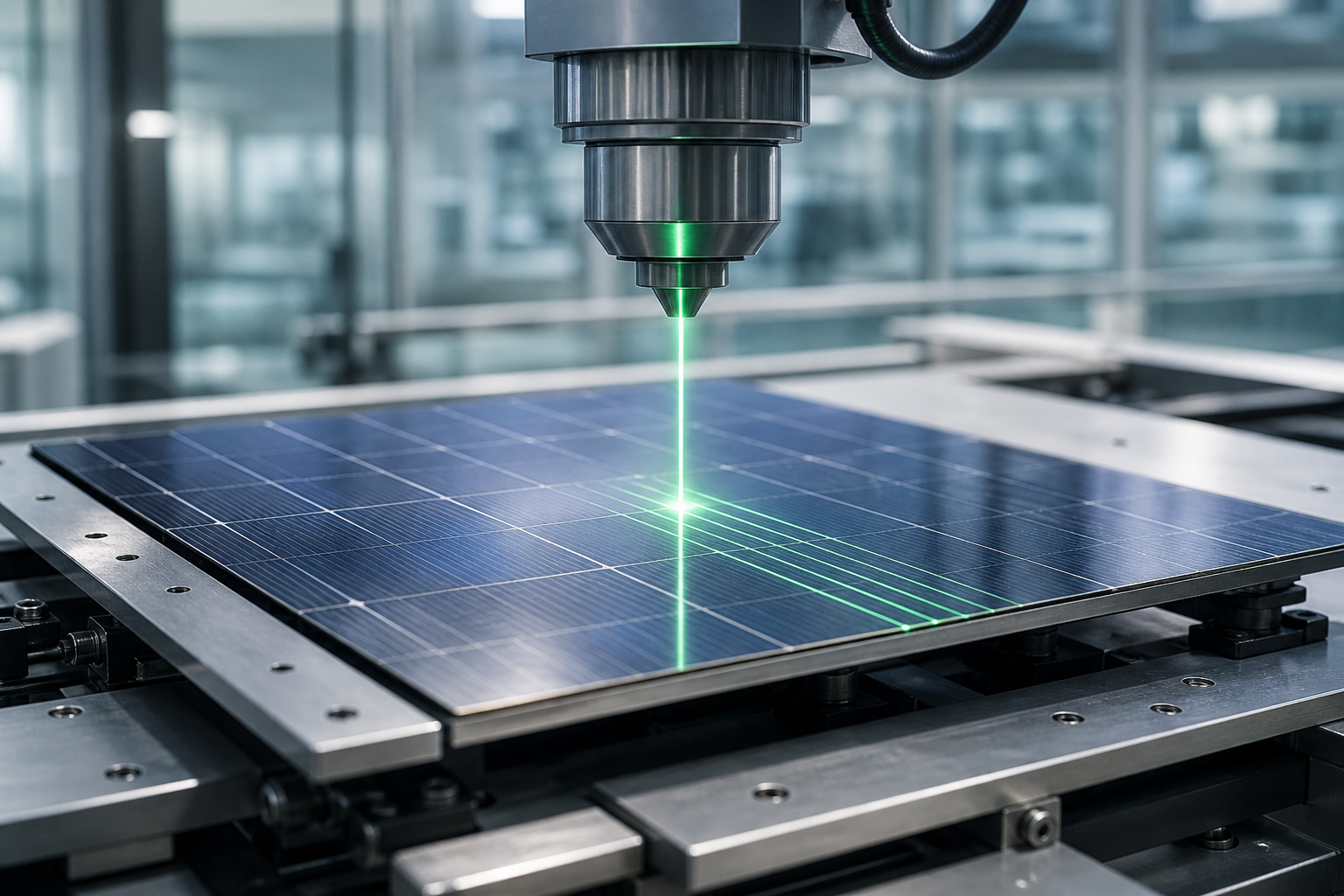
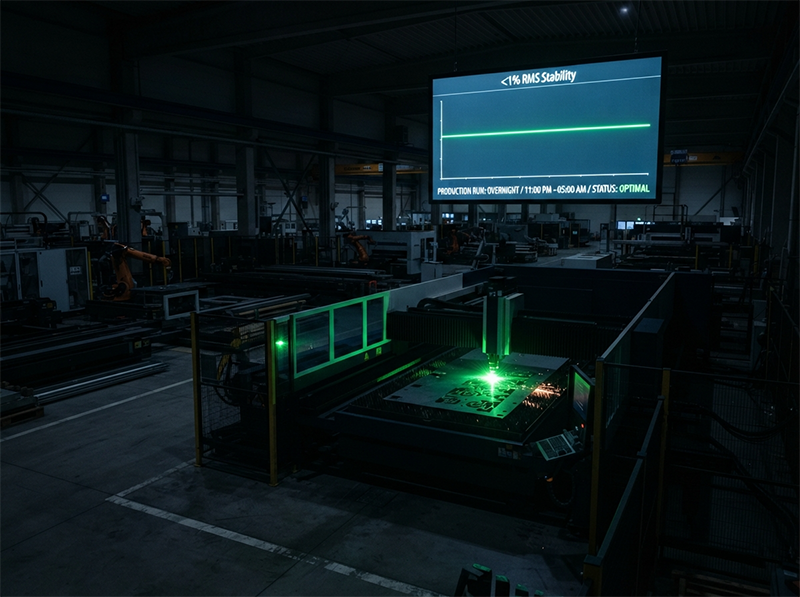
The night shift is where laser lines go to die. During the day, engineers monitor the process, tweak parameters, and keep the yield numbers looking acceptable. But at 2:00 AM, during unmanned operations, the laser’s thermal profile shifts. The beam waist drifts, the spot quality degrades, and scrap rates silently climb. By morning, a significant portion of the overnight production is useless. The instinct is to blame the scanner, the optics, or the material. However, the real culprit is often the laser source itself—specifically, its inability to maintain strict stability under continuous thermal load.
“The instinct was to specify the highest available average power to drive throughput on the 24/7 sapphire dicing line. But during continuous operation, power drift and thermal lensing caused edge-quality variance that spiked scrap rates during unmanned overnight shifts. The bottleneck wasn’t peak power or optical damage limits—it was long-term RMS stability. Moving to a 100W picosecond source specified at <1% RMS over 24 hours eliminated the mid-shift yield drops. The extra 50W we initially demanded wasn’t increasing throughput; it was generating thermal load that destabilized the beam path, requiring constant requalification and ultimately costing 8% of the daily yield.”
— Process engineer, 24/7 sapphire dicing line qualification
This observation forces a complete re-evaluation of how we specify industrial lasers. If an extra 50W of power actively destroys 8% of your daily yield, “more power” is no longer a solution; it is a liability. Understanding picosecond laser RMS stability in 24/7 production is no longer a niche technical detail—it is the primary determinant of whether your automated line can actually survive the night.
In 24/7 production, <1% RMS (Root Mean Square) stability is the true metric of a laser’s capability because it guarantees consistent pulse energy and beam quality over long periods. High peak power means nothing if thermal drift causes the beam to wander or defocus overnight. A laser specified at <1% RMS stability prevents the mid-shift yield drops and scrap accumulation that plague high-power systems lacking adequate thermal management.
If you are qualifying a new laser system for a high-volume manufacturing line, you are likely drowning in spec sheets. Suppliers prominently advertise 100W, 200W, or 300W average power, alongside impressive peak power and pulse energy numbers. It is easy to fall into the trap of selecting the highest power available to ensure you have enough headroom for future applications.
In our engineering practice, evaluating ultrafast laser systems for consumer electronics and semiconductor packaging, we frequently see the same pattern. A line integrates a high-power source, runs flawlessly during 8-hour engineering shifts, and then fails catastrophically during 24/7 mass production. The issue is not that the laser lacks power; it is that the laser cannot maintain its spatial and temporal parameters when run continuously. When we investigate these failures, we find that the specified long-term stability was often 2% to 3% RMS, which is entirely insufficient for maintaining tight tolerances over a 24-hour cycle.
The question of stability vs. power matters because it directly dictates your Overall Equipment Effectiveness (OEE). If you are searching for solutions to a 24/7 laser line yield drop, you are likely fighting a thermal battle, not a power battle.
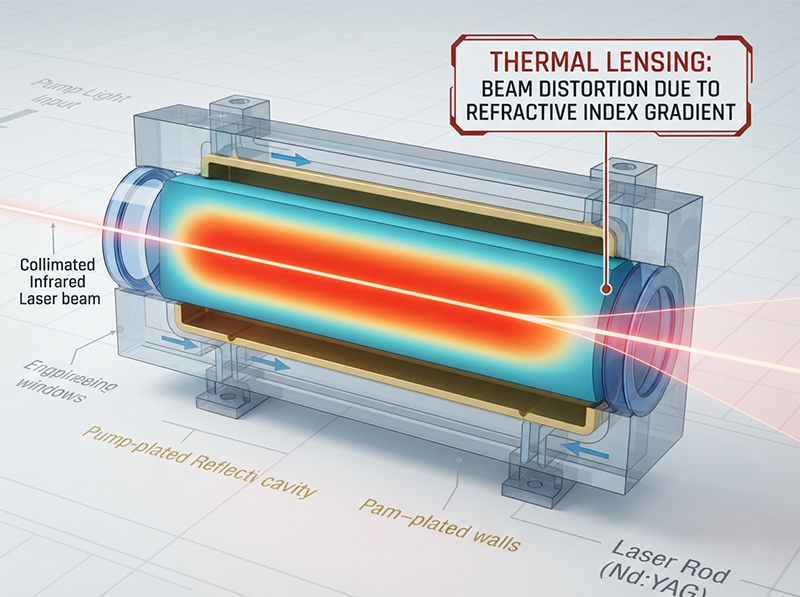
When a high-power picosecond laser operates continuously, the pump diodes generate significant heat. In traditional rod-based amplifier architectures, this heat creates a thermal gradient across the laser crystal. This gradient changes the refractive index of the crystal, effectively turning the rod into a lens—hence the term “thermal lensing.”
As the laser warms up over a 24-hour cycle, this thermal lens shifts the beam waist position and degrades the M² (beam quality) value. Even a shift of a few microns in the focal plane can move the optimal cutting spot outside the depth of focus, drastically reducing peak intensity at the workpiece. This is why a laser that cuts perfectly at 9:00 AM might produce chipped edges and incomplete cuts by 3:00 AM.
Procurement teams often push for the lowest cost-per-watt, but this metric ignores the operational reality of thermal management. When evaluating suppliers, the upfront capital expenditure rarely tells the whole story.
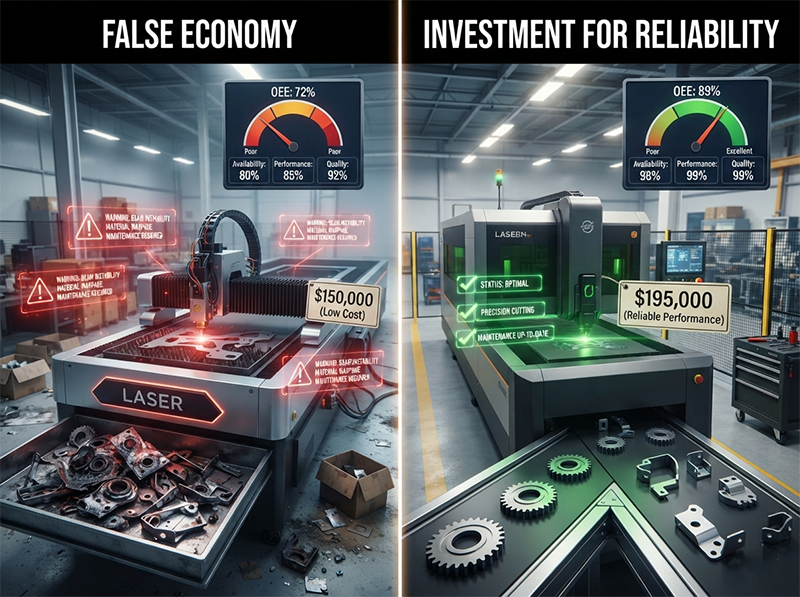
“We evaluated two 200W picosecond sources for a new micro-machining line. Supplier A offered a lower cost-per-watt, but their long-term stability spec was 2% RMS. Supplier B was priced 15% higher but guaranteed <1% RMS. We initially chose A, chasing the capex target. Within six months, thermal drift forced bi-weekly calibrations, causing 4 hours of unplanned downtime per week. The hidden cost wasn’t the laser price; it was the lost production time and scrapped high-value parts. Re-specifying to Supplier B’s source pushed the line’s OEE from 72% to 89%. The deciding metric wasn’t peak power or LIDT prediction—it was stability translating directly to OEE.”
— R&D lead, dual-supplier laser system evaluation
This R&D lead’s experience perfectly illustrates the trap of short-term thinking. A 2% RMS stability spec means the pulse energy can fluctuate significantly over time. For processes requiring tight tolerances, such as PCB depaneling or sapphire dicing, this fluctuation directly translates to process failure.
| Metric | Supplier A (Low Cost/Watt) | Supplier B (High Stability) |
|---|---|---|
| Long-term Stability | 2% RMS | <1% RMS |
| Calibration Frequency | Bi-weekly (4 hrs downtime/wk) | Quarterly |
| Line OEE | 72% | 89% |
| Hidden Cost | High scrap + unplanned downtime | Higher initial Capex |
| Best For | R&D / Low-volume prototyping | 24/7 Mass production |
For anyone involved in high-power picosecond laser specification, the data is clear: a 15% premium on the purchase price can yield a 17% increase in OEE, paying for itself in a matter of months.
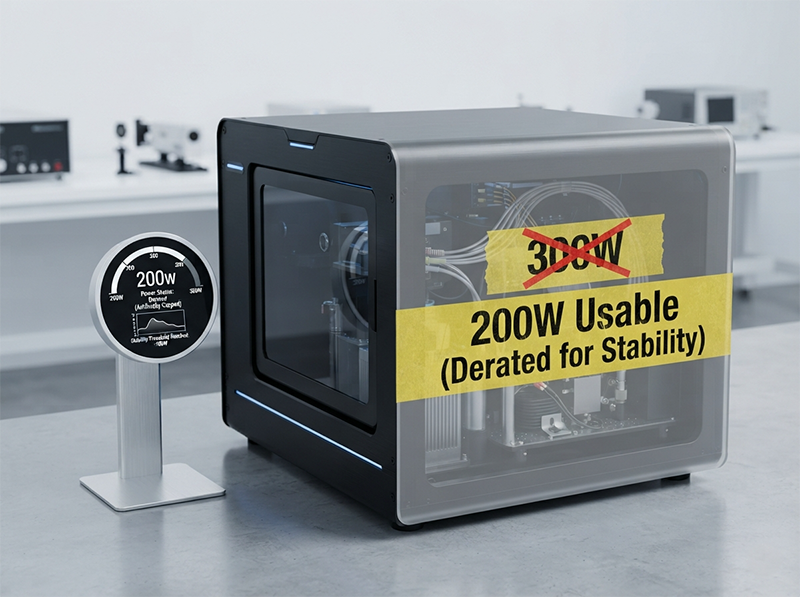
Another common trap is specification redundancy—buying a laser rated for a power level it cannot physically maintain under continuous operation. Many traditional laser architectures simply cannot dissipate heat fast enough to maintain <1% RMS stability at their peak advertised power.
To compensate, integrators often “derate” the laser. They might buy a 300W laser but only run it at 200W to keep the thermal load manageable. You are effectively paying a premium for 300W of hardware but only getting 200W of usable, stable production power. True 24/7 stability requires advanced thermal management architectures, such as slab amplification, which dissipates heat more uniformly than traditional rod designs, allowing the laser to maintain native <1% RMS stability at its full rated power.
When you write your next laser specification sheet, the framework must shift from peak performance to sustained performance.
Selecting a laser for a 24/7 line is a decision that locks in your production capabilities for the next 3 to 5 years. Before finalizing the spec, verify the supplier’s long-term stability claims with raw test data, not just marketing materials. Understand the cooling requirements and the thermal architecture of the gain medium.
If you’re sourcing at scale, talking to a supplier directly can surface details no product listing will tell you.
Talk to our sourcing team →
The pursuit of higher peak power in industrial lasers has masked a fundamental engineering truth: power without stability is just controlled destruction. A 100W laser that holds <1% RMS over 24 hours will always out-produce a 300W laser that drifts off target by 3:00 AM. In the era of lights-out manufacturing, stability is not just a feature; it is the foundation of profitability.
What does <1% RMS stability mean for a picosecond laser?
<1% RMS (Root Mean Square) stability means that the laser’s average power fluctuates by less than 1% over a specified period (typically 24 hours). This ensures that every pulse delivers a consistent amount of energy to the workpiece, which is critical for maintaining tight tolerances and preventing scrap in industrial processes.
Why does laser power drift during 24/7 production?
Power drift occurs primarily due to thermal accumulation. As the laser’s pump diodes and gain medium operate continuously, heat builds up. If the laser’s thermal management system cannot dissipate this heat evenly, it causes thermal lensing—changing the refractive index of the crystal, which alters the beam path, focus, and ultimately the power density at the workpiece.
How does RMS stability affect Overall Equipment Effectiveness (OEE)?
RMS stability directly impacts the “Quality” and “Availability” components of OEE. A laser with poor stability (e.g., 2-3% RMS) causes higher scrap rates (lower Quality) and requires more frequent pauses for recalibration and requalification (lower Availability). Upgrading to a <1% RMS stable laser can push OEE from the 70s to nearly 90%.
“The procurement spec was locked in at 300W picosecond to guarantee enough power headroom… What we didn’t account for was that the selected source could only maintain <1% RMS stability when derated to 200W. At 300W, thermal instability caused beam waist shifts that ruined the ±15µm tolerance. We paid a 300W premium but ran a 200W process.”
— Sourcing manager, PCB depaneling laser component procurement
This sourcing manager’s experience shows that if a laser cannot maintain stability at its advertised power, you are paying for specification redundancy you can never use in production.
Can a high-power laser maintain stability without being derated?
Yes, but it depends on the amplifier architecture. Traditional rod-based amplifiers often struggle with thermal lensing at high powers and must be derated. Advanced designs, such as slab amplification, use a geometric structure that dissipates heat much more efficiently, allowing the laser to maintain native <1% RMS stability at its full rated power (e.g., true 300W) without derating.
Is <1% RMS stability necessary for lower-power lasers?
If the lower-power laser is used in a 24/7 automated production line, yes. Even at 50W or 100W, thermal drift will occur over long periods. If the process requires tight tolerances (e.g., ±10µm or better), any power or beam drift will cause yield drops. <1% RMS stability is the benchmark for reliable automated production, regardless of the absolute power level.
How do I test a laser’s long-term stability before buying?
Request a 24-hour (or longer) stability plot from the supplier. This graph should show both power stability (using a thermal power meter) and beam pointing stability (using a beam profiler or position-sensing detector) over the full duration. Look for any periodic fluctuations or gradual drifts that exceed the <1% RMS specification.