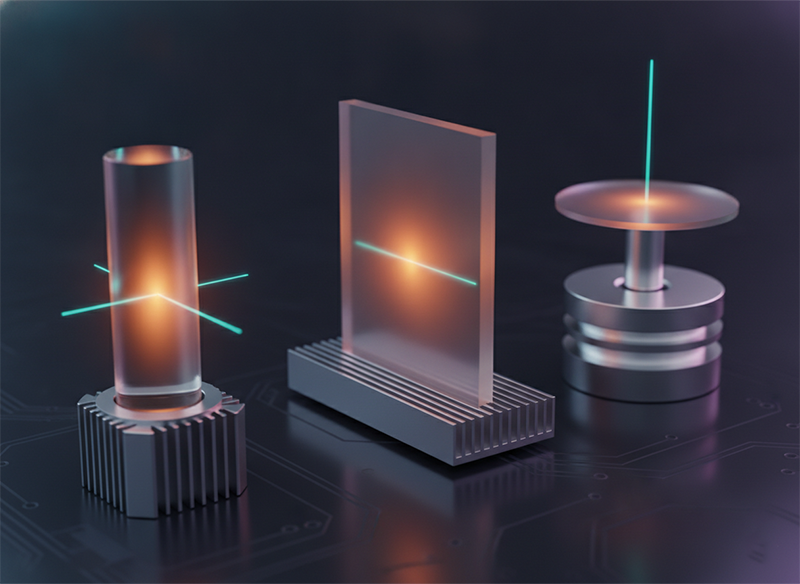
Faced with three amplifier architectures — rod, slab, and disk — most engineers treat them as three separate technologies to study one by one. They are easier to understand than that, because all three are answers to a single question.
“I used to think rod, slab, and disk were three unrelated technologies I had to learn separately. Then a colleague reframed it in one sentence: they’re three answers to the same question — how do you get heat out of the gain medium? A rod lets heat flow radially, a disk flows it axially through a thin face, a slab spreads it across a broad surface. Every difference in power ceiling and beam quality falls out of that one choice. Once I saw the three as ‘three ways to remove heat,’ the comparison stopped being intimidating and started being obvious.” — laser engineer, source evaluation
That reframing is the key to the whole comparison. The difference between rod, slab, and disk laser amplifiers is not three unrelated stories — it is one story about heat, told three ways. This article walks through how each architecture removes heat, what that does to power and beam quality, and how to choose between them.
Rod, slab, and disk are three geometries for the gain medium in a solid-state laser amplifier, and they differ mainly in how they remove heat. A rod lets heat flow radially, which creates a thermal lens that limits power. A slab spreads heat across a broad surface, reaching high power with good beam quality. A disk flows heat axially through a thin face, minimizing thermal lensing and scaling to the highest powers. The right choice depends on your power range, beam quality, and cost — not on which is “most advanced.”
In a high-power laser, the usable output is limited by how well the amplifier removes heat without distorting the beam. So the architecture is not an internal detail — it sets the ceiling on power and beam quality before any other parameter is tuned. Choosing the wrong one means either a power ceiling you hit too early or a cost you did not need to pay.
The trap is treating the three as a quality ladder, with disk at the top and rod at the bottom. They are not ranked; they are suited to different power ranges. Picking the “most advanced” architecture for a job that does not need it wastes money, and assuming the simplest one will scale leaves you stuck at its limit.
Across high-power laser work, the engineers who choose well understand the one thing that separates the three. The sections below explain how each handles heat, compare them side by side, and show how to match the architecture to your application — including a constraint that does not appear on any performance chart.
When you pump a gain medium, some of the energy becomes laser light and the rest becomes heat. That heat creates temperature gradients, and temperature gradients bend the beam — the thermal-lens effect that degrades beam quality and caps usable power. So the entire job of an amplifier geometry is to get heat out while keeping the beam clean. Each architecture solves it differently, and every difference in their performance follows from that one choice.
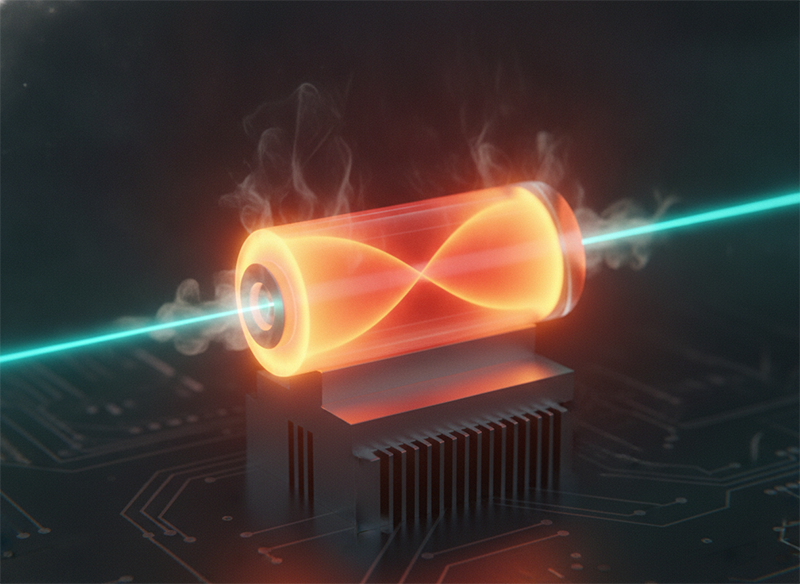
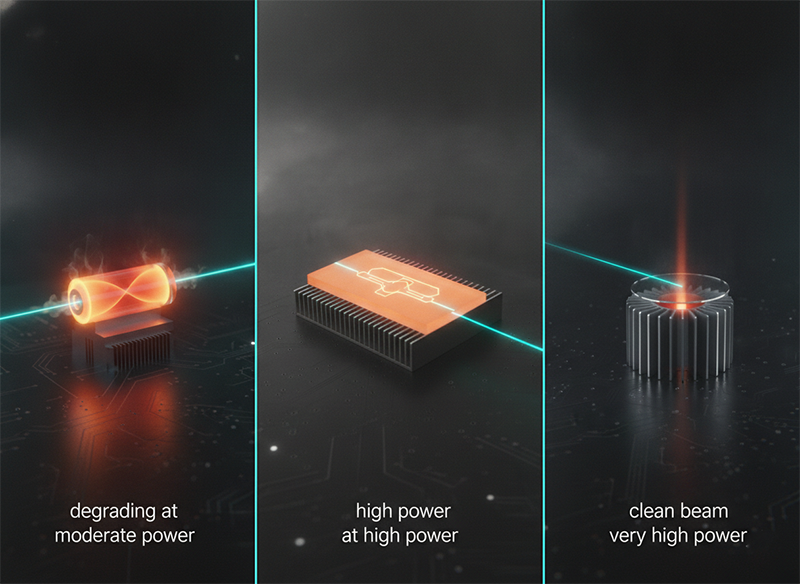
A rod is the classic cylindrical gain medium, and it is the simplest and most economical to build. Its limitation is the direction heat flows: radially outward, from the hot core to the cooled surface. That radial gradient acts as a strong thermal lens that degrades beam quality as power rises, so a rod amplifier hits its usable power ceiling relatively early. For low-to-moderate power, a rod is a sound, cost-effective choice; for high power with good beam quality, the radial heat flow works against it.
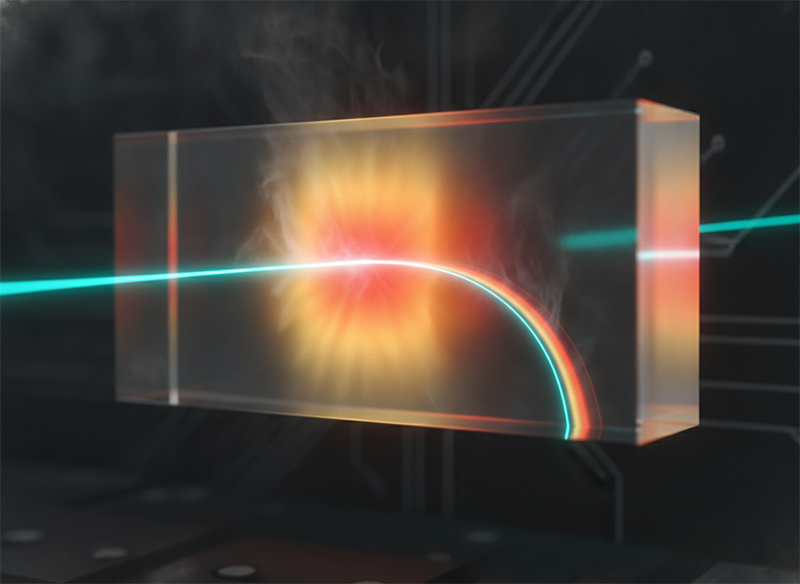
A slab is a flat, rectangular gain medium with a large surface-to-volume ratio, which lets it pull heat out across a broad cooled surface rather than through a narrow radial path. The beam path through the slab is arranged so the remaining thermal gradients tend to cancel rather than accumulate. The result is efficient cooling with good beam quality across roughly the 100 W to kilowatt range — a balance of high power and beam quality that suits demanding industrial processing.
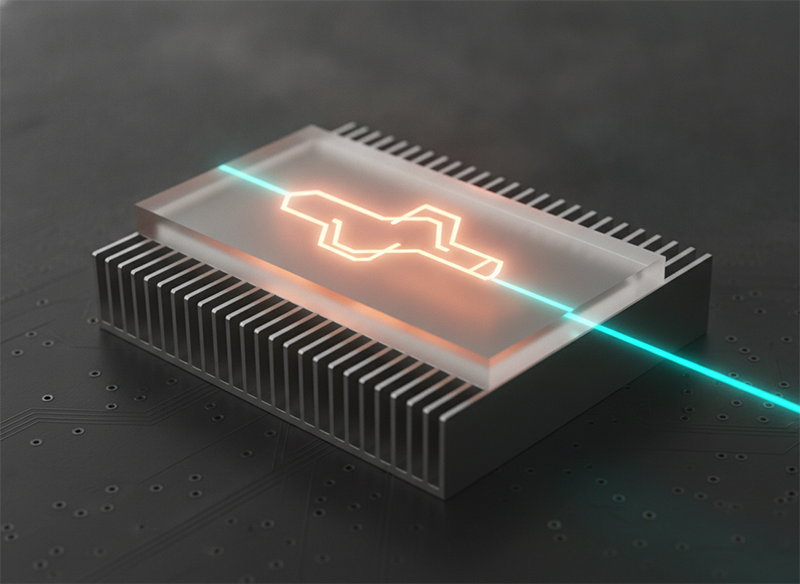
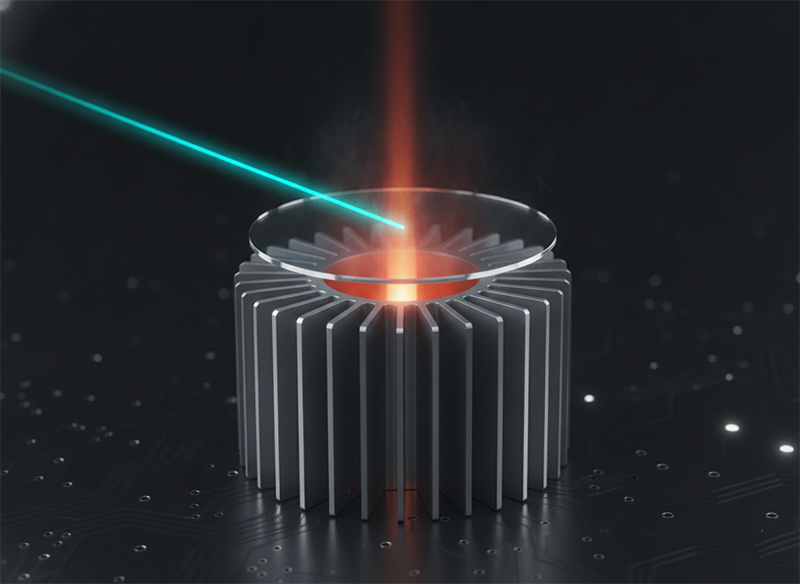
A disk (thin-disk) makes the gain medium a very thin disk mounted on a heat sink, so heat flows axially — straight back through the thin dimension into the cooler. Because the thermal gradient runs along the beam rather than across it, the thermal lens is small in first approximation, which lets disk lasers scale to multi-kilowatt powers. The trade-offs are complexity and a heavily patented technology base, which concentrate it among a few suppliers.
| / | Rod | Slab | Disk |
|---|---|---|---|
| Heat flow | Radial (across beam) | Across a broad surface | Axial (along beam) |
| Thermal lens | Strong, limits power | Managed | Minimal |
| Power range | Low to moderate | High (100W–kW) | Highest (multi-kW) |
| Beam quality at power | Degrades early | Good | Good, scales high |
| Cost / complexity | Lowest | Moderate | Highest, patent-heavy |
| Best for | Economical low-power | High power with beam quality | Very high power |
The table makes the pattern clear: each architecture is strong in a different power band, and the differences all trace back to heat-flow direction. That is also why the next two points matter more than the chart.
“We were specifying a laser for a low-power application and the team pushed for a disk-based source because it was the ‘most advanced’ architecture. It was also the most expensive and the most over-built for what we needed. A simple rod amplifier would have hit our power and beam-quality spec at a fraction of the cost. We’d assumed the three architectures were a ladder — disk at the top, rod at the bottom — when they’re really three tools for three power ranges. We paid a premium to climb a ladder our application never needed.” — process engineer, industrial laser integration
The most common selection mistake is reading the three as a ranking. They are not a ladder where the top rung always wins; they are three tools for three power ranges. A rod is the right answer for economical low-power work, a slab for high power with good beam quality, a disk for the very highest powers. Choosing the most advanced architecture for a modest job means paying for capability the application never uses — and sometimes accepting complexity it does not need. Match the architecture to your power range, and the “simplest one that meets the spec” usually wins.
“On paper, the disk architecture scaled highest, so that’s where our roadmap pointed. The constraint we hadn’t priced in was availability — the disk approach is heavily patented and concentrated among a few suppliers, which meant cost, lead time, and supply risk we couldn’t control. The slab architecture reached the power band we actually needed and came from a supply base we could qualify. The ‘best’ architecture on a performance chart wasn’t the best one we could actually build a product on.” — sourcing engineer, laser system OEM
A comparison that stops at the performance chart misses a real constraint: whether you can actually source the architecture at a cost, lead time, and supply risk you can live with. The disk approach scales highest but is patent-concentrated among a few suppliers, which can put cost and supply outside your control. For many high-power applications, a slab architecture reaches the power band that is actually needed from a broader, more qualifiable supply base. The best architecture for your product is the one that meets your spec and that you can build on — availability belongs in the comparison, not in a footnote.
Start with your power range. If you need economical low-to-moderate power and can live with a rod’s earlier beam-quality limit, a rod amplifier is the cost-effective choice. If you need high power — roughly the hundreds of watts into the kilowatt range — with good beam quality, a slab amplifier is the balance point. If you need the very highest, multi-kilowatt powers and can absorb the cost, complexity, and patent constraints, a disk amplifier scales furthest.
Then weigh beam quality at your actual power, not at low power, and factor in cost, lead time, and supply availability. The right amplifier is the one whose heat-handling matches your power and beam-quality needs and that you can actually source — not the one highest on a performance chart.
A few variables decide more than the architecture name: your target power and beam quality, your duty cycle, your budget, and whether the architecture is available from a supply base you can qualify. Each shifts which of the three fits your application.
Those details are hard to settle from a datasheet. If you are choosing a high-power source, talking to an application engineer about how each architecture maps to your power and beam-quality needs can surface trade-offs no product listing will tell you.
The engineer who reframed three technologies as one question — how do you remove the heat? — turned an intimidating comparison into an obvious one. That is the quiet truth of rod, slab, and disk laser amplifiers: they are not a ranking to memorize but three answers to the same heat problem, each best in a different power range. Match the geometry to your power, weigh what you can actually source, and the right architecture stops being the most advanced one and becomes the one that fits.
What’s the difference between rod, slab, and disk laser amplifiers? They are three gain-medium geometries that differ mainly in how they remove heat. A rod flows heat radially and is power-limited by thermal lensing; a slab spreads heat across a broad surface for high power with good beam quality; a disk flows heat axially through a thin face, minimizing thermal lensing and scaling to the highest powers.
Which laser amplifier is best for high power? It depends on how high. A slab amplifier suits high power in the hundreds of watts to kilowatt range with good beam quality. A disk amplifier scales to the highest, multi-kilowatt powers but is more complex and patent-heavy. A rod is best for economical low-to-moderate power, not high power.
Why do rod lasers have a power limit? Heat flows radially out of a rod, creating a strong temperature gradient across the beam. That gradient acts as a thermal lens that distorts and degrades the beam as power rises, so a rod amplifier reaches its usable power ceiling relatively early compared with slab or disk geometries.
What is a slab laser amplifier? A slab amplifier uses a flat, rectangular gain medium with a large surface-to-volume ratio, which removes heat across a broad cooled surface and keeps thermal gradients manageable. This lets it reach high power — roughly 100 W to the kilowatt range — while holding good beam quality.
What is a thin-disk laser? A thin-disk laser uses a very thin disk-shaped gain medium on a heat sink, so heat flows axially through the thin dimension. Because the thermal gradient runs along the beam rather than across it, thermal lensing is minimal, allowing the architecture to scale to multi-kilowatt powers.
Is a disk laser better than a slab laser? Not universally. A disk scales to higher power and has minimal thermal lensing, but it is more complex, more expensive, and heavily patented. A slab reaches a high power band with good beam quality from a broader supply base. “Better” depends on your power range, cost, and what you can source.
How does amplifier geometry affect beam quality? Geometry determines how heat leaves the gain medium, and heat creates the temperature gradients that bend the beam. A geometry that removes heat with small or well-managed gradients — like a disk’s axial flow or a slab’s broad surface — preserves beam quality at higher power than a rod’s radial flow allows.
Which amplifier architecture should I choose? Match it to your power range: rod for economical low-to-moderate power, slab for high power with good beam quality, disk for the very highest powers. Then weigh beam quality at your actual power, cost, and supply availability. The best choice meets your spec and can be sourced, not simply the one rated highest.