
When engineers compare lasers, they reach first for wavelength and power — the two numbers printed largest on every datasheet. For materials processing, that habit skips the variable that often decides whether the part survives.
“We were comparing two lasers on the two numbers a spec sheet leads with — wavelength and average power — and they looked close enough to pick on price. The parts told the truth the datasheet hid. The cheaper one was nanosecond, and on our heat-sensitive material it left damage the picosecond unit didn’t. The variable that decided the outcome wasn’t on the front of the spec sheet at all — it was the pulse duration, two lines down. We’d been choosing on the numbers that were easy to compare, not the one that mattered.” — process engineer, precision component manufacturing
I take that account seriously because it names a common blind spot. Laser pulse duration — how long each pulse lasts — is the variable that decides whether your process is thermal or athermal, and that single distinction governs the heat-affected zone, the cracking, and the precision. This article explains what pulse duration is, why a threshold inside it changes everything, and how the femtosecond, picosecond, and nanosecond regimes differ in practice.
Laser pulse duration is how long each laser pulse lasts, measured in femtoseconds (fs, 10⁻¹⁵ s), picoseconds (ps, 10⁻¹² s), or nanoseconds (ns, 10⁻⁹ s). It matters because of a threshold: when the pulse is shorter than the time energy takes to move from electrons to the material’s lattice — roughly 1 to 10 picoseconds — ablation happens before heat spreads, giving a “cold” cut with almost no heat-affected zone. Longer nanosecond pulses melt the material and leave a large heat-affected zone.
Pulse duration is the variable that separates two fundamentally different ways a laser can remove material. A nanosecond pulse heats, melts, and vaporizes; a femtosecond pulse ejects material before the surrounding bulk can heat at all. Those are not two settings of the same process — they are two different physical processes, and the part feels the difference.
That is why choosing on wavelength and power alone goes wrong. Two lasers can match on both headline numbers and behave nothing alike if their pulse durations sit on opposite sides of the thermal threshold. On a heat-sensitive material, the longer pulse leaves damage the shorter one never would, and no amount of power tuning closes that gap.
Across ultrafast process work, pulse duration is the first question I ask, before wavelength or power, because it sets the ceiling on what the rest of the parameters can achieve. The sections below define pulse duration, explain the threshold that splits cold from hot, walk through what each regime does well, and show why the right choice is a match to the job rather than a race to the shortest pulse.
Pulse duration is the length of time a single laser pulse is on. The three common regimes are orders of magnitude apart: a nanosecond is a billionth of a second, a picosecond is a thousand times shorter, and a femtosecond is a thousand times shorter again. The jump from nanosecond to femtosecond is a factor of about a million.
That compression does more than shorten the pulse. For a fixed pulse energy, squeezing the same energy into a shorter time raises the peak power enormously — a femtosecond pulse reaches peak intensities a nanosecond pulse cannot approach. Those high peak intensities drive nonlinear, multiphoton absorption, which is what lets ultrafast pulses couple energy into transparent materials like glass that longer pulses pass through. So pulse duration sets not just how long the pulse lasts, but how the energy interacts with the material.

Here is the idea that turns pulse duration from a number into a decision.
“I used to picture pulse duration as a dial — turn it shorter, get a bit less heat, smoothly. The data showed a cliff, not a slope. Cross from nanosecond into the picosecond range and the process doesn’t improve gradually; it changes character — melting stops, the heat-affected zone collapses, the physics flips from thermal to athermal. Below that threshold, going shorter still helps, but the returns flatten. The real decision isn’t ‘how short’ — it’s ‘which side of the threshold.'” — application engineer, laser process development
The threshold is the electron-phonon coupling time: the time it takes energy absorbed by the material’s electrons to transfer into its lattice, which runs roughly 1 to 10 picoseconds in metals. A pulse longer than this heats the lattice while it is still on, so the material melts and heat flows outward — the thermal regime. A pulse shorter than this deposits its energy and ejects the material before the lattice heats, carrying the energy away with the debris — the athermal, or “cold,” regime.
Because the change happens at a threshold, pulse duration behaves like a cliff, not a slope. The large gain comes from crossing from nanosecond into the picosecond-and-shorter range; within the cold regime, going shorter still helps for the finest work but with diminishing returns. Knowing where that cliff is changes how you read every pulse-duration number on a spec sheet.

Nanosecond sits firmly in the thermal regime. The pulse melts and vaporizes material, leaving a recast layer and a wider heat-affected zone. That heat is not always a flaw — for marking, for cutting thick robust metals, and for jobs that tolerate a melt rim, nanosecond lasers are fast, high-power, and economical. Where heat is acceptable, the thermal regime is the practical choice.
Picosecond, around 10 ps, sits near the threshold. It carries a small thermal component but stays close to cold processing, with a heat-affected zone far below a nanosecond pulse. Picosecond is the workhorse of precision industrial processing, scaling to high average power for throughput while keeping the cut clean — the balance point between quality and productivity.
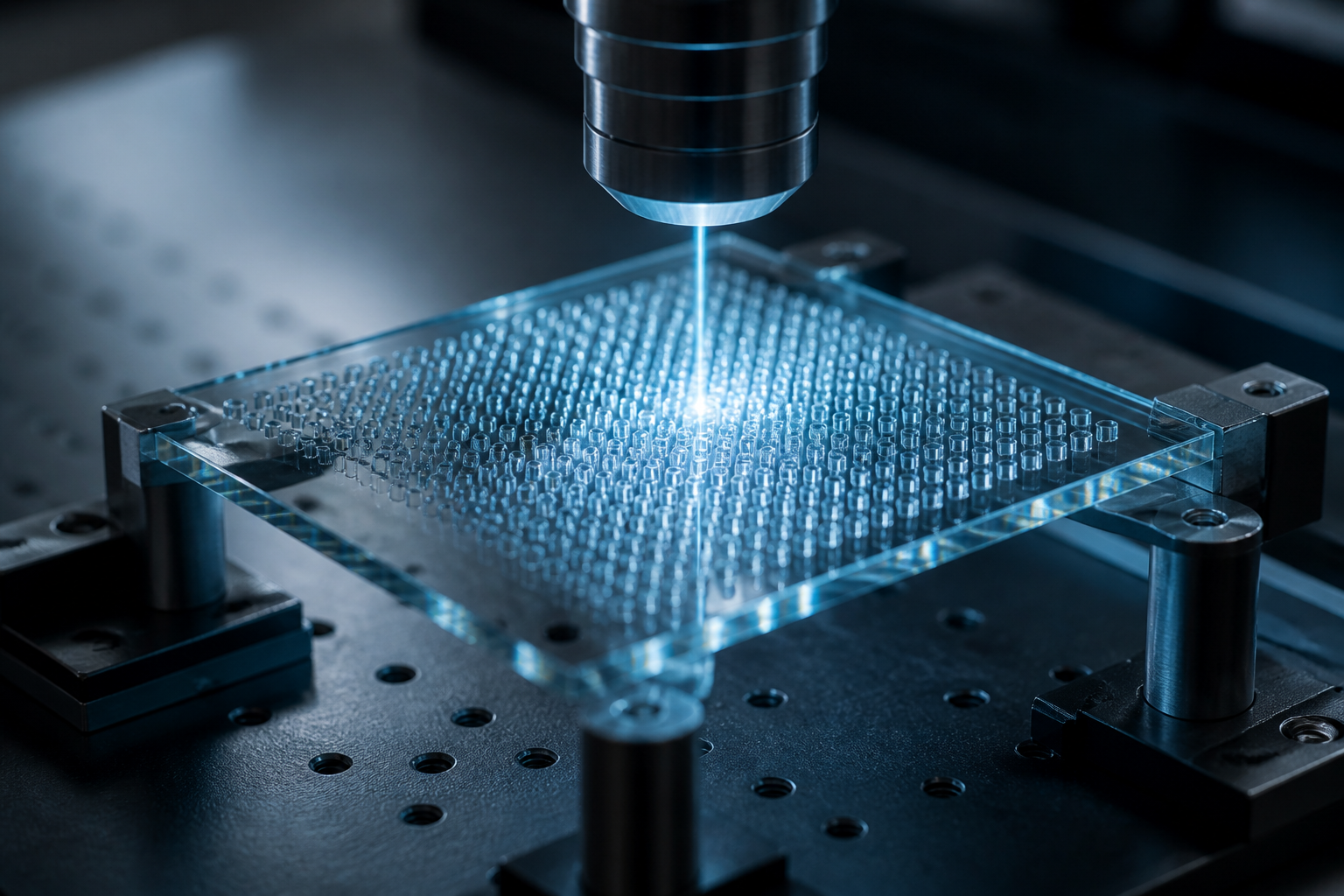
Femtosecond, below 1 ps, is the athermal extreme. Ablation is essentially non-thermal, the heat-affected zone is smallest, and the high peak intensity handles transparent and brittle materials that longer pulses struggle to couple into. Femtosecond earns its premium on sub-micron features, heat-sensitive films, and glass, where the cleanest possible cut is the spec.

| Nanosecond (ns) | Picosecond (ps) | Femtosecond (fs) | |
|---|---|---|---|
| Duration | ~10⁻⁹ s | ~10⁻¹² s | ~10⁻¹⁵ s |
| Regime | Thermal | Near-cold | Athermal (cold) |
| Heat-affected zone | Large | Small | Smallest |
| Peak power (per energy) | Lower | Higher | Highest |
| Strengths | Marking, thick metal, low cost | Precision at throughput | Transparent, brittle, sub-micron |
| Trade-off | Recast, melt | Slight thermal component | Cost, lower power |
The table shows the pattern: moving up in pulse duration trades heat and cost for precision. The skill is knowing how much of each your part actually needs.

“Our shop ran one rule: shortest pulse wins, so everything went on the femtosecond. It made our marking jobs needlessly expensive and slow. The opposite mistake bit us later — a heat-sensitive cut someone ran on the nanosecond ‘to save money’ came back damaged. The lesson was the same both times: pulse duration is a match, not a ranking. Nanosecond for jobs that tolerate heat, ultrafast for the ones that don’t. Pick the wrong regime and it costs you either way — in money on the easy jobs, in scrap on the hard ones.” — manufacturing engineer, mixed-process job shop
The temptation is to treat shorter as simply better and standardize on the most advanced laser. That over-pays on every job a longer pulse would handle, and slows throughput where heat was never a problem. The opposite mistake — forcing a thermal pulse onto a heat-sensitive part to save money — shows up as scrap. Pulse duration is not a quality ladder where the top rung wins. It is a match between the regime and what the material can tolerate, and the cost of mismatching runs in both directions.

Start by asking which side of the threshold your job needs. If your material tolerates heat — robust metals, marking, thick sections — the thermal nanosecond regime is fast and economical, and a shorter pulse buys precision you will not use. If your material is heat-sensitive, brittle, transparent, or demands a minimal heat-affected zone, cross into the cold regime: picosecond for precision at production throughput, femtosecond for the finest features and transparent materials.
Within the cold regime, remember the diminishing returns — do not pay for femtosecond when picosecond meets the spec. Choose wavelength and power after pulse duration, not before, because they refine a process the pulse duration has already defined. Match the regime to the part, and the rest of the parameters have something solid to build on.
A few variables decide more than the pulse-duration label alone: how much heat your material tolerates, whether it is transparent or brittle, your throughput target, and your budget. Each shifts where the right regime sits between cost and precision.
Those details are hard to settle from a datasheet. If you are choosing a laser for a new process, talking to an application engineer who has run your material across pulse regimes can surface trade-offs no product listing will tell you.
The engineer who picked on wavelength and power learned the hard way that the deciding number was two lines down. That is the quiet truth of laser pulse duration: it is the variable that sets the physics, while the headline specs only tune it. Find the threshold, choose the regime your part needs, and the brightest, most powerful laser is whichever one matches the job — not the one with the largest number on the front of the page.
What is laser pulse duration? Laser pulse duration is how long each laser pulse lasts, measured in femtoseconds, picoseconds, or nanoseconds. It determines whether material is removed thermally, by melting, or athermally, by ejecting material before heat spreads. That distinction governs the heat-affected zone, cracking, and achievable precision.
What is the difference between femtosecond, picosecond, and nanosecond lasers? They differ in pulse length by orders of magnitude. Nanosecond pulses melt material and leave a large heat-affected zone. Picosecond pulses are near-cold with a small zone. Femtosecond pulses are athermal with the smallest zone and highest peak power, suited to transparent and brittle materials.
Why does pulse duration matter more than power? Two lasers with the same wavelength and power can behave completely differently if their pulse durations sit on opposite sides of the thermal threshold. Pulse duration decides whether the process melts or cold-ablates the material, which power tuning cannot change, so it often predicts the result better than power.
What is the electron-phonon coupling time? It is the time energy takes to transfer from a material’s electrons to its lattice, roughly 1 to 10 picoseconds in metals. Pulses shorter than this eject material before the lattice heats, producing cold ablation; longer pulses heat the lattice during the pulse, producing a thermal cut.
Is a shorter pulse always better? No. Shorter pulses give a smaller heat-affected zone, but the large gain comes from crossing into the cold regime, and below that threshold returns diminish. For jobs that tolerate heat, like marking or thick-metal cutting, a nanosecond pulse is faster and cheaper. Pulse duration is a match, not a ranking.
How does pulse duration affect the heat-affected zone? The shorter the pulse relative to the electron-phonon coupling time, the smaller the heat-affected zone. Nanosecond pulses heat the lattice and leave a wide altered zone; picosecond and femtosecond pulses eject material before heat spreads, shrinking the zone to microns or less.
Does pulse duration affect peak power? Yes. For a fixed pulse energy, a shorter pulse concentrates that energy into less time, raising peak power sharply. Femtosecond pulses reach peak intensities that drive nonlinear, multiphoton absorption, which lets them process transparent materials that longer pulses pass through.
Which pulse duration should I choose? Match it to your material. Choose nanosecond for heat-tolerant jobs like marking and thick metal, picosecond for precision at production throughput, and femtosecond for transparent, brittle, or sub-micron work. Decide pulse duration first, then refine wavelength and power within the regime you have chosen.