Two ultrafast lasers can both say “300W” on the front of the datasheet and behave like different machines. The number is easy to compare. What it costs to reach that number — in beam quality, in reliability, in heat — is where the engineering actually lives.
“We spec’d ‘300W picosecond’ and treated two quotes as the same product at different prices. They weren’t. At full power, one held its beam quality and the other degraded — the M² that looked fine in the datasheet’s small print drifted as we pushed the power, and our process window drifted with it. The number that was easy to compare, average power, was identical. The thing that decided our throughput — beam quality under load — came down to how each one was amplified. 300W is a spec; holding 300W cleanly is an architecture.” — laser process engineer, high-power micromachining
I take that account seriously because it points at the real question behind high-power ultrafast lasers. Reaching 100–300W is not about pumping harder. It is about removing heat fast enough that the beam survives the power, and the amplifier geometry decides whether that is possible. Slab integrated amplification is one answer, and this article explains how it gets there.
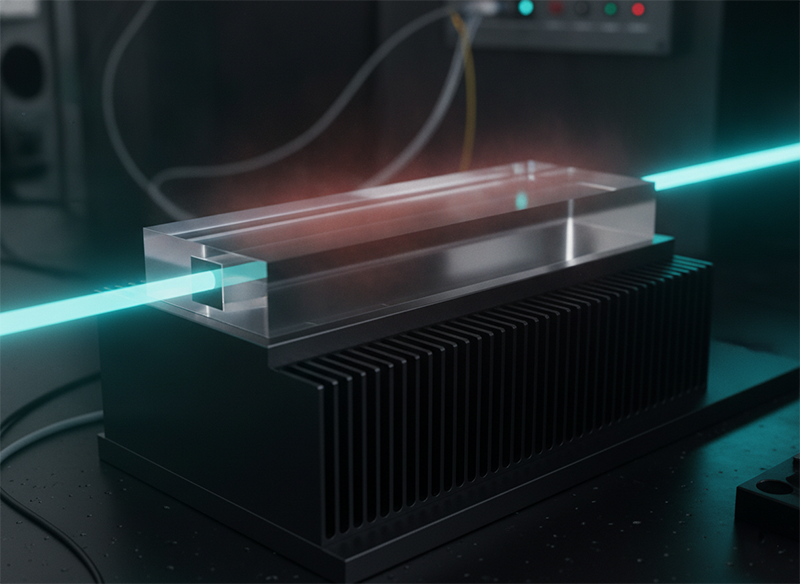
Slab integrated amplification reaches 100–300W by using a slab-shaped gain medium with a large surface-to-volume ratio, which spreads and extracts heat efficiently so the beam keeps its quality as power climbs. High power in ultrafast lasers is limited by heat, not by pump energy: in a rod, radial thermal gradients distort the beam and cap usable power early. The slab geometry suppresses those gradients, letting the laser amplify into the hundreds of watts while holding near-diffraction-limited beam quality.
For high-power micromachining, average power sets throughput — but only if the beam stays clean while delivering it. A laser that produces 300W with a degraded beam does not give you 300W of usable processing; it gives you a wide, distorted spot that drifts your process window. So “how a laser reaches its power” is not an academic detail. It is the difference between a number on a page and watts you can actually put on the part.
This is also where buyers get misled. Comparing two sources on average power treats them as interchangeable when their amplifier architectures may put them in different leagues for beam quality and reliability. The headline spec hides the engineering that determines whether the power holds up under load and over thousands of hours.
Across high-power ultrafast development, the teams that choose well look past the watt number to the amplification approach behind it. The sections below explain why high power is fundamentally a heat problem, how the three main architectures handle it, and how the slab geometry reaches the 100–300W range while keeping the beam usable.
The intuition that more power means more pumping is where the engineering quietly goes wrong.
“I assumed reaching high power was a matter of pumping harder — more pump, more output, scale it up. The bottleneck was heat, not pump. Past a point, the heat deposited in the gain medium distorts the beam faster than added pump buys usable power, and a rod geometry hits that wall early. The reason a slab geometry climbs into the hundreds of watts isn’t more pumping — it’s that its shape spreads and extracts heat so the beam survives the power. We weren’t chasing watts; we were chasing thermal management that let the watts stay usable.” — laser R&D engineer, ultrafast source development
When you pump a gain medium, only part of the energy becomes laser light; the rest becomes heat. That heat creates temperature gradients, and temperature gradients bend the beam — an effect called thermal lensing that degrades beam quality. Past a point, adding pump power adds more heat-driven distortion than usable output. The medium is not short of energy; it is short of a way to get the heat out without wrecking the beam.
So the real engineering problem in a high-power picosecond laser is thermal management: extracting heat fast enough, and shaping how it flows, so the beam stays clean. Geometry is the lever. How you shape the gain medium decides how heat leaves it, and that decides how far you can scale before the beam gives out.
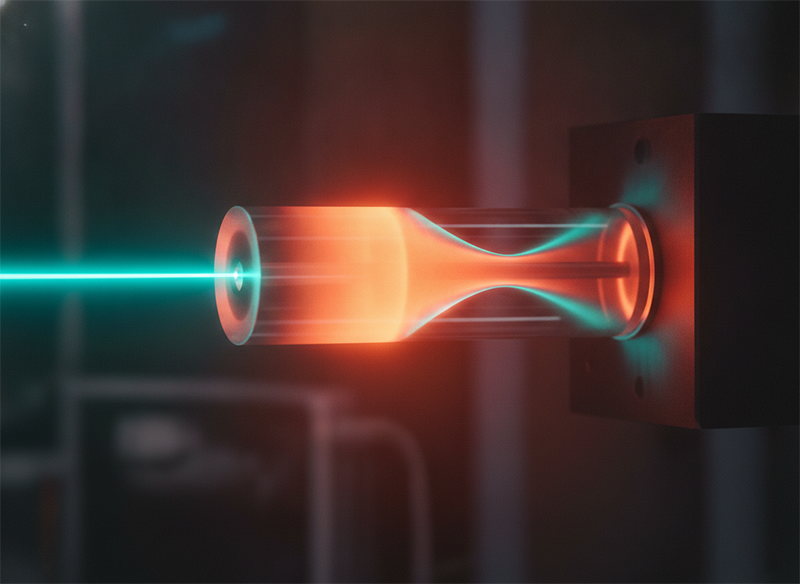
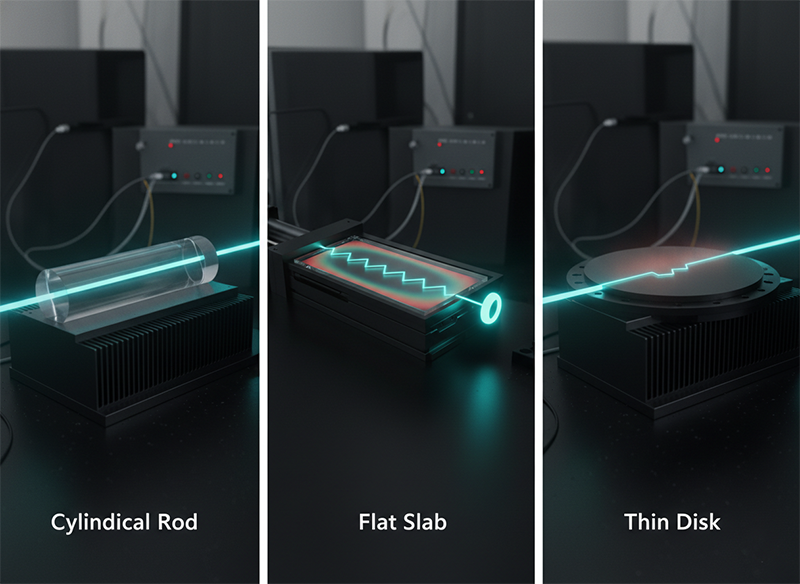
There are three main amplifier geometries, and they differ mainly in how they handle heat.
A rod is the classic shape — simple and economical at low power. But heat flows radially out of a rod, creating strong radial gradients and a thermal lens that degrades the beam as power rises. That caps a rod’s usable power relatively early, which is why rod-based ultrafast amplifiers struggle to climb cleanly into the hundreds of watts.
A thin disk goes to the other extreme. By making the gain medium a very thin disk on a heat sink, heat flows axially and the thermal lens is small in first approximation, which lets thin-disk lasers scale to very high powers. The trade is complexity, and the architecture is heavily patented, which constrains who can build it and at what cost.
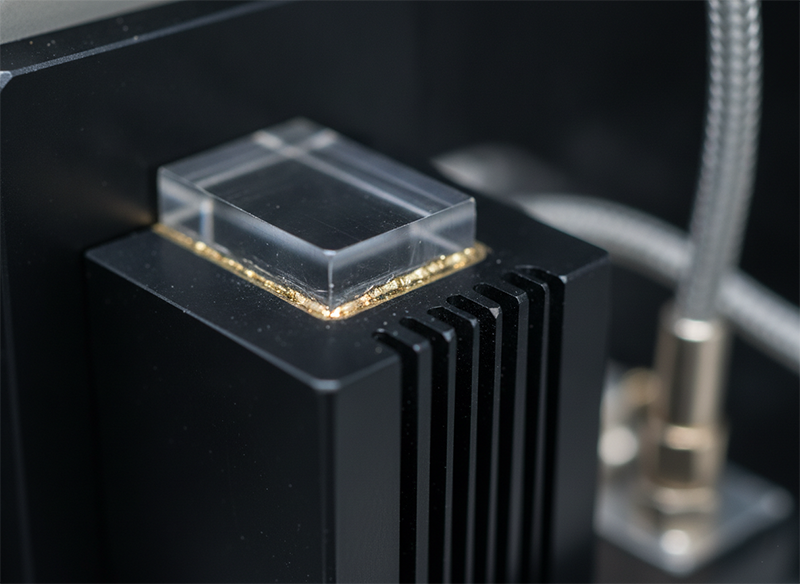
A slab sits between them with a different advantage: a large surface-to-volume ratio. The slab shape exposes more cooled surface per unit of heated volume, and the beam path through the slab averages out the remaining thermal gradients. That combination delivers efficient cooling and good beam quality in the 100W to kilowatt range — the basis of slab integrated amplification.
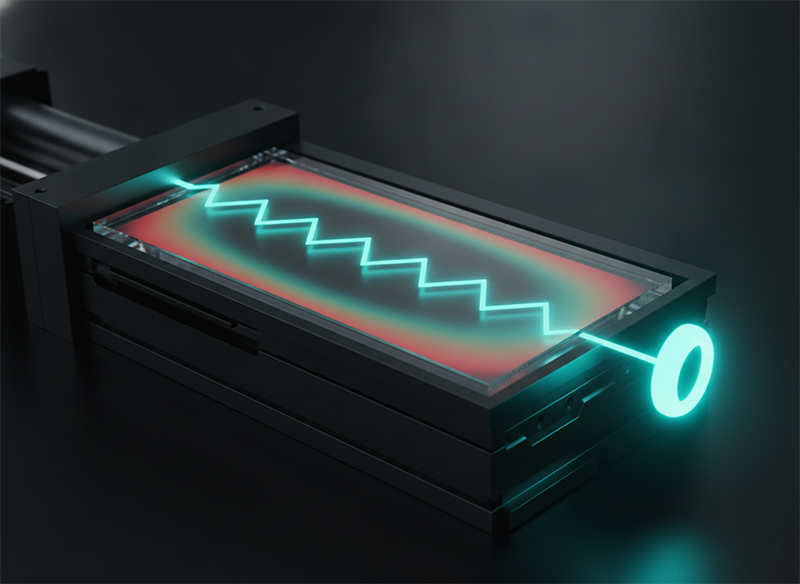
The slab’s reach into the 100–300W band comes from several things working together. The large surface-to-volume ratio pulls heat out across a broad cooled face rather than forcing it through a narrow radial path, which keeps the temperature gradients — and the thermal lens — under control. The beam’s path through the slab is arranged so that what gradients remain tend to cancel rather than accumulate, preserving beam quality as power rises.
Reported slab amplifiers combine this thermal management with moderate gain per pass and reduced nonlinear effects, amplifying ultrafast pulses to high average power while holding near-diffraction-limited beam quality. Integrating the amplification stages and the thermal design into one module is what makes the 100–300W band practical rather than just possible — the heat handling, the pump shaping, and the optical design have to be engineered together for the power to come out usable. Holding M² near the diffraction limit at 300W is the proof the architecture is doing its job.
| Architecture | Heat flow | Beam quality at power | Typical role |
|---|---|---|---|
| Rod | Radial, strong gradients | Degrades early (thermal lens) | Low-power, economical |
| Slab | Large surface-to-volume, averaged gradients | Good into 100W–kW | High-power with beam quality |
| Thin disk | Axial, minimal lensing | Scales to multi-kW | Very high power, patent-heavy |
The table shows why slab integrated amplification occupies a useful middle: it reaches the high-power band most micromachining needs while keeping the beam clean, without the patent constraints of the disk.
Reaching 300W on day one is one thing. Holding it for thousands of hours is another.
“We qualified the source on its power and beam quality and signed off. What we hadn’t tested was what high power does over time. The failures, when they came, traced to thermal stress at the joints inside the module — not the optics we’d scrutinized, but the mounting and bonding that had to survive thousands of hours of heat cycling. The source that lasted used a low-stress bonding approach we’d never thought to ask about. At 300W, reliability isn’t decided by the spec you compare — it’s decided by the details you didn’t know to check.” — reliability engineer, industrial laser integration
High power concentrates heat, and heat cycles stress every joint and interface inside the module. The optics get the attention, but the failures often start at the mounting and bonding that have to survive that cycling without building stress into the components they hold. This is why low-stress bonding methods and careful thermal design matter as much as the headline beam quality — they decide whether the source still holds its spec a year in. None of it shows up in the average-power number, which is exactly why it gets missed during a spec-sheet comparison.
When you evaluate a high-power picosecond laser, do not stop at the watt number. Ask how it reaches that power. If you need clean beam quality at 100–300W for precision processing, look for slab integrated amplification or another architecture that manages heat without sacrificing the beam, and ask for the M² at full power, not at low power. If you need multi-kilowatt power and can absorb the cost and patent constraints, a thin-disk architecture may fit. If your work is low-power, a rod is economical and the question is moot.
Then probe reliability: how the module handles thermal cycling, how it is bonded, how it holds spec over time. The right high-power source is the one whose architecture matches your power and beam-quality needs and whose engineering holds up under load — not simply the one with the largest number on the front.
A few variables decide more than the watt rating: the beam quality you need at full power, your duty cycle and how hard the source runs, and how long it must hold spec in production. Each shifts which architecture and which engineering details matter most.
Those details are hard to settle from a datasheet. If you are specifying a high-power ultrafast source, talking to an application engineer about how it reaches and holds its power can surface trade-offs no product listing will tell you.
The engineer who treated two “300W” quotes as the same product learned that the watt number was the least informative line on the page. That is the quiet truth of slab integrated amplification and high-power ultrafast lasers in general: the power is set by how well you move heat, and the beam you get at that power is the real product. Reaching 100–300W is not about pumping harder — it is about a geometry that lets the watts stay usable. Compare the architecture, and the number finally means something.
What is slab integrated amplification? Slab integrated amplification uses a slab-shaped gain medium, combined with integrated thermal and optical design, to amplify ultrafast laser pulses to high average power. Its large surface-to-volume ratio extracts heat efficiently, which lets the laser reach 100–300W while holding near-diffraction-limited beam quality.
How does a slab amplifier reach high power? By managing heat. The slab’s broad cooled surface and beam path suppress the temperature gradients that distort the beam, so the laser can amplify into the hundreds of watts before thermal effects degrade beam quality. High power is achieved through thermal management, not simply more pump energy.
Why can’t a rod laser reach 300W cleanly? Heat flows radially out of a rod, creating strong gradients and a thermal lens that bends and degrades the beam as power rises. That caps a rod’s usable power relatively early, so rod-based ultrafast amplifiers struggle to reach the hundreds of watts while keeping good beam quality.
Slab vs thin-disk vs rod — what’s the difference? A rod is simple but limited by radial thermal lensing. A thin disk has axial heat flow and minimal lensing, scaling to multi-kilowatt power but with complexity and heavy patenting. A slab uses a large surface-to-volume ratio for efficient cooling and good beam quality in the 100W to kilowatt range.
Does high power reduce beam quality? It can, if the heat is not managed. Temperature gradients in the gain medium cause thermal lensing that degrades beam quality as power rises. A well-designed amplifier architecture suppresses those gradients, which is why two lasers at the same average power can have very different beam quality.
What limits the power of an ultrafast laser? Heat, more than pump energy. Beyond a point, the heat deposited in the gain medium distorts the beam faster than added pump buys usable power. The amplifier geometry — how it extracts and shapes heat flow — sets the practical ceiling on power with good beam quality.
Why does thermal management matter for high-power lasers? Because the usable output is limited by beam quality, and beam quality is limited by heat. Efficient thermal management lets a laser deliver high average power without the thermal lensing that would otherwise distort the beam. It is the core engineering problem behind any high-power ultrafast source.
Are two 300W lasers the same? Not necessarily. Two lasers can match on average power yet differ in beam quality at full power and in long-term reliability, both of which depend on the amplifier architecture and engineering. The watt number alone does not tell you how usable or durable the power is.