
Cutting clear glass cleanly is a solved problem for most shops. Frosted and etched glass breaks that confidence — the same process that runs all day on clear stock starts producing cracks that seem to come from nowhere. The reason is not that frosted glass is harder. It is that the frosted surface changes the rules.
“We had a dialed-in recipe for clear glass, so we ran frosted on the same settings and expected the same result. The parts cracked — not at the cut line, but radiating out from the etched surface. Adding power, our instinct from clear glass, made it worse: the rough surface scattered the beam and the extra energy just built heat. The frosted texture wasn’t a harder version of clear glass; it was a different coupling problem. Once we stopped treating it like clear glass, the cracks stopped.” — process engineer, glass component cutting
I take that account seriously because it names the trap. Frosted and etched glass cutting fails when you treat the texture as a difficulty to overpower instead of a different physical situation to respect. The surface is both an optical problem and a mechanical one, and the cracks come from the mechanical side.
Frosted and etched glass cracks when cut because the roughened surface is full of micro-flaws that act as crack starters, and the thermal stress of cutting drives them to propagate — often away from the cut line. To cut it without cracks, use a low-thermal-stress process. Ultrafast lasers remove material by cold ablation, depositing little heat, so they do not feed the stress that triggers the surface flaws. Adding power makes it worse, because the rough surface scatters the beam and builds heat.
Frosted and etched glass shows up in architectural panels, optics, lighting, appliance fronts, and decorative components — all places where a crack is not a cosmetic issue but a scrapped part. And because the etching usually happens before cutting, a crack at the cutting step throws away a part that already carries value.
The frustrating part is the diagnosis. The cracks frequently appear away from the cut line, radiating out from the etched face, which sends engineers chasing the kerf when the kerf is not the cause. Time gets spent tuning cut quality while the real driver — thermal stress acting on a flaw-rich surface — goes unaddressed.
Across brittle-material processing, the teams that solve frosted-glass cracking are the ones who stop optimizing the cut and start managing thermal stress and beam coupling. The sections below explain why the surface cracks, why it also fights the beam optically, how ultrafast lasers avoid triggering the flaws, and why some of the damage does not show up until later.
The cause traces back to fracture mechanics that have been understood for a century.
“For weeks I chased the cut quality, convinced the kerf was seeding the cracks. The fractography said otherwise — the cracks initiated at the etched surface, at micro-flaws the frosting process had already put there, and any thermal stress from cutting just gave them a reason to run. The cut wasn’t creating cracks; it was triggering ones the surface already carried. That changed the goal from ‘cleaner cut’ to ‘lower thermal stress.'” — failure analysis engineer, brittle-material processing
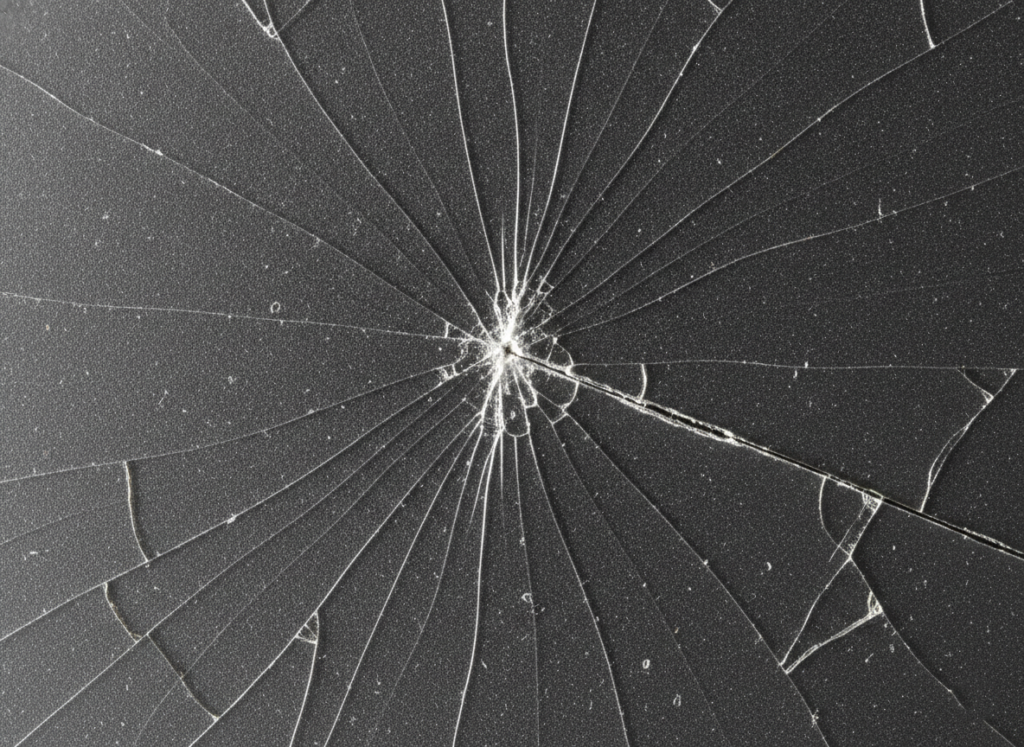
Glass is far weaker in practice than its atomic bonds suggest, and the reason is surface flaws. Griffith’s classic work established that brittle failure starts at tiny surface defects that concentrate stress at their tips, so the stress to fracture real glass is a fraction of its theoretical strength. Frosting and etching deliberately roughen the surface — which means they deliberately fill it with the exact micro-flaws that act as crack starters.
So a frosted surface arrives at the cutting station already primed. The cut does not need to create a crack; it only needs to supply enough stress for a flaw that is already there to run. That reframes the whole problem: the goal is not a prettier kerf, it is a process that does not load those pre-existing flaws.
There is a second reason clear-glass settings fail, and it explains why more power backfires. A smooth glass surface lets the beam couple in predictably. A frosted surface scatters and diffuses the incident light, so energy absorption becomes uneven and inconsistent across the cut.
When the process is thermal and the surface is scattering, turning up the power does not push through — it dumps more heat into an already uneven interaction, which raises thermal stress on a flaw-rich surface. That is the opposite of what you want. The frosted texture is not asking for more energy; it is asking for a coupling mechanism that does not depend on a smooth, absorbing surface.
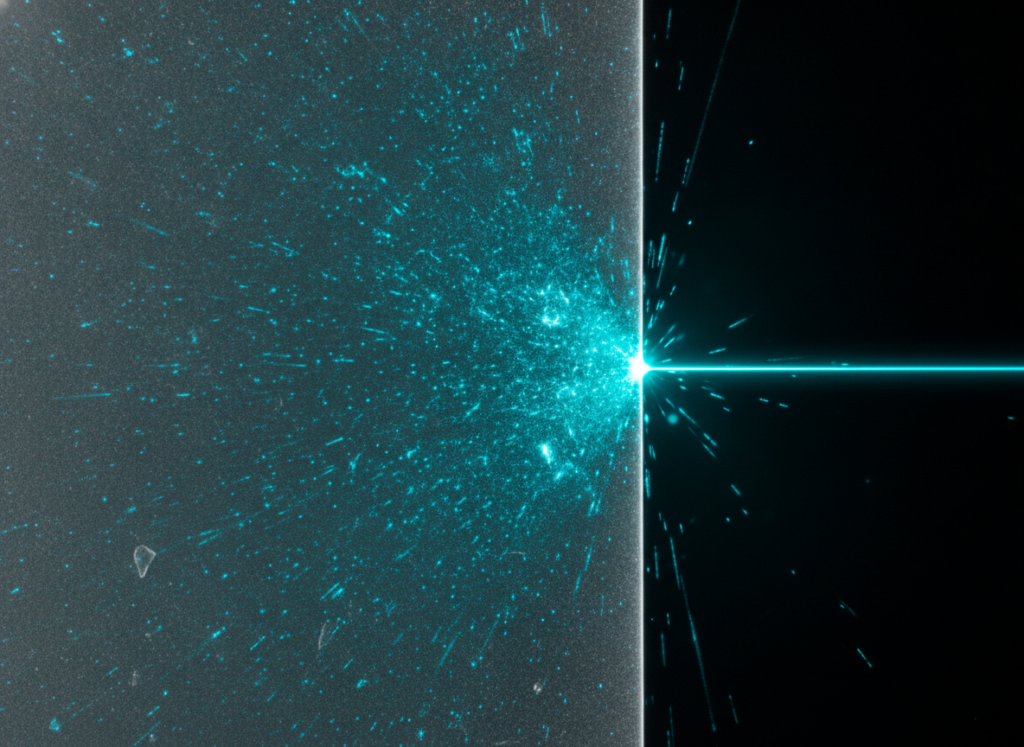
Ultrafast lasers address both problems at once. They remove material by cold ablation — the ultrashort pulse vaporizes material before heat diffuses into the surrounding glass — so the thermal stress that drives surface flaws stays low. Less stress on the flaws means the cracks that a thermal process would trigger stay dormant.
The coupling problem is handled by physics too. Ultrafast pulses drive nonlinear, multiphoton absorption and can form filaments that confine energy inside the material, so the process depends less on a smooth absorbing surface than a thermal cut does. Research on ultrashort-pulse filament cutting of glass focuses precisely on choosing laser parameters that keep micro-crack formation under control, and studies of crack-free conditions center on managing the thermal stress around the processed region. The common thread is the same: control the heat, and the brittle surface stops cracking.
| Approach on frosted/etched glass | Thermal stress | Surface coupling | Crack risk |
|---|---|---|---|
| Mechanical scribe & break | Mechanical stress on flaw-rich surface | n/a | High, jagged on textured face |
| CO₂ / long-pulse laser | High | Hurt by scatter; more power = more heat | High |
| Ultrafast laser (cold ablation) | Low | Nonlinear absorption, less surface-dependent | Low |
The table shows why the answer is a process change, not a power increase: only the low-thermal-stress route stops feeding the flaws.
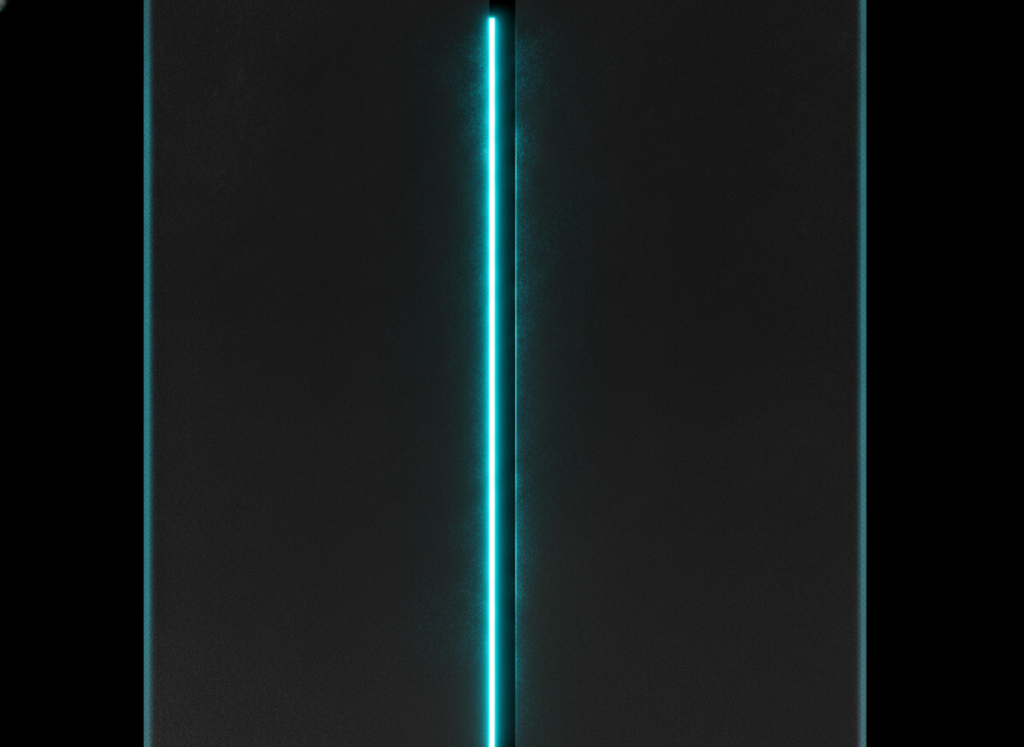
“Our frosted panels passed the line check — no visible cracks, clean edges. The losses showed up later: a fraction cracked through during handling and thermal cycling, traced back to sub-surface damage the cutting left in an already-fragile etched surface. We were scrapping good-looking parts at the worst possible point, after value was added. A low-thermal-stress laser process cut the late-stage cracking because it stopped feeding energy into a surface primed to fail. The cost wasn’t in the parts we caught — it was in the ones we shipped.” — quality engineer, glass panel production
A flaw that has been stressed but not yet propagated does not always crack at the machine. It can sit as sub-surface or sub-critical damage that passes a visual check, then run later under handling stress or thermal cycling. On an etched surface that was already weakened, the margin is thin. This is why a process that minimizes thermal stress pays off twice: it lowers the cracks you see at the cut and the ones that would otherwise surface after the part has gained value. The cost of a cracking process hides in the parts that ship, not the ones you catch.
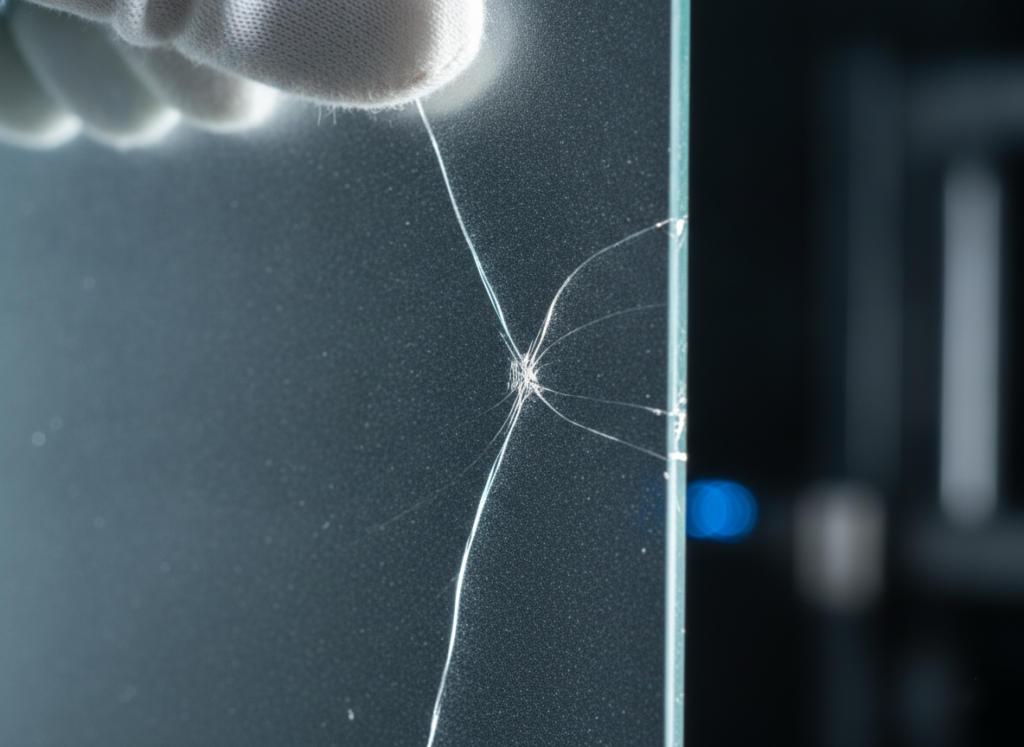
If you are cutting frosted or etched glass, stop porting your clear-glass recipe and stop reaching for more power. Treat the job as a thermal-stress problem: choose a low-heat process, and an ultrafast laser is the straightforward route because cold ablation keeps stress off the surface flaws. Tune parameters — pulse energy, scan strategy, and for thick glass, filament control — to manage micro-crack formation rather than to maximize removal rate.
Verify the right way. A clean surface at the line is not proof; check for sub-surface damage and, where it matters, confirm edge strength rather than appearance. And if your glass is thin, lightly etched, and not destined for handling or thermal stress, a gentler conventional process may still suffice. Match the process to how flaw-rich the surface is and how much stress the part will see in its life.
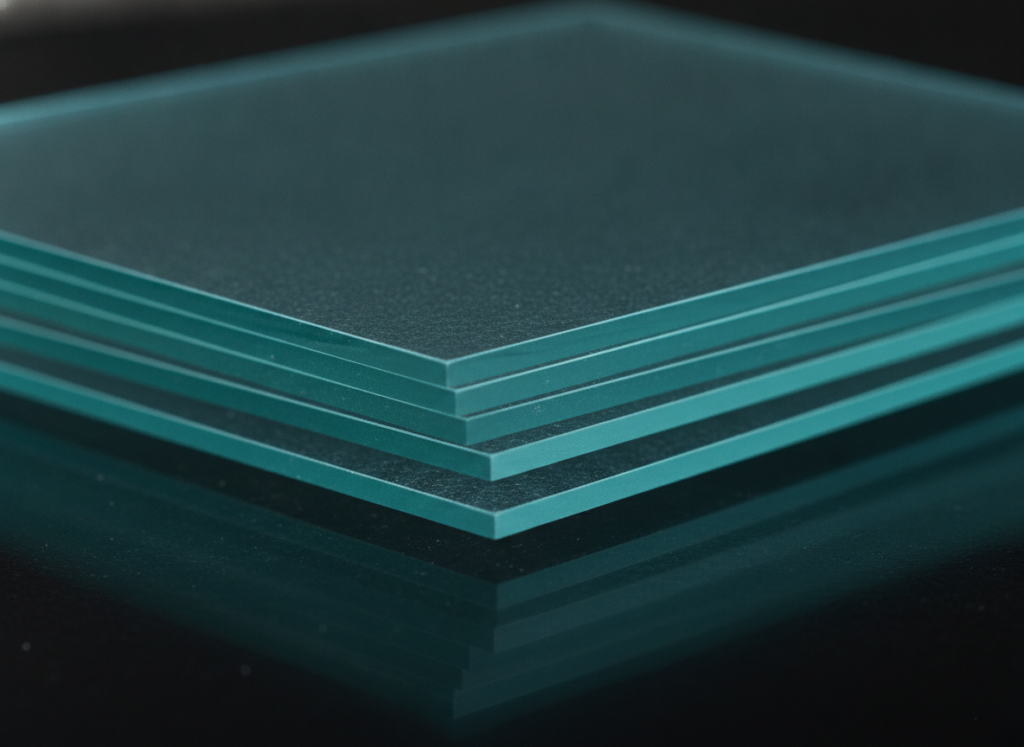
A few variables decide more than the laser: how aggressively the glass was etched, its thickness, and whether the finished part faces handling or thermal cycling that can run a dormant flaw. Each one shifts how much thermal stress you can afford at the cut.
Those details are hard to settle from a datasheet. If you are cutting frosted or etched glass at scale, talking to an application engineer who has processed your surface finish can surface trade-offs no product listing will tell you.
The shop that fixed its cracking did not find a better way to cut — it stopped fighting the surface and started respecting it. That is the quiet truth of frosted and etched glass cutting: the cracks were never made by the cut, only triggered by it, and the surface carried them all along. Lower the thermal stress, and the flaws that were waiting simply stay asleep. The cleanest cut on frosted glass is the one the glass barely feels.
Why does frosted glass crack when you cut it? Frosting and etching roughen the surface, filling it with micro-flaws that act as crack starters. The thermal stress of cutting drives those existing flaws to propagate, often radiating out from the etched surface rather than the cut line. The cut triggers cracks the surface already carried.
Can you laser cut frosted or etched glass? Yes, with the right process. Ultrafast lasers cut frosted and etched glass by cold ablation, depositing little heat, so they avoid the thermal stress that triggers surface flaws. The key is controlling laser parameters to manage micro-crack formation, not maximizing power.
Why doesn’t a clear-glass cutting recipe work on frosted glass? A frosted surface scatters the beam and is full of micro-flaws, so a clear-glass recipe couples energy unevenly and applies stress to a weakened surface. The result is cracking. Frosted glass is not a harder version of clear glass; it is a different optical and mechanical situation.
How do ultrafast lasers cut glass without cracks? They remove material before heat spreads, keeping thermal stress low so it does not drive surface flaws to propagate. Nonlinear, multiphoton absorption and filamentation also let the energy couple into the glass without depending on a smooth surface, which is why ultrafast processing handles textured glass.
What causes glass to crack — the cut or the surface? Both, together. The surface supplies the flaws, established by fracture mechanics as the origin of brittle failure, and the cut supplies the stress that makes them run. Reducing the stress at the cut is what keeps the surface flaws from becoming cracks.
Does frosted glass need more laser power to cut? No — more power usually makes cracking worse. The rough surface scatters the beam, so added energy builds heat and thermal stress on a flaw-rich surface instead of cutting cleanly. The solution is a low-thermal-stress process, not higher power.
Why do cut frosted-glass parts crack later, after inspection? Cutting can leave sub-surface or sub-critical damage that passes a visual check, then propagates later under handling or thermal cycling on an already-weakened etched surface. A low-thermal-stress process reduces this delayed cracking by not loading the surface flaws in the first place.
Is mechanical scribing or laser better for etched glass? Mechanical scribing applies stress directly to a flaw-rich surface and can cleave jaggedly on textured glass. An ultrafast laser avoids mechanical contact and keeps thermal stress low, which generally yields cleaner, crack-free results on frosted and etched glass, especially where edge strength matters.