
Drilling a hole through glass sounds like it should be a matter of finding a strong enough laser. It isn’t. Glass is transparent, brittle, and unforgiving, and the reason TGV laser drilling became its own discipline is that the obvious approach — aim a powerful beam and push through — fails on a material that would rather let the light pass.
“I came in thinking drilling glass was a power problem — find a laser strong enough and push a hole through. Glass had other ideas. It’s transparent to the wavelength we started with, so the energy mostly passed through instead of drilling; and where it did couple, it cracked. The breakthrough wasn’t a bigger laser — it was a process that deposits energy where glass actually absorbs it, without the thermal shock that splits a brittle material. Drilling glass isn’t about force. It’s about coupling energy into a material that would rather let light pass.” — process engineer, glass via formation
I take that account seriously because it names the trap that catches most newcomers to through-glass via fabrication. TGV laser drilling is not about brute power; it is about coupling energy into transparent glass and removing material without cracking it. This article explains what a through-glass via is, why glass resists drilling, what actually defines a good via, and the two main ways lasers form them.
TGV laser drilling is the process of forming vertical holes — through-glass vias — in a glass substrate so they can be metallized into electrical interconnects for advanced packaging. It is difficult because glass is transparent to common laser wavelengths and cracks under thermal shock. Ultrafast lasers solve this by using nonlinear, multiphoton absorption to deposit energy precisely without heating the bulk, forming high-aspect-ratio, crack-free vias with controlled taper. The hardest part is not the entry hole but the sidewall quality, taper, and yield down the depth of the via.
Glass is moving into advanced packaging as a substrate and interposer material because of its electrical and mechanical advantages, and the through-glass via is what makes a glass substrate electrically useful. Without a clean via that metallizes reliably, the substrate is just a sheet of glass. So TGV drilling sits on the critical path of the whole glass-packaging roadmap.
The difficulty is that glass punishes the wrong process invisibly. A via can look fine at the entry and fail where it counts — down the hole, or later at metallization. As packaging pushes toward smaller vias at higher aspect ratios and tighter yield, the margin for a process that “mostly works” disappears.
Across glass via work, the teams that get TGV right treat it as a coupling-and-fracture problem, not a power problem, and they measure the via where it actually has to perform. The sections below define the via, explain why glass resists drilling, show what separates a good via from a good-looking one, and compare the two main process routes.

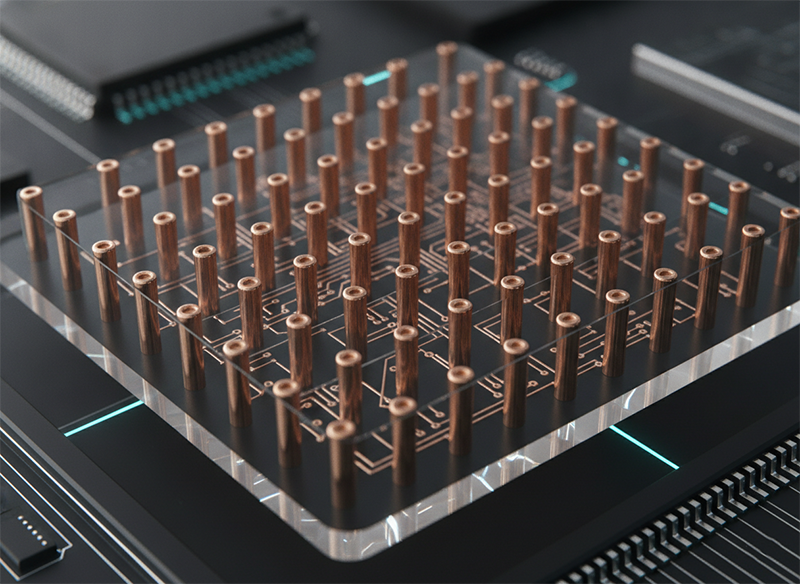
A through-glass via (TGV) is a small vertical hole drilled completely through a glass substrate, which is then filled or coated with metal to carry an electrical signal from one side to the other. It is the glass counterpart to the through-silicon via (TSV) used in silicon interposers.
The via’s job is electrical interconnect, which sets demanding requirements on its shape. It needs to be small in diameter — often tens of microns — with a high aspect ratio (depth relative to diameter), a controlled taper so the walls stay near vertical, and a smooth, crack-free sidewall so metal can fill it uniformly. Reported processes reach aspect ratios beyond 50:1 and into the 80:1 range, with taper angles brought down toward 6–7°. Those numbers, not the existence of a hole, are what define a usable TGV.
Two properties of glass fight the drilling process, and both trace back to the opening account.
First, glass is transparent. At the infrared wavelengths many lasers use, the beam passes through the glass rather than being absorbed, so the energy never couples into the material to remove it. Drilling glass requires getting energy to deposit inside a material designed to transmit light — which is why ultrafast lasers rely on nonlinear, multiphoton absorption, where the extremely high peak intensity of a short pulse drives absorption that does not happen at normal intensities.
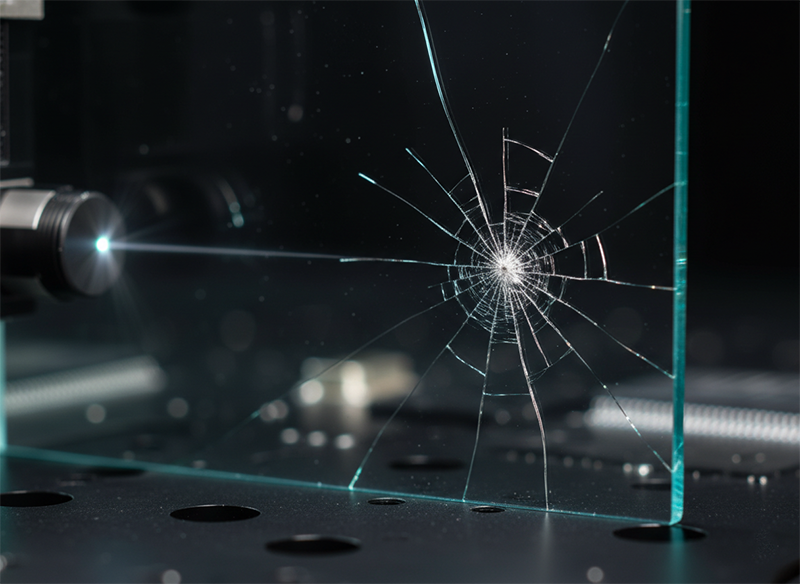
Second, glass is brittle. It carries surface and internal flaws that propagate under stress, so any thermal shock from the drilling process can crack the via or the surrounding substrate. This is why a cold, low-thermal-stress approach matters: it removes material without the heat that would split a brittle solid. Coupling energy in without cracking the glass is the core engineering problem of TGV laser drilling, and power alone solves neither half of it.
Here is the measurement mistake that costs programs the most time.
“We qualified our TGV process on the entry holes — round, clean, the right diameter, perfect from the top. The vias failed metallization anyway. The problem was down the hole: the sidewall tapered and roughened with depth, so the metal couldn’t fill the via uniformly. A round entry told us nothing about the channel beneath it. Once we measured aspect ratio, taper angle, and sidewall quality instead of entry diameter, the process finally became controllable. The via you can see from the top isn’t the via that has to work.” — process integrator, advanced packaging
A through-glass via is a three-dimensional channel, and metallization depends on its full geometry. If the sidewall tapers steeply or roughens with depth, metal cannot fill it uniformly, and the interconnect fails — regardless of how clean the entry looks from above. The metrics that govern a working via are aspect ratio, taper angle, and sidewall smoothness through the depth, plus a crack-free, stress-free wall that metal can adhere to. Qualifying a TGV process on entry diameter is measuring the one feature that does not decide whether it works. The via that has to perform is the channel you cannot see from the top.
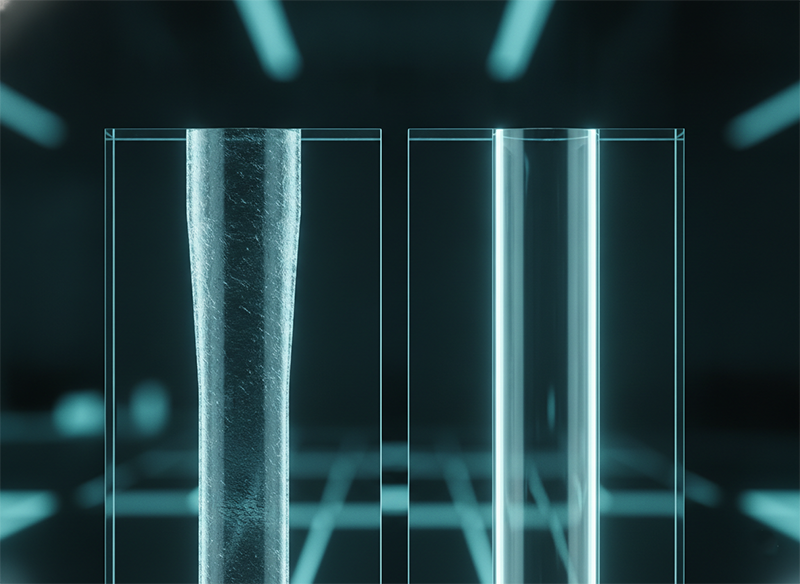
“The pitch for direct laser drilling was ‘one step, fewer operations, lower cost.’ On paper, fewer steps wins. In production, single-step ablation left tapered, crack-prone vias we paid for later in scrap and rework. The two-step route — laser-induced modification followed by etching — added an operation but produced straighter, crack-free vias at a yield the one-step process never reached. Step count was the wrong thing to minimize. Cost per good via was the number that mattered, and more steps got us there.” — manufacturing engineer, glass substrate production
There are two main routes to a through-glass via, and the trade between them is not what step-count intuition suggests.
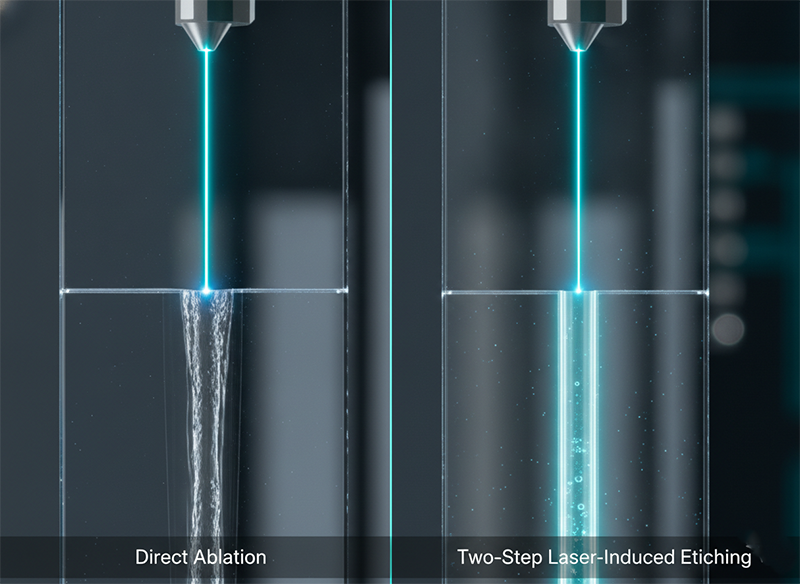
Direct laser ablation drills the via in one operation, with an ultrafast laser removing glass directly, often using burst mode and multi-pass strategies to manage taper and depth. It is a single step, and with careful parameters it reaches high aspect ratios and small taper angles.
Laser-induced etching (such as LIDE) is a two-step process: the laser first modifies the glass along the intended via, changing its chemical properties, and a subsequent etch removes the modified material far faster than the surrounding glass. The two-step route produces smooth, crack-free, chip-free, stress-free sidewalls that metallize reliably, at high volume.
| Direct laser ablation | Laser-induced etching (two-step) | |
|---|---|---|
| Steps | One (drill) | Two (modify, then etch) |
| Sidewall | Good with optimized parameters | Smooth, crack-free, stress-free |
| Strength | Single operation, flexible | Reliable metallization, high volume |
| Trade-off | Taper and cracking need control | Adds an etch step |
The lesson the manufacturer learned generalizes: fewer steps is not automatically cheaper. The number that decides the process is cost per good via, and a two-step route that lifts yield can beat a one-step route that drills faster but scraps more.
If you are evaluating a through-glass via process, judge it on the via that has to work, not the hole you can see. Specify and measure aspect ratio, taper angle, and sidewall quality through the full depth, and confirm the wall is crack-free and clean enough to metallize. Treat the process as a coupling-and-fracture problem: it must deposit energy into transparent glass and remove it without thermal shock.
Then choose the route by your real constraint. If you need maximum flexibility and a single operation, optimized direct ablation can reach high aspect ratios. If you need crack-free sidewalls and reliable metallization at high volume, a laser-induced etching route often wins on cost per good via despite the extra step. Match the process to the via your package needs, and let yield — not step count or drill speed — settle the decision.
A few variables decide more than the laser alone: your glass type and thickness, your target via diameter and aspect ratio, your taper and sidewall tolerance, and your volume. Each shifts whether direct ablation or laser-induced etching fits, and how tightly you must control the process.
Those details are hard to settle from a datasheet. If you are bringing a TGV process toward volume, talking to an application engineer who has formed vias in your glass can surface trade-offs no product listing will tell you.
The engineer who reached for a bigger laser learned that glass does not yield to force — it yields to a process that respects what glass is: transparent and brittle. That is the quiet truth of TGV laser drilling. The hole is the easy part; the crack-free sidewall, the controlled taper, and the yield down the depth are the engineering. Measure the via where it has to work, match the route to your volume, and the glass stops fighting you.
What is a through-glass via (TGV)? A through-glass via is a small vertical hole drilled completely through a glass substrate and then metallized to carry an electrical signal from one side to the other. It is the glass equivalent of a through-silicon via, and it is what makes a glass substrate usable as an interposer in advanced packaging.
Why is glass hard to drill? Glass is transparent to common laser wavelengths, so energy passes through instead of being absorbed, and it is brittle, so thermal shock cracks it. Drilling a TGV requires coupling energy into the glass through nonlinear absorption while avoiding the heat that would split a brittle material.
How does laser TGV drilling work? Ultrafast lasers use high peak intensity to drive nonlinear, multiphoton absorption, depositing energy precisely inside transparent glass without heating the bulk. This forms high-aspect-ratio vias with controlled taper and crack-free walls, either by direct ablation or by modifying the glass for a subsequent etch step.
What is laser-induced deep etching (LIDE)? LIDE is a two-step TGV process: a laser first modifies the glass along the intended via, then a chemical etch removes the modified material much faster than the surrounding glass. The result is smooth, crack-free, stress-free sidewalls that metallize reliably, suited to high-volume production.
What aspect ratio can TGV drilling achieve? Reported TGV processes reach aspect ratios beyond 50:1 and into the 80:1 range, depending on laser and method. Aspect ratio is the via depth relative to its diameter, and a high value is needed to put small, deep vias through a substrate while keeping the diameter small.
What is taper in a TGV, and why does it matter? Taper is how much the via narrows from entry to exit. A steep taper leaves a via that metal cannot fill uniformly, causing interconnect failure. Good processes hold taper angles small — reported down toward 6–7° — so the sidewalls stay near vertical and metallize reliably.
Direct laser drilling or laser-induced etching — which is better? It depends on your constraint. Direct ablation is a single operation and flexible. Laser-induced etching adds an etch step but yields smoother, crack-free sidewalls and reliable metallization at high volume. The deciding metric is cost per good via, which often favors the two-step route despite the extra operation.
What wavelength is used for TGV drilling? Ultrafast lasers across infrared, green, and ultraviolet are used, with the choice affecting absorption and via quality. Because glass is transparent to infrared at normal intensities, the high peak intensity of ultrashort pulses is what enables absorption, so pulse duration matters as much as wavelength.
Fabrication and analysis of through-glass vias for glass-based electronic packaging using an ultrashort pulsed laser. (2024). https://www.researchgate.net/publication/392159686
Nonlinear multiphoton modification of glass substrates for fabrication of high aspect ratio through-glass vias. AIP Advances, 12(5), 055011 (2022). https://pubs.aip.org/aip/adv/article/12/5/055011/2818836
High Aspect Ratio Glass Microstructures by Laser Induced Etching. NSF Public Access Repository. https://par.nsf.gov/biblio/10390308
Application of Through Glass Via (TGV) Technology for Sensors Manufacturing and Packaging. Sensors, 24(1), 171 (2024). https://www.mdpi.com/1424-8220/24/1/171


TGV Laser Source Specs That Matter | Laserion says:
[…] is the selection logic advanced packaging is converging on. Rank laser source specs for Through-Glass Via (TGV) processing by metallization-ready geometry at panel scale, and peak power becomes what it should have been all […]