
A 50:1 hole in glass — fifty times deeper than it is wide — sounds like it should be a matter of enough power to push through. It isn’t. Glass is transparent and brittle, and the instinct to drill deeper by turning up the energy is exactly what stops you from reaching 50:1.
“We needed 50:1, so we did the obvious thing: turned up the pulse energy to push deeper. The glass cracked, and the holes that survived came out conical — wide at the top, pinched at the bottom, nowhere near a usable 50:1. Adding energy didn’t drill deeper; it just dumped more stress into a brittle material. What finally got us there was the opposite instinct — lower per-pulse energy delivered as bursts, letting the hole’s own walls channel the light down to the bottom. Depth in glass doesn’t come from force. It comes from getting light to travel down a hole it already started.”
— process engineer, glass via drilling
That reversal is the key to high-aspect-ratio glass drilling. Reaching 50:1 is not a power problem — it is a problem of coupling light into transparent glass without cracking it, keeping the hole straight as it deepens, and managing heat. This article explains how lasers actually do it.
Lasers drill 50:1 aspect-ratio holes in glass using ultrafast pulses that couple energy into the transparent material through multiphoton absorption, without the heat that would crack a brittle solid. Depth comes not from raw power but from the hole’s own walls reflecting and channeling the light down to the bottom. Splitting energy into high-frequency bursts produces straight, smooth-walled, near-cylindrical holes rather than conical ones — and managing heat accumulation keeps the hole from deforming. Reported aspect ratios reach beyond 50:1, up to around 70:1 in fused silica.
High-aspect-ratio holes in glass are the foundation of through-glass vias (TGVs) — the vertical interconnects that make glass substrates work in advanced semiconductor packaging, RF, and photonics. As packaging pushes toward smaller, denser vias, the ability to put a deep, straight, crack-free hole through thin glass is on the critical path for the whole roadmap.
The trouble is that glass punishes the obvious approach. Engineers arriving from metal drilling reach for more power to go deeper, and glass responds with cracks and conical holes that fail downstream. The depth they want and the straightness they need pull in different directions unless the process is built around how light and heat actually behave in glass.
Across glass micro-drilling work, the teams that hit 50:1 reliably treat it as an optics-and-heat problem, not a power problem. The sections below explain why glass resists a deep hole, why more power backfires, how bursts produce a straight channel, and where the real speed limit sits.
Two properties of glass work against high-aspect-ratio drilling. First, glass is transparent — at common laser wavelengths the beam passes through it rather than being absorbed, so the energy never couples in to remove material. Ultrafast pulses get around this through multiphoton absorption: the extreme peak intensity at the focus drives absorption that does not happen at ordinary intensities, depositing energy precisely where the beam is focused.
Second, glass is brittle. It carries flaws that propagate under stress, so any thermal shock cracks the hole or the surrounding substrate. This is why a cold, ultrafast process matters: it removes material before heat spreads, keeping the stress that would crack the glass to a minimum. Reaching depth without cracking is the first half of the problem — and it already rules out the brute-force approach.
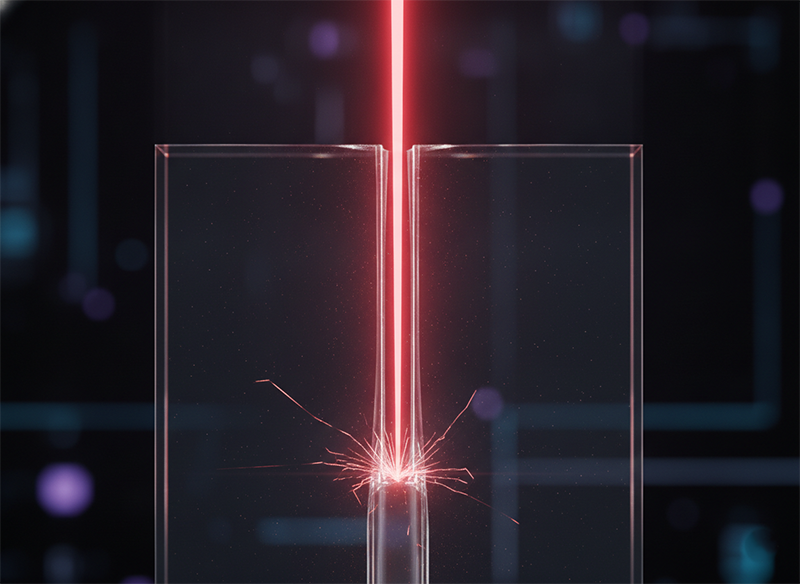
Here is where the metal-drilling instinct fails. Turning up the pulse energy to reach depth does two unwanted things in glass: it raises the thermal stress that cracks the brittle material, and it tends to produce a conical hole — wide at the entrance, pinching to nothing with depth — rather than the straight channel a high aspect ratio requires.
The depth in a deep glass hole does not come from energy pushing further down. It comes from the walls of the hole already formed reflecting the laser light and channeling it toward the bottom, where material removal continues. This light-piping effect lets the hole reach a high aspect ratio despite the beam’s natural divergence — and it depends on the wall being smooth, not on the pulse being stronger. Add power past what the process needs and you degrade the very thing that enables depth. The deep hole is built by guiding light, not by forcing it.
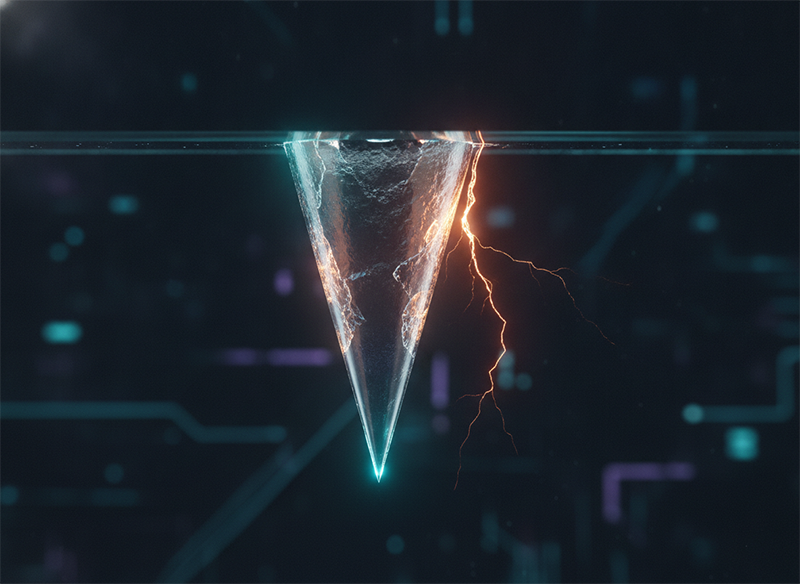
The counter-intuitive fix is to use weaker pulses, delivered as a rapid burst.
“It felt backward the first time: splitting our pulse energy into a train of fifty weaker pulses drilled a straighter, deeper hole than one strong pulse. With single pulses we got conical holes with rough walls — material blasted out continuously, the hole pinching as it went. The burst ejected material in controlled bunches and left a near-cylindrical channel with smooth walls. The smooth wall mattered more than I expected, because it reflected the light cleanly down to the bottom. Weaker pulses, better hole.” — laser process engineer, glass micromachining
Research on GHz-burst drilling — where a burst contains tens of pulses fired a billionth of a second apart — has shown that single-pulse and burst drilling remove material in fundamentally different ways. Single pulses eject material continuously and leave conical holes with rough internal surfaces. Bursts eject material in controlled bunches and leave quasi-cylindrical holes with smooth walls. That smoothness compounds the benefit: a glossy inner wall reflects the light more cleanly down the channel, transmitting energy efficiently to the tip and extending the depth. It is also why fused silica, despite being harder to ablate than sodalime, can be drilled just as deep — its smooth walls pipe the light better. With this approach, reported aspect ratios reach the 30s in sodalime and up to around 70 in fused silica, with taper angles small enough to call the holes nearly cylindrical.
| / | Single-pulse drilling | GHz-burst drilling |
|---|---|---|
| Hole shape | Conical, pinches with depth | Quasi-cylindrical, straight |
| Inner wall | Rough | Smooth |
| Light transmission to tip | Lossy (rough scattering) | Efficient (clean reflection) |
| Achievable aspect ratio | Limited | High (50:1 and beyond) |
The table makes the lesson concrete: the straighter, smoother hole — not the more powerful pulse — is what reaches 50:1.
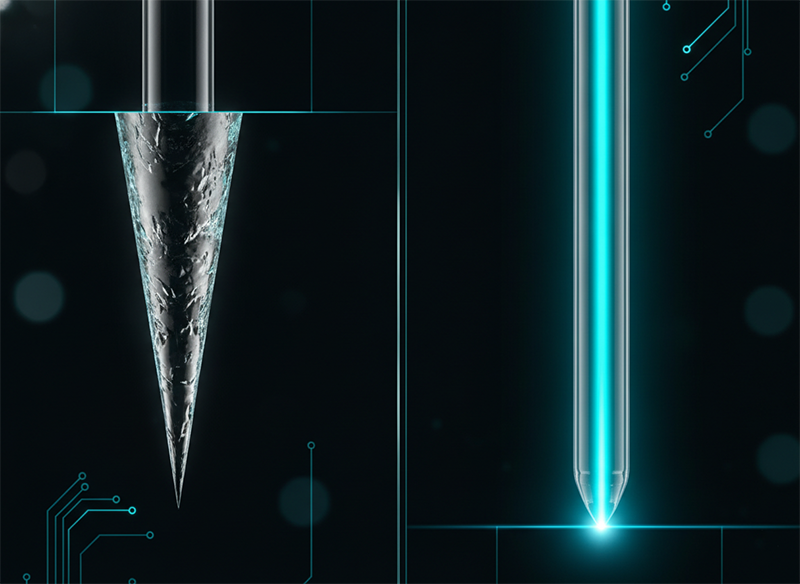
Once you can drill a straight deep hole, the next instinct is to go faster — and that runs into a wall the datasheet does not mention.
“Production pushed us to go faster, so we cranked the repetition rate — more shots per second, more holes per hour, obviously. Past a point, the holes started deforming: a heat-affected cone at the surface, then holes collapsing and refilling below the surface as the glass softened. Even with ‘cold’ ultrafast pulses, packing them too close in time accumulates heat the glass can’t shed. The real throughput limit on 50:1 glass holes isn’t the laser’s speed — it’s how fast the glass can cool between shots.” — manufacturing engineer, glass substrate production
Ultrafast pulses are individually cold, but fired too close together in time they accumulate heat faster than the glass can dissipate it. Studies of burst drilling in sodalime show this directly: heat accumulation is beneficial up to a repetition rate around 20 kHz, then turns harmful above roughly 25 kHz, producing a heat-affected cone at the surface and, at higher rates, holes that deform and collapse as the glass nears its softening temperature. The practical consequence is a ceiling on drilling speed — pushing the rate beyond it trades yield for throughput. The throughput limit on high-aspect-ratio glass drilling is set less by how fast the laser can fire than by how fast the glass can cool between shots, which is why the process is co-designed with the material, not just the laser.
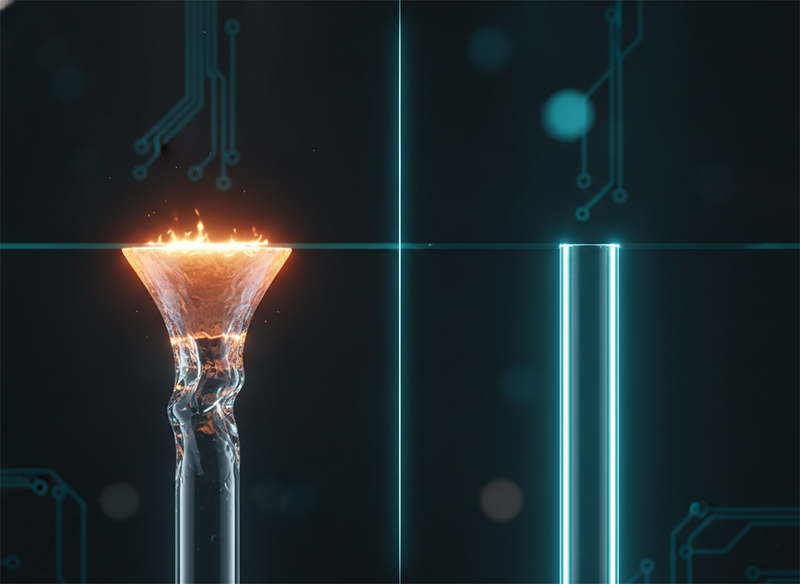
If you are drilling high-aspect-ratio holes in glass, build the process around three things rather than power. First, use an ultrafast source that couples through multiphoton absorption and keeps thermal stress low, so the brittle glass does not crack. Second, favor a burst or beam-shaping strategy that produces a straight, smooth-walled channel — the smooth wall is what pipes light to the bottom and gets you the depth. Third, respect the heat-accumulation limit: find the repetition rate where heat turns from helpful to harmful on your glass, and hold below it, or the hole deforms.
And measure the right thing. A hole that reaches depth but tapers is not a usable 50:1 — qualify the process on taper and sidewall straightness through the full depth, ideally by cross-section, not on entry diameter or depth alone. For the cleanest, most reproducible high-aspect-ratio holes, a laser-induced etching route (laser modification followed by chemical etch) is also worth evaluating where production volume justifies the extra step.
A few variables decide more than the laser alone: your glass type and thickness, your target diameter and aspect ratio, your taper tolerance, and your throughput target. Each shifts whether direct burst drilling or a laser-induced etch route fits, and where your heat-accumulation ceiling sits.
Those details are hard to settle from a datasheet. If you are bringing high-aspect-ratio glass drilling toward production, talking to an application engineer who has drilled your glass can surface trade-offs no product listing will tell you.
The engineer who turned up the power learned what glass teaches everyone who tries to force it: depth is not pushed, it is guided. A 50:1 hole in glass is built by coupling light cleanly, keeping the channel straight enough to pipe that light to the bottom, and not letting heat pile up faster than the glass can shed it. Match the process to how glass actually behaves — transparent, brittle, slow to cool — and the aspect ratio that looked impossible becomes routine.
How do lasers drill 50:1 aspect-ratio holes in glass? Ultrafast lasers couple energy into transparent glass through multiphoton absorption, removing material without the heat that cracks brittle glass. Depth comes from the hole’s walls reflecting light down to the bottom rather than from raw power, and burst-mode pulses keep the channel straight and smooth, enabling aspect ratios of 50:1 and beyond.
Why can’t you just use more power to drill deeper in glass? More power raises thermal stress that cracks brittle glass and tends to produce conical holes that pinch with depth, rather than the straight channel a high aspect ratio needs. Depth in glass depends on light being channeled down a smooth-walled hole, which extra power degrades rather than helps.
What is aspect ratio in glass drilling? Aspect ratio is the hole’s depth divided by its diameter. A 50:1 ratio means the hole is fifty times deeper than it is wide. A usable high aspect ratio requires the diameter to stay roughly constant through the depth — a deep hole that tapers to a point is not a true 50:1 via.
What is GHz-burst laser drilling? GHz-burst drilling fires a burst of tens of pulses spaced about a billionth of a second apart, instead of one strong pulse. In glass this ejects material in controlled bunches and produces near-cylindrical holes with smooth walls, in contrast to the conical, rough-walled holes single pulses tend to leave.
Why does glass crack when drilling deep holes? Glass is brittle and carries flaws that propagate under thermal stress. A process that deposits too much heat — high pulse energy or heat accumulated from firing pulses too close together — builds stress that cracks the hole or surrounding glass. Cold ultrafast processing and controlled repetition rates keep that stress low.
How fast can you drill holes in glass? Speed is limited by heat accumulation, not just laser firing rate. Above a repetition rate around 20–25 kHz in some glasses, accumulated heat deforms or collapses the hole. Within those limits, burst-mode drilling can reach tens to hundreds of holes per second depending on depth and fluence.
What’s the highest aspect ratio achievable in glass? Reported burst-mode drilling reaches aspect ratios in the 30s for sodalime and up to around 70 for fused silica. Fused silica drills deeper despite being harder to ablate because its smooth inner walls reflect light more efficiently down to the bottom of the hole.
Single-pulse or burst-mode drilling — which is better for high aspect ratio? Burst-mode is generally better for high aspect ratios in glass. Single pulses produce conical holes with rough walls that scatter light and limit depth. Bursts produce straight, smooth-walled holes that channel light efficiently to the tip, reaching higher and more uniform aspect ratios.