
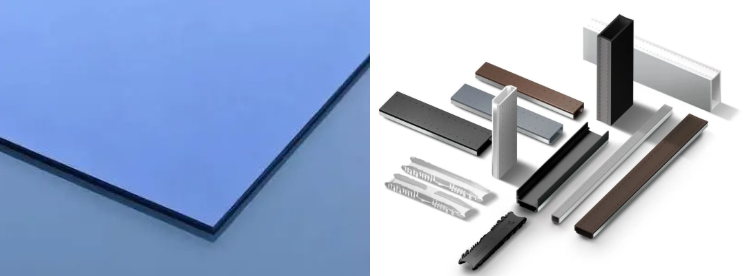
△ Showcase of Coating Glass Materials
In high-end manufacturing fields such as consumer electronics, photovoltaics, and semiconductors, it is often necessary to pattern glass substrates with high precision, which poses a challenge because the gold layer must be completely removed without damaging the glass substrate. Traditional chemical etching suffers from side etching and undercutting issues, while mechanical grinding is incapable of processing micron-scale features; consequently, laser etching, owing to its non-contact nature, high precision, and flexibility in pattern design, has become the mainstream solution for this application scenario.
From the perspective of process implementation, this paper systematically elaborates on the gold-plated glass ultraviolet picosecond laser etching process route and measured application data.
Laser etching is a processing technology that uses high-energy laser beams acting on material surfaces to achieve precise removal or modification, thereby forming patterns, text, or microstructures. Its core principle relies on the thermal effect of lasers or photochemical effects : high-energy laser beams are focused onto the material’s surface, causing instantaneous vaporization or ionization of the material to form permanent markings or structures.
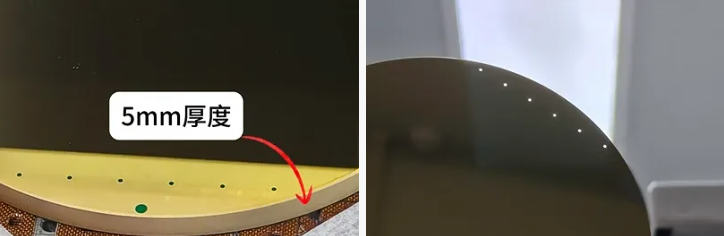
△ Laser Etching Case Images
According to pulse duration, mainstream processing lasers can be classified into nanosecond, picosecond, femtosecond three categories . Among them, picosecond lasers, thanks to ultra-short pulse width and extremely low thermal impact,The ultra-high processing precision characteristics perfectly avoid the drawbacks of large laser heat-affected zones and easy scorching of the substrate, while also balancing processing efficiency and cost advantages, making it the preferred process for stripping coatings from brittle precision materials.
To further verify the advantages of ultraviolet picosecond laser in the precision etching of gold-plated glass, Huachuang Hongdu conducted specialized process measurements. This test used 355 nm ultraviolet picosecond laser , relying on its unique “light-material” interaction characteristics and precise parameter control, it successfully achieved selective and precise removal of the gold coating, ensuring the glass substrate remained intact throughout the process, with processing precision and product quality meeting high-end industry standards.
The core process data and machining effect of this test are as follows:
① Ultra-high machining accuracy
The positioning accuracy of the processed workpiece is controlled within 0.01 mm , enabling 50 μm gold plating layers to be completely selectively removed with uniform stripping thickness, no local residue, and perfect compatibility with the stringent dimensional tolerance requirements of high-precision devices.
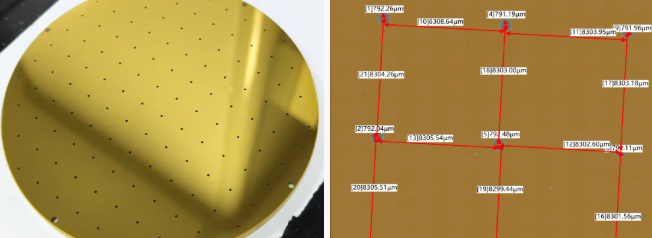
△ Precision of Sample Position after Processing
② Base materials guarantee zero damage
The depth of approximately 4.8 μm surface metal coating was successfully removed; after processing, the back and front surfaces of the glass substrate showed no scratches, microcracks, or thermal burns, with no degradation in optical transmittance or flatness, and the substrate properties remained unaffected by the processing.
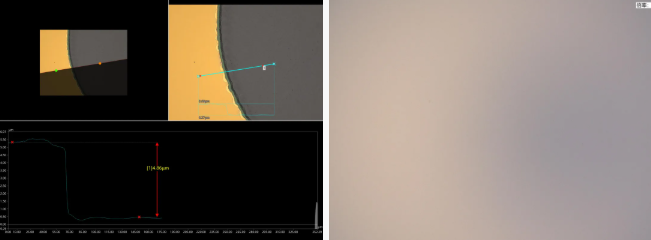
△ Processing Depth and Display of the Back of the Glass
③ Edge machining is of superior quality
Thanks to the “cold processing” characteristic of picosecond lasers, the etched patterns feature sharp and smooth edges, without burrs, edge hanging, or lateral etching diffusion, achieving extremely high pattern consistency and regularity, with dimensional accuracy better than 0.01mm ,The small circle has a diameter of approximately 0.791 mm,While ensuring appearance quality, fully meet performance index requirements.
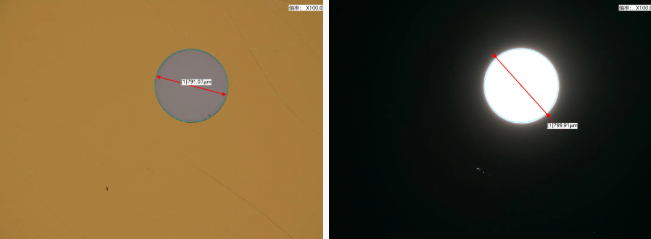
△ Microscopic Effect of the Sample after Processing
Technical preview
In the coming installments of the “Process Notes” series, we will continue to explore the limitless possibilities of laser processing on a variety of different materials, and you are welcome to stay tuned.